



 Chat with AI
Exam 29: Controlling Manufacturing Costs: Standard Costs

Exam 16: Notes Payable and Notes Receivable88 Questions
Exam 17: Merchandise Inventory78 Questions
Exam 18: Property, Plant, and Equipment90 Questions
Exam 19: Accounting for Partnerships85 Questions
Exam 20: Corporations: Formation and Capital Stock Transactions81 Questions
Exam 21: Corporate Earnings and Capital Transactions85 Questions
Exam 22: Long-Term Bonds90 Questions
Exam 23: Financial Statement Analysis100 Questions
Exam 24: The Statement of Cash Flows90 Questions
Exam 25: Departmentalized Profit and Cost Centers90 Questions
Exam 26: Accounting for Manufacturing Activities89 Questions
Exam 27: Job Order Cost Accounting83 Questions
Exam 28: Process Cost Accounting83 Questions
Exam 29: Controlling Manufacturing Costs: Standard Costs89 Questions
Exam 30: Cost-Revenue Analysis for Decision Making90 Questions
Select questions type


Usually, a well-run manufacturing company prepares only annual manufacturing cost budgets.
(True/False)
4.9/5  (76)
(76) The price variance for an item is the difference between its actual price and its standard price, multiplied by the ____________________ quantity.
(Short Answer)
4.7/5 (82)
(82) Semi-variable costs vary in direct proportion to the volume of activity.
(True/False)
4.7/5 (96)
(96) Costs that vary in some degree with the volume of activity, but not in direct proportion to it are called ____________________ costs.
(Short Answer)
4.8/5 (87)
(87) Costs that tend to change in total directly with the volume of manufacturing activity are called ____________________ costs.
(Short Answer)
4.9/5 (79)
(79) Deducting the total variable cost from the total cost results in
(Multiple Choice)
4.7/5 (73)
(73) As the level of activity increases, the total variable costs for the period
(Multiple Choice)
5.0/5 (88)
(88) The difference between the total standard cost and the total actual cost is the
(Multiple Choice)
4.8/5 (78)
(78) The labor time (efficiency) variance and the labor ____________________ variance together make up the total labor variance.
(Short Answer)
4.8/5 (85)
(85) The Hoatzin Birdhouse Factory produced the following standard cost card. In July, the company had an order for 500 birdhouses (Model: Wren) for Job No. CB32. Manufacturing overhead is based on direct labor hours. The manufacturing overhead cost estimates for the year total $32,400 and total direct labor hours are estimated at 9,000 for the year. Complete the Standard Cost Card and Job Order Cost Sheet. Calculate the total cost variance.
Balsawood (7-- 8 " \times 10 " sheets at \ 0.92 per sheet) \6 .44 Balsa precut trim (1--3' strip a \ 0.86 per strip) .86 Total materials Labor 1/3 hour \ 15.30 Manufacturing Overhead 1/3 hour \ ? ? ? ? ? Total Standard Cost per Unit
Balsawood (3510 8" \times 10 " sheets) \3 ,194.00 Balsa precut trim ( 495 strips) Total materials Labor 165 hours Manufacturing Overhead 1651/2 hours \ ????? Total manufacturing costs
(Essay)
4.8/5 (75)
(75) The labor standard for a product was five hours at a wage rate of $8 per hour. The firm produced 900 units of the item. Labor costs totaled $35,250 and 4,700 hours of labor were used. An analysis of labor costs would indicate
(Multiple Choice)
4.8/5 (88)
(88) The standard quantity of materials for a product was 40 pounds per unit at the standard price of $2.00 per pound. The actual price per pound of materials was $1.50, and the actual quantity used was 44 pounds. An analysis would indicate
(Multiple Choice)
4.9/5 (70)
(70) A budget that shows expected costs at more than one level of activity is called a(n) ____________________ budget.
(Short Answer)
4.8/5 (72)
(72) The range of activity at which the factory is likely to operate is referred to as the ____________________ range of activity.
(Short Answer)
4.8/5 (88)
(88) Use the high-low point method to determine total costs if 16,000 units are produced.
(Multiple Choice)
4.9/5 (86)
(86) The cost per unit of direct materials changes as output changes.
(True/False)
4.8/5 (81)
(81) Complete the flexible budget of manufacturing costs for Lansome Industries for September 2013. Overhead is based on direct labor hours. 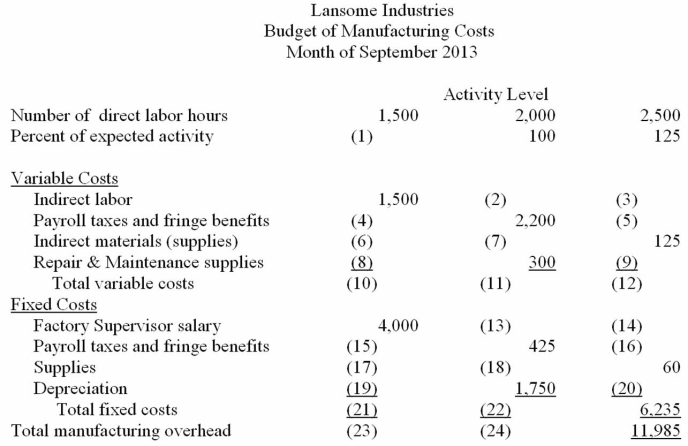
(Essay)
4.9/5 (88)
(88) In a factory, the fixed costs are $6,000 when 600 units are produced. If 900 units are produced, the fixed costs per unit would be
(Multiple Choice)
4.9/5 (86)
(86) A flexible budget shows budgeted costs at several different levels of activity.
(True/False)
4.9/5 (75)
(75) 
Filters
- Essay(0)
- Multiple Choice(0)
- Short Answer(0)
- True False(0)
- Matching(0)