



 Chat with AI
Exam 29: Controlling Manufacturing Costs: Standard Costs

Exam 16: Notes Payable and Notes Receivable88 Questions
Exam 17: Merchandise Inventory78 Questions
Exam 18: Property, Plant, and Equipment90 Questions
Exam 19: Accounting for Partnerships85 Questions
Exam 20: Corporations: Formation and Capital Stock Transactions81 Questions
Exam 21: Corporate Earnings and Capital Transactions85 Questions
Exam 22: Long-Term Bonds90 Questions
Exam 23: Financial Statement Analysis100 Questions
Exam 24: The Statement of Cash Flows90 Questions
Exam 25: Departmentalized Profit and Cost Centers90 Questions
Exam 26: Accounting for Manufacturing Activities89 Questions
Exam 27: Job Order Cost Accounting83 Questions
Exam 28: Process Cost Accounting83 Questions
Exam 29: Controlling Manufacturing Costs: Standard Costs89 Questions
Exam 30: Cost-Revenue Analysis for Decision Making90 Questions
Select questions type


As the level of activity increases, the fixed cost per unit of activity
(Multiple Choice)
4.7/5  (78)
(78) Kenwood Company's manufacturing overhead costs for the assembly department are given below. Fixed Costs Per Month Variable Costs Per Hour Indirect Labor \ 1,400 \ .95 Payroll Taxes 90 1.05 Indirect Materials 220 .20 Power and Water 340 .35 Depreciation 1,020 - Taxes and Insurance 450 - Repairs 175 .15
-Using the information provided, prepare a flexible budget for the department for the month of May 2013, assuming that the expected production is for 2,000 direct labor hours. The flexible budget should show costs for production levels of 90 percent and 110 percent of the expected production level of 2,000 hours.
(Essay)
4.8/5 (75)
(75) The purchasing department can determine the standard quantity per unit of each type of raw material required to manufacture a product.
(True/False)
4.8/5 (72)
(72) If the standard cost for an item exceeds the actual cost, the variance is favorable.
(True/False)
4.9/5 (83)
(83) Direct materials and direct labor are examples of costs that tend to vary directly with the volume of output.
(True/False)
4.8/5 (90)
(90) The materials price variance for an item is the difference between its actual price and its standard cost
(Multiple Choice)
4.8/5 (66)
(66) The standard costs for a unit of product are shown below. Materials: 2 pounds at \ 1.00 per pound \2 .00 Labor: 1 hours at \ 10.00 per hour 10.00 Overhead: 60\% of direct labor 6.0
During June, Job N-5 for 100 units was completed. The actual costs of the job are shown below. Materials: 300 pounds at \ 1.45 per pound \4 35.00 Labor: 200 hours at \ 9.50 per hour 1,900 Overhead Applied: 60\% of direct labor 1,140 1. What is the total cost variance between actual cost and standard cost?
2. What is the total material variance?
3. What is the material quantity variance?
4. What is the material price variance?
(Essay)
4.9/5 (79)
(79) Topic: Cost Behavior and the Budget Soville Manufacturing Company Budget Performance Report Month Ended June 30, 2013 Budget 1000 hours Direct materials \ 42,000 Direct labor 16,000 Manufacturing overhead Payroll taxes and fringe benefits 4,500 Factory supplies 360 Machine repairs \& maintenance 800 Factory supervisor salary 4,000 Janitorial services 1,600 Depreciation 2,800 Insurance 400 Property taxes Total manufacturing overhead Total manufacturing cost Actual (Over) 1020 hours Under \ 43,600 16,200 4,620 345 575 4,000 1,580 2,800 400
-Complete the Budget Performance Report for Soville Manufacturing. Create a flexible budget by adding a budget column at the actual number of labor hours. Compare the actual to the flexible budget numbers you calculated.
(Essay)
4.7/5 (81)
(81) Canine Cottage Industries makes several specially designed doghouses. The Standard Cost Card for The Gables model is shown. A customer ordered three of this model for their Labrador retrievers. The Job Cost Sheet is shown. 
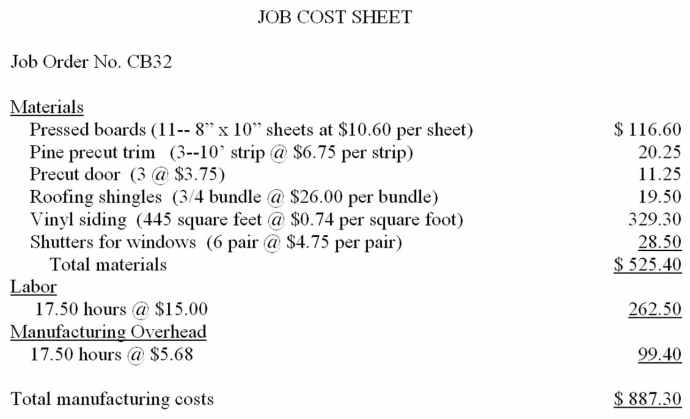 -From the information given for Canine Cottage Industries, compute the labor total, time and rate variances.
 (Essay)
4.9/5 (69)
(69) The standard costs for a unit of product are shown below. Materials: 2 pounds at \ 1.50 per pound \3 .00 Labor: 3/4 hours at \ 10.00 per hour 7.50 Overhead: 60\% of direct labor 4.50
During July, Job N-5 for 200 units was completed. The actual costs of the job are shown below. Materials: 408 pounds at \ 1.45 per pound \5 91.60 Labor: 142 hours at \ 10.15 per hour 1,441.30 Overhead Applied: 60\% of direct labor 864.78 1. What is the total cost variance between actual cost and standard cost?
2. What is the total material variance?
3. What is the material quantity variance?
4. What is the material price variance?
(Essay)
4.9/5 (71)
(71) The cost of utilities consumed in the factory is a good example of
(Multiple Choice)
4.8/5 (69)
(69) Use the high-low point method to determine total fixed cost:
(Multiple Choice)
4.9/5 (86)
(86) In a factory, the fixed costs per unit are $45 when 400 units are produced. If 450 units are produced, the fixed costs per unit would be
(Multiple Choice)
4.9/5 (66)
(66) Canine Cottage Industries makes several specially designed doghouses. The Standard Cost Card for The Gables model is shown. A customer ordered three of this model for their Labrador retrievers. The Job Cost Sheet is shown.
-From the information given for Canine Cottage Industries, compute the materials, quantity and price variances.
-From the information given for Canine Cottage Industries, compute the materials, quantity and price variances. (Essay)
4.8/5 (81)
(81) Prepare a budget for manufacturing costs for Nacelle Manufacturing for the month of July 2013 from the following information. Direct materials are estimated to be $480,000 for the year and direct labor is estimated to be $96,000. The direct labor per hour average is $13 and the budgeted level of activity for the month is 1,200 hours. Factory Supervisor salary Janitorial/Maintenance labor Payroll taxes and fringe benefits Insurance Supplies Equipment Depreciation Property Taxes Total Fixed Costs per Month \ 4,500 500 1,000 300 125 2,500 Variable Costs per Direct Labor Hour \ 0.00 1.50 2.00 0.00 0.25 0.00
(Essay)
4.9/5 (64)
(64) In a factory, the total variable costs are $600 if 500 units are produced. If 400 units are produced, the total variable costs would be
(Multiple Choice)
4.8/5 (76)
(76) The three classifications for manufacturing costs are fixed, variable, and semivariable. Explain what each is and how they relate to production.
(Essay)
4.7/5 (78)
(78) 
Filters
- Essay(0)
- Multiple Choice(0)
- Short Answer(0)
- True False(0)
- Matching(0)