



 Chat with AI
Exam 15: Accounts Receivable and Uncollectible Accounts

Exam 1: Accounting: the Language of Business77 Questions
Exam 2: Analyzing Business Transactions90 Questions
Exam 3: Analyzing Business Transactions Using T Accounts105 Questions
Exam 4: The General Journal and the General Ledger85 Questions
Exam 5: Adjustments and the Worksheet85 Questions
Exam 6: Closing Entries and the Postclosing Trial Balance83 Questions
Exam 7: Accounting for Sales and Accounts Receivable83 Questions
Exam 8: Accounting for Purchases and Accounts Payable85 Questions
Exam 9: Cash Receipts, Cash Payments, and Banking Procedures85 Questions
Exam 10: Payroll Computations, Records, and Payment82 Questions
Exam 11: Payroll Taxes, Deposits, and Reports82 Questions
Exam 12: Accruals, Deferrals, and the Worksheet85 Questions
Exam 13: Financial Statements and Closing Procedures84 Questions
Exam 14: Accounting Principles and Reporting Standards85 Questions
Exam 15: Accounts Receivable and Uncollectible Accounts85 Questions
Select questions type


On December 31, 2013, prior to adjustments, the Allowance for Doubtful Accounts has a debit balance of $750. An aging of the accounts receivable produces an estimate of $6,500 of probable losses from uncollectible accounts. The adjusting entry needed to record the estimated losses from uncollectible accounts includes a:
(Multiple Choice)
4.9/5  (78)
(78) The estimated loss from uncollectible accounts can be based on net credit sales or __________________.
(Short Answer)
4.8/5 (79)
(79) On December 31, 2014, prior to adjustments, Accounts Receivable has a debit balance of $356,000 and the Allowance for Doubtful Accounts has a credit balance of $1,200. The firm estimates its losses from uncollectible accounts to be 4% of accounts receivable at the end of the year. The amount of the adjusting entry needed to record the estimated losses from uncollectible accounts is
(Multiple Choice)
4.9/5 (83)
(83) On December 31, prior to adjustments, the balance of Accounts Receivable is $52,000 and Allowance for Doubtful Accounts has a debit balance of $600. The firm estimates its losses from uncollectible accounts to be 5% of accounts receivable at the end of the year. The adjusting entry needed to record the estimated losses from uncollectible accounts is made for
(Multiple Choice)
4.8/5 (84)
(84) A firm reported net credit sales of $225,000 during the year and has a balance of $20,000 in its Accounts Receivable account at year-end. Prior to adjustments, Allowance for Doubtful Accounts has a debit balance of $100. The firm estimates its losses from uncollectible accounts to be one-half of 1 percent of net credit sales. The entry to record the estimated losses from uncollectible accounts will include a credit to Allowance for Doubtful Accounts for
(Multiple Choice)
5.0/5 (78)
(78) Allowance for Doubtful Accounts may be used for the valuation of all types of receivables.
(True/False)
4.9/5 (93)
(93) The adjusting entry to record estimated losses from uncollectible accounts consists of a debit to
(Multiple Choice)
4.7/5 (77)
(77) To achieve good internal control over accounts receivable, it is important to separate the recording of accounts receivable transactions and the collection of cash from customers.
(True/False)
4.9/5 (71)
(71) The ____________________ principle is emphasized when the estimate of the loss from uncollectible accounts is based on sales.
(Short Answer)
4.9/5 (76)
(76) At the end of the current year, the trial balance of Bianca's Exports included the accounts and balances shown below. Credit sales were $9,200,000. Returns and allowances on these sales were $55,000. Assume that the firm bases its estimate of the loss from uncollectible accounts on 4 percent of accounts receivable. Accounts Receivable \ 1,300,000 Allowance for Doubtful Accounts 9,000 Sales 14,000,000 Sales Returns and Allowances 110,000 1. What is the balance in the Allowance for Doubtful Accounts account after the adjusting entry for the estimated loss from uncollectible accounts is posted?
2. What is the amount of the adjusting entry for the estimated loss from uncollectible accounts?
(Short Answer)
5.0/5 (81)
(81) If the estimate of loss from uncollectible accounts is based on sales, the existing balance in the Allowance for Doubtful Accounts account is added to the percentage of sales to determine the amount of the adjustment.
(True/False)
4.8/5 (80)
(80) At the end of the current year, the trial balance of Monique's Fashion Industries included the accounts and balances shown below. Credit sales were $4,600,000. Returns and allowances on these sales were $27,500. Assume that the firm bases its estimate of the loss from uncollectible accounts on 0.3 percent of net credit sales. Accounts Receivable \ 650,000 Allowance for Doubtful Accounts 4,500. Sales 7,000,000. Sales Returns and Allowances 55,000. 1. What is the estimated loss from uncollectible accounts for the current year?
2. What is the amount of the adjusting entry for the estimated loss from uncollectible accounts? (Round your answers to the nearest dollar.)
(Short Answer)
4.8/5 (71)
(71) The Haven Company uses the allowance method to provide for losses from uncollectible accounts. Record the following selected transactions on page 3 of a general journal, assuming the company also uses a Cash Receipts journal. Omit descriptions. 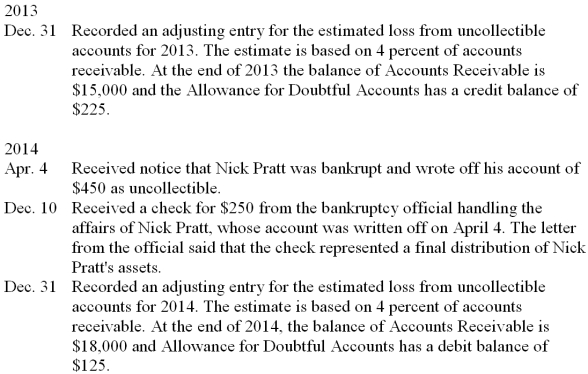
(Essay)
5.0/5 (79)
(79) At the end of the current year, the trial balance of Kate's Cafe included the accounts and balances shown below. Credit sales were $90,000. Returns and allowances on these sales were $1,000. Assume that the firm bases its estimate of the loss from uncollectible accounts on 3 percent of accounts receivable. Accounts Receivable \ 18,000. Allowance for Doubtful Accounts 500. Sales 145,000 . Sales Returns and Allowances 2,000. 1. What is the balance in the Allowance for Doubtful Accounts account after the adjusting entry for the estimated loss from uncollectible accounts is posted?
2. What is the amount of the adjusting entry for the estimated loss from uncollectible accounts?
(Short Answer)
4.9/5 (76)
(76) When the allowance method of recognizing losses from uncollectible accounts is used, the entry to record the write-off of a specific account consists of a debit to
(Multiple Choice)
4.8/5 (78)
(78) On December 31, 2014, prior to adjustments, Accounts Receivable has a debit balance of $356,000 and the Allowance for Doubtful Accounts has a debit balance of $1,200. The firm estimates its losses from uncollectible accounts to be 4% of accounts receivable at the end of the year. The amount of the adjusting entry needed to record the estimated losses from uncollectible accounts is
(Multiple Choice)
4.7/5 (76)
(76) On December 31, prior to adjustments, the balance of Accounts Receivable is $26,000 and Allowance for Doubtful Accounts has a debit balance of $300. The firm estimates its losses from uncollectible accounts to be 5% of accounts receivable at the end of the year. The adjusting entry needed to record the estimated losses from uncollectible accounts is made for
(Multiple Choice)
4.9/5 (67)
(67) On December 31, 2013, prior to adjustments, the Allowance for Doubtful Accounts has a debit balance of $750. An aging of the accounts receivable produces an estimate of $6,500 of probable losses from uncollectible accounts. The balance in the Allowance for Doubtful Accounts after the entry to record estimated losses from uncollectible accounts will be:
(Multiple Choice)
4.8/5 (86)
(86) 
Filters
- Essay(0)
- Multiple Choice(0)
- Short Answer(0)
- True False(0)
- Matching(0)