



 Chat with AI
Exam 1: The Equity Method of Accounting for Investments

Exam 1: The Equity Method of Accounting for Investments119 Questions
Exam 2: Consolidation of Financial Information115 Questions
Exam 3: Consolidations-Subsequent to the Date of Acquisition120 Questions
Exam 4: Consolidated Financial Statements and Outside Ownership117 Questions
Exam 5: Consolidated Financial Statements - Intra-Entity Asset Transactions127 Questions
Exam 6: Variable Interest Entities, Intra-Entity Debt, Consolidated Cash Flo115 Questions
Exam 7: Consolidated Financial Statements - Ownership Patterns and Income118 Questions
Exam 8: Segment and Interim Reporting113 Questions
Exam 9: Foreign Currency Transactions and Hedging Foreign Exchange Risk93 Questions
Exam 10: Translation of Foreign Currency Financial Statements97 Questions
Exam 11: Worldwide Accounting Diversity and International Standards60 Questions
Exam 12: Financial Reporting and the Securities and Exchange Commission77 Questions
Exam 13: Accounting for Legal Reorganizations and Liquidations82 Questions
Exam 14: Partnerships: Formation and Operations88 Questions
Exam 15: Partnerships: Termination and Liquidation70 Questions
Exam 16: Accounting for State and Local Governments78 Questions
Exam 17: Accounting for State and Local Governments46 Questions
Exam 18: Accounting and Reporting for Private Not-For-Profit Organizations62 Questions
Exam 19: Accounting for Estates and Trusts80 Questions
Select questions type


Figure:
On January 3, 2011, Austin Corp. purchased 25% of the voting common stock of Gainsville Co., paying $2,500,000. Austin decided to use the equity method to account for this investment. At the time of the investment, Gainsville's total stockholders' equity was $8,000,000. Austin gathered the following information about Gainsville's assets and liabilities: Book Value Fair Value Buildings (10-year life) \ 400,000 \ 500,000 Equipment (5 -year life) 1,000,000 1,300,000 Franchises ( 8 - year life) 0 400,000 For all other assets and liabilities, book value and fair value were equal. Any excess of cost over fair value was attributed to goodwill, which has not been impaired.
-For 2011, what is the total amount of excess amortization for Austin's 25% investment in Gainsville?
(Multiple Choice)
5.0/5  (86)
(86) Aqua Corp. purchased 30% of the common stock of Marcus Co. by paying $500,000. Of this amount, $50,000 is associated with goodwill.
Required:
Prepare the journal entry to record Aqua's investment.
(Essay)
4.7/5 (71)
(71) Figure:
Acker Inc. bought 40% of Howell Co. on January 1, 2010 for $576,000. The equity method of accounting was used. The book value and fair value of the net assets of Howell on that date were $1,440,000. Acker began supplying inventory to Howell as follows: Year Cost to Acker Transfer Price Amount Held by Howell at Year-End 2010 \ 55,000 \ 75,000 \ 15,000 2011 \ 70,000 \ 110,000 \ 55,000 Howell reported net income of $100,000 in 2010 and $120,000 in 2011 while paying $40,000 in dividends each year.
-What is the Equity in Howell Income that should be reported by Acker in 2010?
(Multiple Choice)
4.9/5 (91)
(91) Figure:
Cayman Inc. bought 30% of Maya Company on January 1, 2011 for $450,000. The equity method of accounting was used. The book value and fair value of the net assets of Maya on that date were $1,500,000. Maya began supplying inventory to Cayman as follows: Year Cost to Maya Transfer Price Amount Held by Cayman at Year-End 2011 \ 30,000 \ 45,000 \ 9,000 2012 \ 48,000 \ 80,000 \ 20,000 Maya reported net income of $100,000 in 2011 and $120,000 in 2012 while paying $40,000 in dividends each year.
-What is the balance in Cayman's Investment in Maya account at December 31, 2012?
(Multiple Choice)
4.9/5 (93)
(93) On January 1, 2010, Dawson, Incorporated, paid $100,000 for a 30% interest in Sacco Corporation. This investee had assets with a book value of $550,000 and liabilities of $300,000. A patent held by Sacco having a book value of $10,000 was actually worth $40,000 with a six year remaining life. Any goodwill associated with this acquisition is considered to have an indefinite life. During 2010, Sacco reported income of $50,000 and paid dividends of $20,000 while in 2011 it reported income of $75,000 and dividends of $30,000. Assume Dawson has the ability to significantly influence the operations of Sacco.
-The equity in income of Sacco for 2011, is
(Multiple Choice)
4.7/5 (76)
(76) The balance in the investment account at December 31, 2012, is
(Multiple Choice)
4.9/5 (85)
(85) On January 1, 2011, Anderson Company purchased 40% of the voting common stock of Barney Company for $2,000,000, which approximated book value. During 2011, Barney paid dividends of $30,000 and reported a net loss of $70,000.
-What is the balance in the investment account on December 31, 2011?
(Multiple Choice)
4.8/5 (75)
(75) Figure:
Acker Inc. bought 40% of Howell Co. on January 1, 2010 for $576,000. The equity method of accounting was used. The book value and fair value of the net assets of Howell on that date were $1,440,000. Acker began supplying inventory to Howell as follows: Year Cost to Acker Transfer Price Amount Held by Howell at Year-End 2010 \ 55,000 \ 75,000 \ 15,000 2011 \ 70,000 \ 110,000 \ 55,000 Howell reported net income of $100,000 in 2010 and $120,000 in 2011 while paying $40,000 in dividends each year.
-What is the Equity in Howell Income that should be reported by Acker in 2011?
(Multiple Choice)
5.0/5 (78)
(78) How does the use of the equity method affect the investor's financial statements?
(Essay)
4.9/5 (78)
(78) Figure:
On January 4, 2011, Bailey Corp. purchased 40% of the voting common stock of Emery Co., paying $3,000,000. Bailey properly accounts for this investment using the equity method. At the time of the investment, Emery's total stockholders' equity was $5,000,000. Bailey gathered the following information about Emery's assets and liabilities whose book values and fair values differed: Book Value Fair Value Buildings (20-year life) \ 1,000,000 \ 1,800,000 Equipment (5 -year life) 1,500,000 2,000,000 Franchises (10-year life) 0 700,000 Any excess of cost over fair value was attributed to goodwill, which has not been impaired. Emery Co. reported net income of $400,000 for 2011, and paid dividends of $200,000 during that year.
-What is the amount of the excess of purchase price over book value?
(Multiple Choice)
4.9/5 (91)
(91) Figure:
On January 1, 2011, Jackie Corp. purchased 30% of the voting common stock of Rob Co., paying $2,000,000. Jackie properly accounts for this investment using the equity method. At the time of the investment, Rob's total stockholders' equity was $3,000,000. Jackie gathered the following information about Rob's assets and liabilities whose book values and fair values differed: Buildings (15-year life) \ 1,000,000 \ 1,500,000 Equipment (5-year life) 2,500,000 3,000,000 Franchises (10-year life) 0 500,000 Any excess of cost over fair value was attributed to goodwill, which has not been impaired. Rob Co. reported net income of $300,000 for 2011, and paid dividends of $100,000 during that year.
-What is the amount of excess amortization expense for Jackie Corp's investment in Rob Co. for year 2011?
(Multiple Choice)
4.8/5 (95)
(95) For each of the following numbered situations below, select the best letter answer concerning accounting for investments:
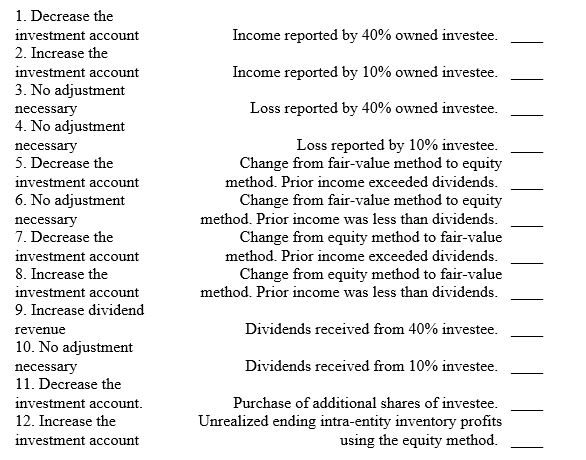
(Essay)
4.9/5 (68)
(68) On January 4, 2010, Trycker, Inc. acquired 40% of the outstanding common stock of Inkblot Co. for $2,400,000. This investment gave Trycker the ability to exercise significant influence over Inkblot. Inkblot's assets on that date were recorded at $8,000,000 with liabilities of $2,000,000. There were no other differences between book and fair values.
During 2010, Inkblot reported net income of $500,000 and paid dividends of $300,000. The fair value of Inkblot at December 31, 2010 is $7,000,000. Trycker elects the fair value option for its investment in Inkblot.
-How are dividends received from Inkblot reflected in Trycker's accounting records for 2010?
(Multiple Choice)
4.9/5 (74)
(74) On January 4, 2011, Mason Co. purchased 40,000 shares (40%) of the common stock of Hefly Corp., paying $560,000. At that time, the book value and fair value of Hefly's net assets was $1,400,000. The investment gave Mason the ability to exercise significant influence over the operations of Hefly. During 2011, Hefly reported income of $150,000 and paid dividends of $40,000. On January 2, 2012, Mason sold 10,000 shares for $150,000.
-What is the appropriate journal entry to record the sale of the 10,000 shares? 
(Multiple Choice)
4.9/5 (75)
(75) All of the following would require use of the equity method for investments except:
(Multiple Choice)
4.8/5 (79)
(79) How should an investor account for, and report, an investee's extraordinary income or loss?
(Essay)
4.7/5 (82)
(82) Dodge, Incorporated acquires 15% of Gates Corporation on January 1, 2011, for $105,000 when the book value of Gates was $600,000. During 2011 Gates reported net income of $150,000 and paid dividends of $50,000. On January 1, 2012, Dodge purchased an additional 25% of Gates for $200,000. Any excess cost over book value is attributable to goodwill with an indefinite life. The fair-value method was used during 2011 but Dodge has deemed it necessary to change to the equity method after the second purchase. During 2012 Gates reported net income of $200,000 and reported dividends of $75,000.
-The income reported by Dodge for 2011 with regard to the Gates investment is
(Multiple Choice)
4.9/5 (79)
(79) Figure:
On January 1, 2011, Jackie Corp. purchased 30% of the voting common stock of Rob Co., paying $2,000,000. Jackie properly accounts for this investment using the equity method. At the time of the investment, Rob's total stockholders' equity was $3,000,000. Jackie gathered the following information about Rob's assets and liabilities whose book values and fair values differed: Buildings (15-year life) \ 1,000,000 \ 1,500,000 Equipment (5-year life) 2,500,000 3,000,000 Franchises (10-year life) 0 500,000 Any excess of cost over fair value was attributed to goodwill, which has not been impaired. Rob Co. reported net income of $300,000 for 2011, and paid dividends of $100,000 during that year.
-What is the amount of the excess of purchase price over book value?
(Multiple Choice)
4.7/5 (77)
(77) When should an investor not use the equity method for an investment of 21% in another corporation?
(Essay)
4.9/5 (74)
(74) 
Filters
- Essay(0)
- Multiple Choice(0)
- Short Answer(0)
- True False(0)
- Matching(0)