



 Chat with AI
Exam 13: Accounting for Legal Reorganizations and Liquidations

Exam 1: The Equity Method of Accounting for Investments119 Questions
Exam 2: Consolidation of Financial Information115 Questions
Exam 3: Consolidations-Subsequent to the Date of Acquisition120 Questions
Exam 4: Consolidated Financial Statements and Outside Ownership117 Questions
Exam 5: Consolidated Financial Statements - Intra-Entity Asset Transactions127 Questions
Exam 6: Variable Interest Entities, Intra-Entity Debt, Consolidated Cash Flo115 Questions
Exam 7: Consolidated Financial Statements - Ownership Patterns and Income118 Questions
Exam 8: Segment and Interim Reporting113 Questions
Exam 9: Foreign Currency Transactions and Hedging Foreign Exchange Risk93 Questions
Exam 10: Translation of Foreign Currency Financial Statements97 Questions
Exam 11: Worldwide Accounting Diversity and International Standards60 Questions
Exam 12: Financial Reporting and the Securities and Exchange Commission77 Questions
Exam 13: Accounting for Legal Reorganizations and Liquidations82 Questions
Exam 14: Partnerships: Formation and Operations88 Questions
Exam 15: Partnerships: Termination and Liquidation70 Questions
Exam 16: Accounting for State and Local Governments78 Questions
Exam 17: Accounting for State and Local Governments46 Questions
Exam 18: Accounting and Reporting for Private Not-For-Profit Organizations62 Questions
Exam 19: Accounting for Estates and Trusts80 Questions
Select questions type


How should liabilities (except for deferred income taxes) be reported by a company using fresh start accounting?

Free
(Multiple Choice)
4.7/5  (81)
(81) Correct Answer: Verified
D
A company that was to be liquidated had the following liabilities: Income Taxes \ 10,000 Notes Payable secured by land 100,000 Accounts Payable 50,000 Salaries Payable (\ 12,000 from Employee \#1 and \ 2,000 for Employee \#2) 14,000 Administrative expenses for liquidation 20,000 The company had the following assets: Book Value Fair Value Current Assets \ 100,000 95,000 Land 50,000 75,000 Building 150,000 200,000
-Total unsecured nonpriority liabilities are calculated to be what amount?
Free
(Multiple Choice)
4.8/5 (74)
(74) Correct Answer:Verified
VerifiedC
How much will be paid to the holder of the note payable secured by the land and building?
(Round your payout percentage to the nearest whole number)
Free
(Essay)
4.8/5 (79)
(79) Correct Answer:Verified
VerifiedAssets available after priority obligations/Unsecured liabilities = $75,550/$252,050 = .2997 = .30 rounded.
$250,000 secured by land & bldg + ($50,000 not recovered by security x .30) = $265,000.
Which one of the following unsecured liabilities has the highest priority when an insolvent company is about to be liquidated?
(Multiple Choice)
4.8/5 (82)
(82) Bazley Co. had severe financial difficulties and was considering the possibility of filing a bankruptcy petition. At that time, the company had the following assets (stated at net realizable value) and liabilities. Assets (pledged against debts of \ 91,000) \ 150,800 Assets (pledged against debts of \ 169,000) 65,000 Other assets 104,000 Liabilities with priority 54,600 Unsecured creditors 260,000
-Assets that are available for unsecured creditors after payment of liabilities with priority are calculated to be what amount?
(Essay)
4.8/5 (87)
(87) Bazley Co. had severe financial difficulties and was considering the possibility of filing a bankruptcy petition. At that time, the company had the following assets (stated at net realizable value) and liabilities. Assets (pledged against debts of \ 91,000) \ 150,800 Assets (pledged against debts of \ 169,000) 65,000 Other assets 104,000 Liabilities with priority 54,600 Unsecured creditors 260,000
-In a liquidation, total assets available to pay liabilities with priority and unsecured creditors are calculated to be what amount?
(Essay)
4.8/5 (73)
(73) A company that was to be liquidated had the following liabilities: Income taxes \ 10,400 Notes payable (secured by land) 156,000 Accounts payable \ 107,900 Salaries payable to employees ( \ 15,000 for John Jay and \ 2,800 for Ann Still) 17,800 Bonds payable 81,000 Administrative expenses for liquidation 26,000 The company had the following assets: Book Fair Value Value Current assets \ 104,000 \ 42,900 Land 130,000 117,000 Buildings \& equipment 130,000 143,000
-Total assets available to pay liabilities with priority and unsecured creditors are calculated to be what amount?
(Essay)
4.8/5 (75)
(75) Hampton Company is trying to decide whether to seek liquidation or reorganization. Hampton has provided the following balance sheet:  Additional information is as follows:
- The investments are currently worth $13,000.
- It is estimated that $32,000 of the accounts receivable are collectible.
- The inventory can be sold for $74,000.
- The prepaid expenses and the intangible assets have no net realizable value.
- The land and building are currently valued at $250,000.
- The equipment can be sold for $60,000.
- Administrative expenses (not yet recorded) are estimated to be $12,500.
- Accrued expenses include $17,000 of salaries payable ($11,000 to one employee and $3,000 each to two other employees).
- Accrued expenses include $7,000 of unpaid payroll taxes.
-Compute the amount of total assets available to pay liabilities with priority and unsecured creditors.
Additional information is as follows:
- The investments are currently worth $13,000.
- It is estimated that $32,000 of the accounts receivable are collectible.
- The inventory can be sold for $74,000.
- The prepaid expenses and the intangible assets have no net realizable value.
- The land and building are currently valued at $250,000.
- The equipment can be sold for $60,000.
- Administrative expenses (not yet recorded) are estimated to be $12,500.
- Accrued expenses include $17,000 of salaries payable ($11,000 to one employee and $3,000 each to two other employees).
- Accrued expenses include $7,000 of unpaid payroll taxes.
-Compute the amount of total assets available to pay liabilities with priority and unsecured creditors. (Essay)
4.9/5 (87)
(87) Mount Inc. was a hardware store that operated in Boise, Idaho. Management made some poor inventory acquisitions that loaded the store with unsalable merchandise. Due to the decline in revenues, the company became insolvent. Following is a trial balance as of March 15, 2011, the day the company filed for a Chapter 7 liquidation.  Company officials believed that sixty percent of the accounts receivable could be collected if the company was liquidated. The building and land had a fair value of $97,500, while the equipment was worth $24,700. The investments represented shares of a publicly traded company that could be sold at the time for $27,300. The entire inventory could be sold for only $42,900. Administrative expenses necessary to carry out a liquidation would have approximated $20,800.
-Assume that the company was being liquidated and that the following transactions occurred:
Accounts receivable of $23,400 were collected.
All of the company's inventory was sold for $52,000.
Additional accounts payable of $13,000 incurred for various expenses such as utilities and maintenance were discovered.
The land and building were sold for $92,300.
The note payable due to the Idaho Savings and Loan was paid.
The equipment was sold at auction for only $14,300 with the proceeds applied to the note owed to the Second National Bank.
The investments were sold for $27,300.
Administrative expenses totaled $26,000 as of July 26, 2011, but no payment had yet been made.
Required:
Prepare a statement of realization and liquidation for the period from March 15 through July 26, 2011.
Company officials believed that sixty percent of the accounts receivable could be collected if the company was liquidated. The building and land had a fair value of $97,500, while the equipment was worth $24,700. The investments represented shares of a publicly traded company that could be sold at the time for $27,300. The entire inventory could be sold for only $42,900. Administrative expenses necessary to carry out a liquidation would have approximated $20,800.
-Assume that the company was being liquidated and that the following transactions occurred:
Accounts receivable of $23,400 were collected.
All of the company's inventory was sold for $52,000.
Additional accounts payable of $13,000 incurred for various expenses such as utilities and maintenance were discovered.
The land and building were sold for $92,300.
The note payable due to the Idaho Savings and Loan was paid.
The equipment was sold at auction for only $14,300 with the proceeds applied to the note owed to the Second National Bank.
The investments were sold for $27,300.
Administrative expenses totaled $26,000 as of July 26, 2011, but no payment had yet been made.
Required:
Prepare a statement of realization and liquidation for the period from March 15 through July 26, 2011. (Essay)
5.0/5 (74)
(74) On a statement of financial affairs, a company's assets should be valued at
(Multiple Choice)
4.8/5 (73)
(73) On a statement of financial affairs, a company's liabilities should be valued at
(Multiple Choice)
4.8/5 (65)
(65) A company that was to be liquidated had the following liabilities: Income taxes \ 10,400 Notes payable (secured by land) 156,000 Accounts payable \ 107,900 Salaries payable to employees ( \ 15,000 for John Jay and \ 2,800 for Ann Still) 17,800 Bonds payable 81,000 Administrative expenses for liquidation 26,000 The company had the following assets: Book Fair Value Value Current assets \ 104,000 \ 42,900 Land 130,000 117,000 Buildings \& equipment 130,000 143,000
-Total payment on notes payable is calculated to be what amount? (Round the payout percentage to one decimal place)
(Essay)
4.8/5 (69)
(69) What are the four categories of debts in a Statement of Financial Affairs?
(Essay)
4.8/5 (81)
(81) Mandich Co. had the following amounts for its assets, liabilities, and stockholders' equity accounts just before filing a bankruptcy petition and requesting liquidation: 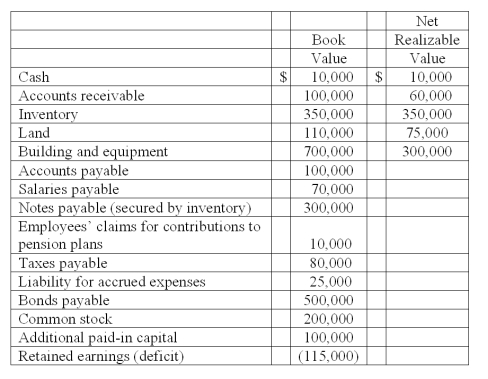 Of the salaries payable, $30,000 was owed to an officer of the company. The remaining amount was owed to salaried employees who had not been paid within the previous 80 days: John Webb was owed $10,600, Samantha Jones was owed $15,000, Sandra Johnson was owed $11,900, and Dennis Roberts was owed $2,500. The maximum owed for any one employee's claims for contributions to benefit plans was $800. Estimated expense for administering the liquidation amounted to $40,000.
-What amount would the company have expected to pay for every dollar of unsecured liability without priority?
Of the salaries payable, $30,000 was owed to an officer of the company. The remaining amount was owed to salaried employees who had not been paid within the previous 80 days: John Webb was owed $10,600, Samantha Jones was owed $15,000, Sandra Johnson was owed $11,900, and Dennis Roberts was owed $2,500. The maximum owed for any one employee's claims for contributions to benefit plans was $800. Estimated expense for administering the liquidation amounted to $40,000.
-What amount would the company have expected to pay for every dollar of unsecured liability without priority? (Multiple Choice)
4.8/5 (83)
(83) A company that was to be liquidated had the following liabilities: Income Taxes \ 10,000 Notes Payable secured by land 100,000 Accounts Payable 50,000 Salaries Payable (\ 12,000 from Employee \#1 and \ 2,000 for Employee \#2) 14,000 Administrative expenses for liquidation 20,000 The company had the following assets: Book Value Fair Value Current Assets \ 100,000 95,000 Land 50,000 75,000 Building 150,000 200,000
-Total assets, available to pay liabilities with priority and unsecured creditors, are calculated to be what amount?
(Multiple Choice)
4.9/5 (78)
(78) Which statement is false regarding the acceptance and confirmation of a reorganization plan?
(Multiple Choice)
4.9/5 (82)
(82) 
Filters
- Essay(0)
- Multiple Choice(0)
- Short Answer(0)
- True False(0)
- Matching(0)