



 Chat with AI
Exam 3: Accounting for Merchandising Businesses

Exam 1: An Introduction to Accounting242 Questions
Exam 2: Accounting for Accruals and Deferrals122 Questions
Exam 3: Accounting for Merchandising Businesses143 Questions
Exam 4: Internal Controls, Accounting for Cash, and Ethics191 Questions
Exam 5: Accounting for Receivables and Inventory Cost Flow150 Questions
Exam 6: Accounting for Long-Term Operational Assets150 Questions
Exam 7: Accounting for Liabilities150 Questions
Exam 8: Proprietorships, Partnerships, and Corporations149 Questions
Exam 9: Financial Statement Analysis151 Questions
Exam 10: An Introduction to Management Accounting148 Questions
Exam 11: Cost Behavior, Operating Leverage, and Profitability Analysis202 Questions
Exam 12: Cost Accumulation, Tracing, and Allocation121 Questions
Exam 13: Relevant Information for Special Decisions126 Questions
Exam 14: Planning for Profit and Cost Control149 Questions
Exam 15: Performance Evaluation150 Questions
Exam 16: Planning for Capital Investments154 Questions
Select questions type


The following is a list of selected events for Unger Sales and Service for 2014. Unger uses a perpetual inventory system and had a zero inventory balance prior to these transactions.
1) Purchased merchandise on account for $67,000.
2) Sold inventory costing $48,000 for $88,000 on account.
3) Paid transportation-out cost of $1,000 on goods sold.
4) Paid salary expense of $25,000.
5) A count of the inventory revealed that there was $18,500 of inventory on hand at the end of 2010.
Required:
Answer the following questions based on the above information.
a) What was Unger's net income for 2014?
b) Compute gross margin and the gross margin percent for 2014.
c) What amount of inventory will appear on the balance sheet for 2014?
d) Prepare an income statement for 2014.
(Essay)
4.8/5  (70)
(70) Gains from sales of assets other than inventory are shown as part of sales revenue on the income statement.
(True/False)
4.9/5 (77)
(77) The following are the income statements of the Franz Company for two consecutive years. Which expense(s) increased substantially as a percentage of sales and thus contributed to the net loss in 2014? 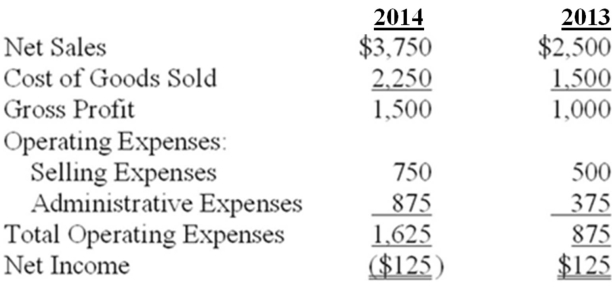
(Multiple Choice)
4.7/5 (79)
(79) During the month of March, Wang Company sold merchandise on account for $9,100. The merchandise had cost Wang $4,900. Which of the following represents the effects of this transaction on Wang's financial statements? 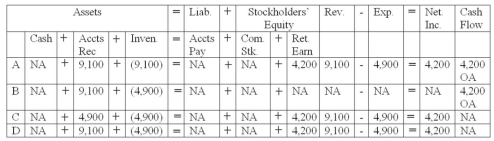
(Multiple Choice)
4.7/5 (80)
(80) An entry to record the amount of inventory shrinkage decreases both assets and equity.
(True/False)
4.8/5 (65)
(65) Indicate how each event affects the elements of financial statements. Use the following letters to record your answer in the box shown below each element. You do not need to enter amounts. Assume use of a perpetual inventory system.
After a physical count of its inventory, Rand Co. discovered that $5,000 of inventory was missing. Show how the required write-down of inventory would affect Rand's financial statements. Assets Liabilities Equity Revenues Expenses Net Income Cash
(Short Answer)
5.0/5 (78)
(78) A company using the perpetual inventory method paid cash to purchase inventory. Which of the following answers reflects the effects of this event on the financial statements? 
(Multiple Choice)
4.8/5 (66)
(66) At the beginning of the year, Kelly Sales had $2,400 of merchandise inventory. During the year, Kelly purchased $22,000 of inventory. At the end of the year, a count of the inventory revealed that Kelly had $1,600 of inventory on hand. Kelly uses a periodic inventory system.
Required:
a) What is the amount of goods available for sale?
b) What is cost of goods sold for the year?
(Essay)
4.9/5 (84)
(84) The term "shrinkage" reflects decreases in inventory for reasons other than theft.
(True/False)
4.9/5 (85)
(85) Inventory shrinkage cannot be determined without a physical count.
(True/False)
5.0/5 (86)
(86) The following events pertain to Burlington Supply Company for January, 2014. The company uses the perpetual inventory method. Indicate how each of the events affects the company's financial statements, using the financial statement model provided.
1) Jan 3. Purchased $4,000 of merchandise inventory from supplier, Kelly Distributors, Inc. The terms of the purchase: 2/10, n/30 and FOB shipping point.
2) Jan 5. Paid $90 cash for freight to trucking company to have goods shipped from Kelly Distributors, Inc.
3) Jan 7. (a) Sold merchandise for $800 to a customer on account. (b) The merchandise sold had cost $560.
4) Jan 10. Returned $500 (list price) of defective merchandise to Kelly Distributors, Inc.
5) Jan. 11. Paid amount due to Kelly Distributors for merchandise purchased on Jan. 3.
6) Jan. 12. a) Accepted a return of $150 of the goods sold on Jan. 7. b) The cost of these goods was $110. 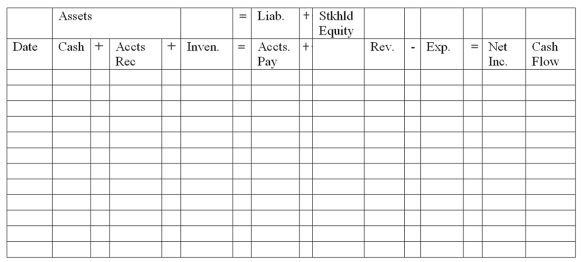
(Essay)
4.8/5 (78)
(78) Hanson Company uses a periodic inventory system. For 2014, its beginning inventory was $74,000; purchases of inventory were $328,000; and inventory at the end of the period was $89,000. What was the amount of Hanson's cost of goods sold for 2014?
(Multiple Choice)
4.9/5 (81)
(81) A merchandising firm's accounting system must allocate the Cost of Goods Available for Sale between
(Multiple Choice)
4.9/5 (89)
(89) Waco Company's Cost of Goods Sold for 2014 was $302,000. Which of the following statements is true?
(Multiple Choice)
4.8/5 (85)
(85) Scott Company is a merchandising business that was started in 2014. Scott uses the perpetual inventory system. It experienced the following events during 2014.
1. Acquired $25,000 cash by issuing common stock
2. Purchased inventory on account that cost $14,000, terms 2/10, n/30
3. Sold inventory that had cost $8,400 for $15,000 cash
4. Paid for the merchandise referred to in event 2, within the discount period
Required:
a) Record the events in the financial statements model below; include column totals.
b) Prepare an income statement for 2014.
c) What is the amount of total assets at the end of 2014? 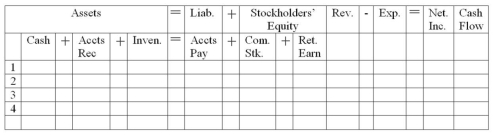
(Essay)
4.8/5 (83)
(83) Gross margin percentage is a measure of how high a markup a company is charging on the products it sells.
(True/False)
4.9/5 (84)
(84) Baxter Company's merchandise inventory at the start of 2014 was $85,000. The company purchased inventory during 2014 in the amount of $323,000, and its inventory at the end of the year was $102,000.
What was Baxter's Cost of Goods Sold for 2014?
(Multiple Choice)
4.9/5 (71)
(71) The term "loss" represents the excess of cost over revenue from transactions that occur on a regular basis.
(True/False)
4.8/5 (80)
(80) Assume Beta Company uses the perpetual inventory method and engaged in the following transactions:
1) Purchased $5,000 of merchandise on account under terms 2/10, n/30.
2) Returned $600 (list price) of merchandise to the supplier before payment was made.
3) Paid the account payable within the discount period.
4) Sold the merchandise for $6,500 cash.
What effect does the return of merchandise to the supplier have on the accounting equation?
(Multiple Choice)
4.8/5 (79)
(79) Income statements that display a single comparison of all revenues minus all expenses are called single-step income statements.
(True/False)
4.9/5 (79)
(79) 
Filters
- Essay(0)
- Multiple Choice(0)
- Short Answer(0)
- True False(0)
- Matching(0)