



 Chat with AI
Exam 3: Accounting for Merchandising Businesses

Exam 1: An Introduction to Accounting242 Questions
Exam 2: Accounting for Accruals and Deferrals122 Questions
Exam 3: Accounting for Merchandising Businesses143 Questions
Exam 4: Internal Controls, Accounting for Cash, and Ethics191 Questions
Exam 5: Accounting for Receivables and Inventory Cost Flow150 Questions
Exam 6: Accounting for Long-Term Operational Assets150 Questions
Exam 7: Accounting for Liabilities150 Questions
Exam 8: Proprietorships, Partnerships, and Corporations149 Questions
Exam 9: Financial Statement Analysis151 Questions
Exam 10: An Introduction to Management Accounting148 Questions
Exam 11: Cost Behavior, Operating Leverage, and Profitability Analysis202 Questions
Exam 12: Cost Accumulation, Tracing, and Allocation121 Questions
Exam 13: Relevant Information for Special Decisions126 Questions
Exam 14: Planning for Profit and Cost Control149 Questions
Exam 15: Performance Evaluation150 Questions
Exam 16: Planning for Capital Investments154 Questions
Select questions type


Assume the perpetual inventory method is used.
1) Marathon Company purchased merchandise inventory that cost $8,000 under terms of 2/10, n/30 and FOB shipping point.
2) Marathon paid freight cost of $500 on the merchandise.
3) Marathon made payment to the supplier within the discount period.
4) All of the goods were sold to customers on account for $12,000.
The gross margin from these transactions of Marathon Company is

Free
(Multiple Choice)
4.9/5  (81)
(81) Correct Answer: Verified
C
Baxter Company's merchandise inventory at the start of 2014 was $85,000. The company purchased inventory during 2014 in the amount of $323,000, and its inventory at the end of the year was $102,000.
What was Baxter's Cost of Goods Available for Sale for the year 2014?
Free
(Multiple Choice)
4.8/5 (75)
(75) Correct Answer:Verified
VerifiedC
Give an example of a product cost for a retailing business.
Free
(Essay)
4.8/5 (80)
(80) Correct Answer:Verified
VerifiedTransportation-in, storage costs or purchase price for merchandise inventory
Gains and losses are shown separately on the income statement to communicate the expectation that they are nonrecurring.
(True/False)
4.8/5 (85)
(85) A multistep income statement shows Sales, Cost of Goods Sold, and Gross Margin.
(True/False)
4.8/5 (80)
(80) Detroit Company is a merchandising business that started its operations in 2014. During the year, Detroit reported sales of $450,000; inventory purchases of $310,000; and an inventory balance of $50,000 at the end of the year.
Required:
a. What was Detroit's cost of goods available for sale for 2014?
b. What was the cost of goods sold?
c. Calculate the amount of Detroit's gross margin for 2014 and the gross margin percentage.
(Essay)
4.8/5 (89)
(89) What is a common size income statement? Explain the benefit of the common size income statement to financial statement users.
(Essay)
4.8/5 (73)
(73) Ruthven Company had the following transactions for 2014, the first year of operations:
1) Issued common stock for $50,000 cash.
2) Purchased merchandise on account, $40,000, terms 1/10, n/30.
3) Sold merchandise on account for $25,000. The inventory sold had cost $14,000.
4) Paid for the merchandise purchased within the discount period.
5) Collected $20,000 on the merchandise sold on account.
6) Paid operating expense of $5,000.
Required:
a) What are total assets at the end of 2014?
b) What is the balance of the cash account at the end of 2014?
c) What is gross margin for 2014?
d) What is net income for 2014?
e) What are total liabilities at the end of 2014?
f) What is total equity at the end of 2014?
g) What is total retained earnings at the end of 2014?
h) What was the amount of cash flows from operating activities? 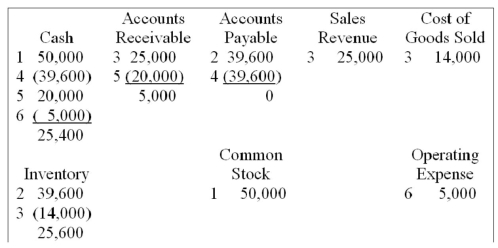
(Essay)
4.9/5 (84)
(84) Assume the perpetual inventory method is used.
1) Marathon Company purchased merchandise inventory that cost $8,000 under terms of 2/10, n/30 and FOB shipping point.
2) Marathon paid freight cost of $500 on the merchandise.
3) Marathon made payment to the supplier within the discount period.
4) All of the goods were sold to customers on account for $12,000.
As a result of Marathon's four transactions above, the net amount of the company's cash flow from operating activities is
(Multiple Choice)
4.9/5 (77)
(77) Interest expense is reported as a non-operating item on a multistep income statement, but it is reported in the operating activities section of the statement of cash flows.
(True/False)
4.8/5 (77)
(77) Indicate how each event affects the elements of financial statements. Use the following letters to record your answer in the box shown below each element. You do not need to enter amounts. Assume use of a perpetual inventory system.
Youkilis Co. returned some defective merchandise it had previously purchased on account from a supplier. Show how the transaction would affect Youkilis's financial statements. Assets Liabilities Equity Revenues Expenses Net Income Cash
(Short Answer)
4.8/5 (93)
(93) Net income does not change as a result of using the single-step format over the multistep format.
(True/False)
4.8/5 (72)
(72) Unger Company uses the perpetual inventory method. Unger sold goods that cost $3,500 for $7,200. If the sale was made to a customer on account, the sale will:
(Multiple Choice)
5.0/5 (82)
(82) On a multistep income statement, gains and losses are included in the calculation of operating income.
(True/False)
4.7/5 (77)
(77) The following events pertain to The Craft Shop, which began operations in October 2014. The company uses the perpetual inventory method. 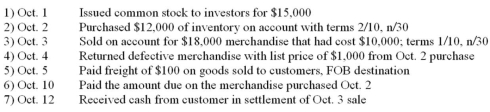 Required:
a. What was the amount of cash that The Craft Shop paid on October 10?
b. What was the amount of cash that The Craft Shop collected on October 12?
c. What was the balance in The Craft Shop's cash account at the end of the day on October 12?
Required:
a. What was the amount of cash that The Craft Shop paid on October 10?
b. What was the amount of cash that The Craft Shop collected on October 12?
c. What was the balance in The Craft Shop's cash account at the end of the day on October 12? (Essay)
4.8/5 (72)
(72) On October 1, Snyder Company made a $50,000 sale giving the customer terms of 3/10, n/30. The receivable was collected from the customer on October 8. What effect will the collection of cash from the receivable have on the company's financial statements? 
(Multiple Choice)
4.9/5 (84)
(84) Operating income is the amount of income that is generated from the normal recurring operations of a business.
(True/False)
4.7/5 (80)
(80) Explain the computation of and the meaning of each of the following:
a. Gross margin percentage
b. Net income percentage (also known as return on sales)
(Essay)
4.8/5 (63)
(63) 
Filters
- Essay(0)
- Multiple Choice(0)
- Short Answer(0)
- True False(0)
- Matching(0)