



 Chat with AI
Exam 7: Accounting for Liabilities

Exam 1: An Introduction to Accounting242 Questions
Exam 2: Accounting for Accruals and Deferrals122 Questions
Exam 3: Accounting for Merchandising Businesses143 Questions
Exam 4: Internal Controls, Accounting for Cash, and Ethics191 Questions
Exam 5: Accounting for Receivables and Inventory Cost Flow150 Questions
Exam 6: Accounting for Long-Term Operational Assets150 Questions
Exam 7: Accounting for Liabilities150 Questions
Exam 8: Proprietorships, Partnerships, and Corporations149 Questions
Exam 9: Financial Statement Analysis151 Questions
Exam 10: An Introduction to Management Accounting148 Questions
Exam 11: Cost Behavior, Operating Leverage, and Profitability Analysis202 Questions
Exam 12: Cost Accumulation, Tracing, and Allocation121 Questions
Exam 13: Relevant Information for Special Decisions126 Questions
Exam 14: Planning for Profit and Cost Control149 Questions
Exam 15: Performance Evaluation150 Questions
Exam 16: Planning for Capital Investments154 Questions
Select questions type


Pella Company issued bonds with a face value of $3,000,000 on January 1, 2014. The bonds were issued at face value and carried a 4-year term to maturity. Interest at 9% was payable in cash on December 31 of each year. Based on this information alone, the amount of interest expense shown on the 2014 income statement and the cash flow from operating activities shown on the 2014 statement of cash flows would be: 
(Multiple Choice)
4.9/5  (72)
(72) Roskos Corporation issued to Ewold Bank a two-year, $200,000, 6% interest-bearing note on August 1, 2014. Interest is paid annually on July 31. Principal and the final interest payments are to be made on July 31, 2016.
Using the financial statements model provided, indicate the effect on Roskos' financial statements of:
a) the issuance of the note payable.
b) Roskos' adjusting entry on 12/31/14.
c) the first interest payment on 7/31/15.
Include dollar amounts of increases and decreases. Also, indicate whether cash flows are operating activities, investing activities, or financing activities. 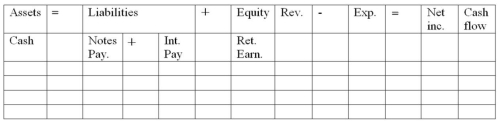
(Essay)
4.8/5 (80)
(80) San Jose Company issued 5-year $200,000 face value bonds at 105 on January 1, 2012. The stated interest rate on these bonds is 9%. Use the straight line method to complete the amortization schedule below. 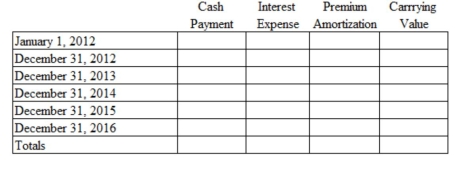
(Essay)
4.7/5 (87)
(87) Applegate Company experienced an accounting event that affected its financial statements as indicated below:  Which of the following accounting events could have caused these effects on Knight's statements?
 (Multiple Choice)
4.9/5 (83)
(83) Osgood Company estimated that its warranty expense would be $2,125 for the current year. During the year, Osgood paid $950 to repair merchandise that was returned by customers.
a) What type of transaction is the recording of warranty expense?
b) If this is the first year of operations, what is the amount of warranty liability that will be shown on the balance sheet at the end of the year?
(Essay)
4.9/5 (77)
(77) Indicate how each event affects the elements of financial statements. Use the following letters to record your answer in the box shown below each element. You do not need to enter amounts.
On March 17, Ransom Company paid the interest that was due on a note payable. Part of the interest had been accrued at the end of the previous accounting period. Assets Liabilities Equity Revenues Expenses Net Income Cash Flow
(Short Answer)
4.9/5 (91)
(91) Chicago Company sold merchandise to a customer for $600 cash in a state with a 6% sales tax rate. The total amount of cash collected from the customer was
(Multiple Choice)
4.7/5 (91)
(91) Sandusky Company borrowed $10,000 from the Lakeside Bank by issuing a 10% three-year installment note. Sandusky agreed to repay the principal and interest by making annual payments in the amount of $4,021.15. Based on this information, the amount of the interest expense associated with the second payment would be: (round your answer to the nearest dollar)
(Multiple Choice)
4.8/5 (78)
(78) For a long-term note payable, repaying a portion of principal along with interest payments is called loan amortization.
(True/False)
4.8/5 (79)
(79) Locke Company issued bonds payable. Which of the following choices accurately reflects how the issue would affect Locke's financial statements? 
(Multiple Choice)
4.8/5 (78)
(78) What is solvency? How could you measure solvency based on a company's financial statements?
(Essay)
4.8/5 (82)
(82) Indicate how each event affects the elements of financial statements. Use the following letters to record your answer in the box shown below each element. You do not need to enter amounts.
Terrace Company examined its contingent liabilities and determined that for one of the liabilities, the likelihood of a future obligation was probable and that the amount could be estimated. Assets Liabilities Equity Revenues Expenses Net Income Cash Flow
(Short Answer)
4.9/5 (81)
(81) Indicate how each event affects the elements of financial statements. Use the following letters to record your answer in the box shown below each element. You do not need to enter amounts.
On January 1, 2014, Spencer Corporation borrowed $20,000 on a line of credit from Mid-Rivers Bank. Show the effects of this transaction on Spencer's financial statements. Assets Liabilities Equity Revenues Expenses Net Income Cash Flow
(Short Answer)
4.8/5 (79)
(79) On a classified balance sheet, the financial statement user will be able to distinguish between:
(Multiple Choice)
4.7/5 (75)
(75) On January 1, 2014, Hays Corporation arranged a $3,000 line of credit with the Barnett Bank. It agreed to accept the bank's offer of 1% above the prime rate with interest payments on December 31 of each year. All borrowings and payments on principal are to take place on January 1 of each year.
On January 1, 2013, Hays borrowed an additional $1,000 from Barnett Bank, bringing the total amount borrowed to $2,000. On January 1, 2014, Hays paid $500 on the principal of the loan. On December 31, 2014, Hays records the 2014 interest payment. The prime rate for 2014 was 5 percent. Which of the following answers shows the effect of the 2014 interest payment on the financial statements? Assets = Liabilities + Equity Revenue - Expenses = Net Inc. Cash A) (75) = (75) + NA NA - NA = NA (75) FA B) (75) = NA + (75) NA - 75 = (75) (75) OA C) (90) = (90) + NA NA - NA = NA (90) FA D) (90) = NA + (90) NA - 90 = (90) (90)
(Multiple Choice)
4.9/5 (81)
(81) Indicate how each event affects the elements of financial statements. Use the following letters to record your answer in the box shown below each element. You do not need to enter amounts.
On December 31, 2014, Sweetwater Co. paid cash for interest on bonds it had issued on January 1, 2014. Indicate the effects of the payment of interest. Assets Liabilities Equity Revenues Expenses Net Income Cash Flow
(Short Answer)
4.9/5 (78)
(78) Knowles Company issued $100,000 of bonds at face value on January 1. The bonds carry an 8% annual stated rate of interest. Interest is payable in cash on December 31 of each year. Which of the following reflects the financial statement effects of the first interest payment? 
(Multiple Choice)
4.9/5 (76)
(76) Quayle Company has been sued by a customer who claims injury from use of Quayle's product. The company's lawyers and a consultant believe that the likelihood of a judgment against Quayle is remote. What should Quayle do to account for this potential liability?
(Multiple Choice)
4.9/5 (83)
(83) 
Filters
- Essay(0)
- Multiple Choice(0)
- Short Answer(0)
- True False(0)
- Matching(0)