



 Chat with AI
Exam 12: Cost Accumulation, Tracing, and Allocation

Exam 1: An Introduction to Accounting242 Questions
Exam 2: Accounting for Accruals and Deferrals122 Questions
Exam 3: Accounting for Merchandising Businesses143 Questions
Exam 4: Internal Controls, Accounting for Cash, and Ethics191 Questions
Exam 5: Accounting for Receivables and Inventory Cost Flow150 Questions
Exam 6: Accounting for Long-Term Operational Assets150 Questions
Exam 7: Accounting for Liabilities150 Questions
Exam 8: Proprietorships, Partnerships, and Corporations149 Questions
Exam 9: Financial Statement Analysis151 Questions
Exam 10: An Introduction to Management Accounting148 Questions
Exam 11: Cost Behavior, Operating Leverage, and Profitability Analysis202 Questions
Exam 12: Cost Accumulation, Tracing, and Allocation121 Questions
Exam 13: Relevant Information for Special Decisions126 Questions
Exam 14: Planning for Profit and Cost Control149 Questions
Exam 15: Performance Evaluation150 Questions
Exam 16: Planning for Capital Investments154 Questions
Select questions type


Old Virginia Meat Processing Plant processes hogs to produce three joint products: bacon, sausage, and pork chops. The company incurs common processing costs of $100,000 per batch. Each batch yields 15,000 pounds of bacon, 18,000 pounds of sausage, and 7,000 pounds of pork chops. Pork chops can be sold for $3.00 per pound. The bacon and sausage products are sold at the split-off point for $3.25 per pound and $3.50 per pound, respectively.
Required:
1) Allocate Old Virginia's joint costs using pounds produced as the allocation base.
2) Allocate Old Virginia's joint costs using the relative sales value at split-off method.
3) Assume that the pork chops are processed further after the split-off point at an additional cost of $4,000 and that joint costs are allocated based on pounds produced. What would be the total cost assigned to pork chops?
(Essay)
4.8/5  (83)
(83) Which of the following is not an example of a cost object and its related cost driver? 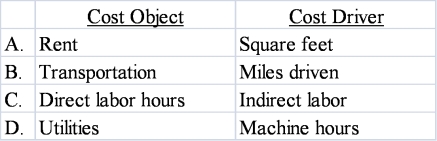
(Multiple Choice)
4.9/5 (88)
(88) A cost object is anything for which management desires a separate tracking of costs, while a cost driver is the factor that causes the cost object to increase or decrease.
(True/False)
4.7/5 (79)
(79) How are indirect costs assigned to cost objects? Are they traced to cost objects?
(Essay)
4.8/5 (89)
(89) Danforth Manufacturing Company uses a cost-plus pricing strategy. At the beginning of 2013, Danforth estimated that total annual fixed overhead costs would amount to 60,000. Further, Danforth estimated that the annual volume of production would be 1,000 units of product. Based on these estimates, Danforth computed a predetermined overhead rate that was used to allocate overhead cost to the products made throughout the year. As predicted, the actual volume of production amounted to 1,000 units of product. However, actual fixed overhead costs amounted to $56,000. Based on this information alone:
(Multiple Choice)
4.8/5 (91)
(91) Which of the following best describes the term used to assign indirect costs to a cost object?
(Multiple Choice)
4.8/5 (67)
(67) Custom Quilters makes decorative comforters, quilted garments, and other products in a small sewing factory. In 2012, the company expects to make 2,000 comforters. With respect to the comforters how would the fabric used to make the comforters be classified?
(Multiple Choice)
4.8/5 (79)
(79) An allocation base has a cause-and-effect relationship with a cost object.
(True/False)
4.7/5 (83)
(83) Indicate whether each of the following statements is true or false.
1. Information prepared using allocated costs often is used in evaluating the performance of managers.
2. Information prepared using allocated costs should not be used in budgeting and resource allocation decisions within a company.
3. A cost that is indirect with respect to one cost object may be direct with respect to other cost objects.
4. Fixed costs generally are direct costs, and variable costs generally are indirect.
5. An allocation base causes a cost to be incurred.
(Short Answer)
4.9/5 (80)
(80) The Western and Pacific Railroad has two divisions, the Western Division and the Pacific Division. The company recently invested $8,000,000 to maintain its railroad track. Pertinent data for the two divisions are as follows:
Total Miles Traveled: Western Division 800,000 miles Pacific Division 1,200,000 miles
The amount of track improvement cost that should be allocated to the Western Division is: (Do not round your intermediate calculations.)
(Multiple Choice)
4.9/5 (86)
(86) The management accountant at Morrison, Inc. provided the following estimated costs for producing 2,500 units of a specialty product manufactured by the firm: Direct Materials \ 10,000 Direct Labor (1 hour per unit) 5,000 Unit-level support costs 10,000 Batch level support costs 5,000 Product-level support costs 3,000 Facility-level support costs 7,000
The company believes that direct labor hours are the most appropriate cost driver for assigning overhead costs to its product.
Required:
1) Compute the predetermined overhead rate for this company.
2) Compute the specialty product's total estimated cost per unit.
3) Why do firms assign overhead costs using a predetermined overhead rate instead of assigning actual costs?
(Essay)
4.9/5 (83)
(83) The accuracy of managerial accounting information usually is more important than timeliness.
(True/False)
4.9/5 (81)
(81) Pets 'n Pals is attempting to determine the cost of operating a particular store. Which of the following costs would be classified as an indirect cost?
(Multiple Choice)
4.7/5 (91)
(91) Some costs that possibly could be traced directly to cost objects are nonetheless classified as indirect costs because:
(Multiple Choice)
4.8/5 (81)
(81) Herald Manufacturing Company uses a predetermined overhead rate to allocate fixed manufacturing overhead to production on a monthly basis. At the end of the accounting period it was determined that actual overhead cost was less than the estimated overhead cost and that the actual volume of production was higher than estimated. Based on this information alone:
(Multiple Choice)
4.8/5 (96)
(96) What cost driver would you use to allocate indirect materials to products?
(Essay)
4.9/5 (89)
(89) How a particular cost behaves (fixed versus variable) is dependent of whether the cost is classified as direct or indirect.
(True/False)
4.7/5 (78)
(78) Assume that a factory seeks to allocate rent to several departments that occupy the factory. The factory is occupied by all the departments. Which of the following is the most logical cost driver for allocating the factory rent?
(Multiple Choice)
4.8/5 (101)
(101) Sometimes, volume-based cost drivers are used to allocate fixed indirect costs.
(True/False)
4.7/5 (71)
(71) 
Filters
- Essay(0)
- Multiple Choice(0)
- Short Answer(0)
- True False(0)
- Matching(0)