



 Chat with AI
Exam 13: Relevant Information for Special Decisions

Exam 1: An Introduction to Accounting242 Questions
Exam 2: Accounting for Accruals and Deferrals122 Questions
Exam 3: Accounting for Merchandising Businesses143 Questions
Exam 4: Internal Controls, Accounting for Cash, and Ethics191 Questions
Exam 5: Accounting for Receivables and Inventory Cost Flow150 Questions
Exam 6: Accounting for Long-Term Operational Assets150 Questions
Exam 7: Accounting for Liabilities150 Questions
Exam 8: Proprietorships, Partnerships, and Corporations149 Questions
Exam 9: Financial Statement Analysis151 Questions
Exam 10: An Introduction to Management Accounting148 Questions
Exam 11: Cost Behavior, Operating Leverage, and Profitability Analysis202 Questions
Exam 12: Cost Accumulation, Tracing, and Allocation121 Questions
Exam 13: Relevant Information for Special Decisions126 Questions
Exam 14: Planning for Profit and Cost Control149 Questions
Exam 15: Performance Evaluation150 Questions
Exam 16: Planning for Capital Investments154 Questions
Select questions type


Easton Company makes and sells scooters. Easton incurred the following costs in its most recent fiscal year: Cost Items Appearing on the Income Statement Materials cost ( \1 0 per unit) Depreciation on manufacturing equipment Company president's salary Salaries of administrative personnel Labor cost ( \4 per unit) Research and development costs Advertising costs ( 150.000 per year) Real estate taxes on factory Shipping and handling (\ 0.15 per unit) Inspection costs Easton can currently purchase the scooters it makes from another company. If the company purchases the scooters, Easton would still continue to use its own logo, sales staff, and advertising programs. Which of the following costs would be classified as a unit-level cost?
(Multiple Choice)
4.8/5  (70)
(70) Mary must decide between two alternatives for the weekend: babysitting or yard work. If she babysits, she will receive $40 and will incur $15 in transportation costs. If she does yard work, she will receive $40 and will incur $3 in lawn mower gas and oil costs and $5 in transportation costs. The payment she would receive for the jobs is relevant in deciding which alternative to select.
(True/False)
4.8/5 (83)
(83) The Enhanced Products Division of Forrest Industries makes ceramic pots that are used to hold large decorative plants. During 2013, the division produced 10,000 pots and incurred the following costs: Unit-level materials costs (10,000@\ 15) \ 150,000 Unit-level labor costs (10,000@\ 20) 200,000 Unit-level overhead costs (10,000@\ 16) 160,000 Depreciation expenses on equipment* 12,000 Other manufacturing overhead** 36,000
*The equipment was purchased last year for $150,000 and has a current book value of $120,000, remaining useful life of four years, and a zero salvage value. If the equipment is not used to produce ceramic pots, it can be leased for $8,000 per year.
**Includes supervisors' salaries and rent for manufacturing plant.
Required:
1) Assume Evergreen Industries uses a cost plus pricing strategy. What price should be charged for the ceramic pot product if the division sets its price 40 percent above the unit product cost?
2) A potential overseas customer who would not compete with the division's existing customers would like to purchase 1,000 ceramic pots but is not willing to pay the regular price. At what selling price would the division be indifferent about accepting the special order?
3) Suppose the division has the opportunity to purchase the ceramic pot from another manufacturer for $60. The supplier is willing to hold sufficient inventories to meet Evergreen's demand. Should the division outsource its ceramic pots? Why or why not?
(Essay)
4.9/5 (70)
(70) Chavez Company is considering purchasing new equipment or overhauling its existing equipment. The manager has gathered the following information: 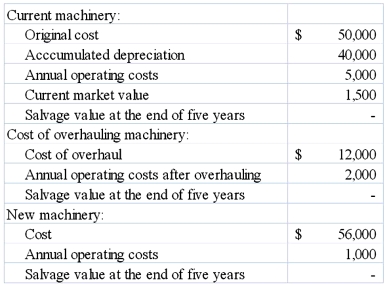 Required:
1) Identify the sunk costs associated with this decision.
2) Compute the increase or decrease in total income over the five-year period if the company chooses to buy the new equipment.
3) Compute the increase or decrease in total income over the five-year period if the company chooses to overhaul its existing machinery.
4) What is your recommendation for this decision?
Required:
1) Identify the sunk costs associated with this decision.
2) Compute the increase or decrease in total income over the five-year period if the company chooses to buy the new equipment.
3) Compute the increase or decrease in total income over the five-year period if the company chooses to overhaul its existing machinery.
4) What is your recommendation for this decision? (Essay)
4.8/5 (79)
(79) The practice of buying goods and services from other companies is commonly known as vertical integration.
(True/False)
4.8/5 (86)
(86) Expected future revenues that differ among the alternatives under consideration are often referred to as:
(Multiple Choice)
5.0/5 (73)
(73) The costs and revenues associated with two alternatives are listed below: Alternative 1 Alternative 2 Projected revenue \ 100,000 \ 125,000 Unit-level costs 20,000 30,000 Batch-level costs 20,000 25,000 Product-level costs 15,000 15,000 Facility-level costs 10,000 10,000 Which alternative should be selected based on this information?
(Multiple Choice)
4.9/5 (60)
(60) Indicate whether each of the following statements is true or false.
1. Accepting a special order will usually involve incurring product-level costs.
2. An outsourcing decision typically affects unit-level and batch-level costs but not product-level costs.
3. Eliminating a business segment often allows a company to avoid some facility-level costs.
4. Classifying a cost as unit-level, batch-level, product-level, or facility-level is based primarily on the dollar amount of the cost.
5. Facility-level costs generally are not relevant in special order decisions.
(Short Answer)
4.7/5 (89)
(89) Differential revenues are expected future revenues that vary between the alternatives under consideration.
(True/False)
4.9/5 (71)
(71) For purposes of decision making, avoidable costs are costs that:
(Multiple Choice)
4.8/5 (80)
(80) Select the term from the list provided that best matches each of the following descriptions. Put the number of the term in the column for Your Answer. Your Answer Description or Definition Term A. Future oriented costs that differ between business alternatives 1. Avoidable costs B. Costs that can be avoided when a product line or type of service is eliminated 2. Batch-level costs C. Costs that are incurred each time a company makes a single product of performs a single service 3. Differential costs D. Features such as company reputation, welfare of employees, and customer reaction 4. Low-ball pricing E. Items that are future oniented and that differ between the alternatives 5 . Opportunity costs F. Setting a selling price low enough to hure customers away from competitors 6. Outsourcing decisions G. Costs that are not relevant for decision making 7. Product-level costs H. Costs that, for example, would include the cost of setting up machinery to produce a specific lot of units 8. Qualitative characteristics I. The \ 20 variation between Alternative A, which costs \ 100 and Alternative B, which costs \ 80 9. Relevant costs J. Revenues or cost savings that are sacrified when one alternative is chosen over another 10. Relevant information . Deciding to purchase a component that until now has been produced in house. 11. Sunk costs L. Future costs that do not have to be incurred if a specified course of action is taken 12. Unit-level costs
(Essay)
4.8/5 (83)
(83) Anton Valve Company produces a mechanical valve used in water systems. Three years ago the company introduced an electronic version of the valve. Sales of the mechanical model have steadily declined, and the company will report a loss on the product this year as follows: Sales revenue \ 200,000 Less costs: Unit-level manufacturing costs \ 157,500 Batch-level costs 2,500 Product-level costs 5,000 Facility-level costs 30,000 Allocated corporate costs 11,500 Total costs 206,500 Net loss \ (6,500)
If production of the mechanical valve is discontinued, product-level costs will be eliminated but facility level and corporate costs would not be affected.
Required:
1) Prepare a quantitative analysis that indicates whether the valve should be discontinued.
2) What qualitative factors should be considered in this decision?
(Essay)
4.9/5 (67)
(67) A company that provides services (not goods) to its customers may incur costs that are appropriately classified as product-level costs.
(True/False)
4.9/5 (66)
(66) Gibbs Corporation makes indoor gas fireplaces. A standard fireplace includes unit-level materials, labor, and overhead costs. In addition, the company incurs product-level engineering and advertising costs. The sales staff is paid a 5% commission on each fireplace sold. A sales representative has been in contact with a building developer who wants to buy 20 fireplaces only if he can buy them at amount lower than Gibbs' selling price. Which of the following costs would be relevant to this special order decision?
(Multiple Choice)
4.8/5 (84)
(84) Clean, Inc. cleans and waxes floors for commercial customers. The company is presently operating at less than capacity with equipment and employees idle at times. The company recently received an order from a potential customer outside the company's normal geographic service region for a price of $4,500. The size of the proposed job is 11,000 square feet. The company's normal service costs are as follows: Unit-level materials \ 0.18 per square foot Unit-level labor \ 0.25 per square foot Unit-level variable overhead \ 0.08 per square foot Facility-level overhead Allocated at \ 0.10 per square foot
If the company accepts the special offer:
(Multiple Choice)
4.9/5 (94)
(94) Great Outdoors Company operates a store in downtown Denver that has five departments including a fishing department. If the fishing department is closed, the store manager's position will not be affected, but if the entire store is closed, the manager will be terminated. Which of the following lessons should be learned from this example?
(Multiple Choice)
4.7/5 (80)
(80) The cost that is avoided when a company eliminates a single item of a product or service is a:
(Multiple Choice)
4.8/5 (78)
(78) Hancock Company manufactures and sells two lines of furniture, case goods and upholstery. During the most recent accounting period, the Case Goods and Upholstery Divisions sold 15,000 and 2,000 units, respectively. The company's most recent financial statements are shown below (Do not round intermediate calculations.):  If unit sales for both divisions increased 10%, the company would report which of the following?
 (Multiple Choice)
4.8/5 (78)
(78) 
Filters
- Essay(0)
- Multiple Choice(0)
- Short Answer(0)
- True False(0)
- Matching(0)