



 Chat with AI
Exam 7: Firms in Competitive Markets

Exam 1: The Role and Method of Economics235 Questions
Exam 2: The Economic Way of Thinking152 Questions
Exam 3: Supply and Demand252 Questions
Exam 4: Using Supply and Demand248 Questions
Exam 5: Market Failure and Public Choice206 Questions
Exam 6: Production and Costs177 Questions
Exam 7: Firms in Competitive Markets200 Questions
Exam 8: Monopoly162 Questions
Exam 9: Monopolistic Competition and Oligopoly193 Questions
Exam 10: Labor Markets, Income Distribution, and Poverty230 Questions
Exam 11: Introduction to Macroeconomics: Unemployment, Inflation, and Economic Fluctuations151 Questions
Exam 12: Economic Growth177 Questions
Exam 13: Aggregate Demand and Aggregate Supply180 Questions
Exam 14: Fiscal Policy123 Questions
Exam 15: Monetary Institutions170 Questions
Exam 16: The Federal Reserve System and Monetary Policy133 Questions
Exam 17: Issues in Macroeconomic Theory and Policy105 Questions
Exam 18: International Economics261 Questions
Select questions type


A profit maximizing perfectly competitive firm would never operate at an output level where
(Multiple Choice)
4.9/5  (76)
(76) The long-run supply curve for a decreasing-cost industry is:
(Multiple Choice)
4.8/5 (91)
(91) In a perfectly competitive market, marginal revenue is the same as the market price.
(True/False)
4.8/5 (79)
(79) Beginning from a long run equilibrium in an increasing cost industry, if there is a substantial, permanent fall in demand for industry output:
(Multiple Choice)
4.9/5 (73)
(73) Which of the following is most likely to be a price taker?
(Multiple Choice)
4.7/5 (80)
(80) Figure 7-D  -Refer to Figure 7-D.The firm's supply curve corresponds to which segment of the marginal cost curve in the diagram?
 (Multiple Choice)
4.7/5 (76)
(76) A perfectly competitive firm has no influence over price because:
(Multiple Choice)
4.8/5 (72)
(72) Say that Japanese firms commit not to lay off their employees when demand for their products is low, but American firms often lay off workers when demand is low.As a result, ceteris paribus, we would expect Japanese firms to:
(Multiple Choice)
4.8/5 (77)
(77) What is the maximum amount of profit the perfectly competitive firm depicted below could earn in the short run? 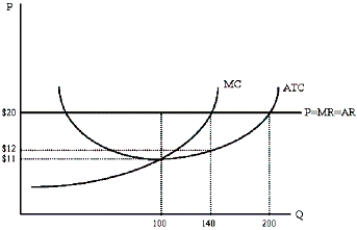
(Multiple Choice)
4.7/5 (84)
(84) Table 7-B
The long-run total cost schedule of a perfectly competitive firm that produces walnuts is as follows:
Pounds of 1,000 2,000 3,000 4,000 5,000 6,000 Walnuts Total Cost \3 ,000 \5 ,500 \7 ,500 \8 ,000 \1 1,000 \1 5,000
-Refer to Table 7-B.The average total cost of producing 6,000 pounds of walnuts in the long run is:
(Multiple Choice)
5.0/5 (70)
(70) In a perfectly competitive industry, influence over price is exerted by:
(Multiple Choice)
4.8/5 (86)
(86) If a perfectly competitive industry uses a large proportion of the available inputs in a resource market, then the long-run market supply curve for the industry will most likely be:
(Multiple Choice)
4.8/5 (94)
(94) A perfectly competitive firm faces a perfectly elastic demand curve.
(True/False)
4.8/5 (87)
(87) The behavior of an individual perfectly competitive firm has a perceptible influence on the market price.
(True/False)
4.9/5 (89)
(89) Toys for Twerps, Inc., sells in a perfectly competitive market, with an equilibrium price of $5.Its marginal revenue:
(Multiple Choice)
4.7/5 (87)
(87) Figure 7-D
-Refer to Figure 7-D.The lowest price at which the firm can earn at least zero economic profit is:
-Refer to Figure 7-D.The lowest price at which the firm can earn at least zero economic profit is: (Multiple Choice)
4.9/5 (94)
(94) Farmer Brady sells wheat in a market where sellers are price takers.Which of the following is true in regard to Farmer Brady's production and pricing decisions?
(Multiple Choice)
4.9/5 (88)
(88) 
Filters
- Essay(0)
- Multiple Choice(0)
- Short Answer(0)
- True False(0)
- Matching(0)