



 Chat with AI
Exam 7: Firms in Competitive Markets

Exam 1: The Role and Method of Economics235 Questions
Exam 2: The Economic Way of Thinking152 Questions
Exam 3: Supply and Demand252 Questions
Exam 4: Using Supply and Demand248 Questions
Exam 5: Market Failure and Public Choice206 Questions
Exam 6: Production and Costs177 Questions
Exam 7: Firms in Competitive Markets200 Questions
Exam 8: Monopoly162 Questions
Exam 9: Monopolistic Competition and Oligopoly193 Questions
Exam 10: Labor Markets, Income Distribution, and Poverty230 Questions
Exam 11: Introduction to Macroeconomics: Unemployment, Inflation, and Economic Fluctuations151 Questions
Exam 12: Economic Growth177 Questions
Exam 13: Aggregate Demand and Aggregate Supply180 Questions
Exam 14: Fiscal Policy123 Questions
Exam 15: Monetary Institutions170 Questions
Exam 16: The Federal Reserve System and Monetary Policy133 Questions
Exam 17: Issues in Macroeconomic Theory and Policy105 Questions
Exam 18: International Economics261 Questions
Select questions type


In a constant cost industry, the cost curves of individual firms will shift upward as the industry output expands.
(True/False)
4.9/5  (89)
(89) Figure 7-D  -Refer to Figure 7-D.At a market price of $30, total revenue is sufficient to pay:
 (Multiple Choice)
4.9/5 (70)
(70) Figure 7-H  -What is productive efficiency? Does it guarantee that markets are operating efficiently?
 (Essay)
4.9/5 (86)
(86) It is relatively easy for firms to enter and exit a perfectly competitive market.
(True/False)
4.7/5 (69)
(69) If a particular perfectly competitive industry uses only a small fraction of the supply of any of its inputs, the long run supply curve for that industry will tend to be:
(Multiple Choice)
4.8/5 (79)
(79) Suppose losses cause industry Z to contract, and as a result, the prices of inputs used intensively in the industry's production process fall.We know, as a result, that industry Z is:
(Multiple Choice)
4.9/5 (83)
(83) Figure 7-H
-Refer to Figure 7-H.This pair of graphs demonstrates the chain of events for a lawn care firm, beginning with an increase in the market demand for lawn care services.Which of the following statements is incorrect?
-Refer to Figure 7-H.This pair of graphs demonstrates the chain of events for a lawn care firm, beginning with an increase in the market demand for lawn care services.Which of the following statements is incorrect? (Multiple Choice)
4.9/5 (83)
(83) Whenever marginal revenue is greater than marginal cost, a profit-maximizing firm should reduce its output.
(True/False)
4.9/5 (75)
(75) A perfectly competitive firm cannot make economic profits in the long run because:
(Multiple Choice)
4.8/5 (81)
(81) When price exceeds average variable cost for a firm, it is possible that:
(Multiple Choice)
4.9/5 (74)
(74) The short-run supply curve of a perfectly competitive firm is:
(Multiple Choice)
4.8/5 (73)
(73) If a perfectly competitive firm is operating in the short run and seeks to maximize profit, the firm should:
(Multiple Choice)
5.0/5 (76)
(76) As an industry's output increases, the industry's demand for the inputs that it uses will also increase.
(True/False)
4.8/5 (69)
(69) Figure 7-E 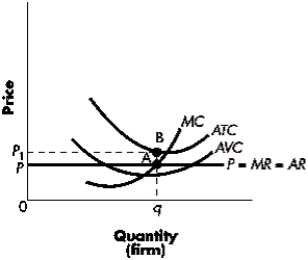 -Refer to Figure 7-E.If P represents the market price for a price-taking firm, the best course of action in the short run for the firm is to:
 (Multiple Choice)
4.9/5 (78)
(78) Economic losses caused several firms to leave the car wash business in Portland, Oregon.Though prices have risen, firms are still leaving the industry.Apparently:
(Multiple Choice)
4.9/5 (80)
(80) Figure 7-H
-Refer to Table 7-C.What levels of capital (K=1, K=2, or K=3) would the firm choose in the long run for producing three canisters and five canisters of peanuts per hour, respectively?
-Refer to Table 7-C.What levels of capital (K=1, K=2, or K=3) would the firm choose in the long run for producing three canisters and five canisters of peanuts per hour, respectively? (Essay)
4.8/5 (75)
(75) In perfect competition, at the firm's profit maximizing short run output, which of the following is true?
(Multiple Choice)
4.9/5 (84)
(84) A competitive firm facing a perfectly elastic demand curve can:
(Multiple Choice)
4.8/5 (79)
(79) Assume that a firm's total revenue is less than its total cost for the level of output it is producing.In the short run, this firm should:
(Multiple Choice)
4.9/5 (71)
(71) Figure 7-F
The figure shows the price, marginal cost, and average cost curves of a perfectly competitive firm.  -Refer to Figure 7-F.How many units of output per day should the firm produce if it wants to maximize its profits (i.e., minimize its losses)?
 (Multiple Choice)
4.8/5 (78)
(78) 
Filters
- Essay(0)
- Multiple Choice(0)
- Short Answer(0)
- True False(0)
- Matching(0)