



 Chat with AI
Exam 13: Gene Structure and Expression

Exam 1: Light and Life118 Questions
Exam 2: The Cell: an Overview158 Questions
Exam 3: Defining Life and Its Origins59 Questions
Exam 4: Energy and Enzymes80 Questions
Exam 5: Cell Membranes and Signalling85 Questions
Exam 6: Cellular Respiration64 Questions
Exam 7: Photosynthesis100 Questions
Exam 8: Cell Cycles93 Questions
Exam 9: Genetic Recombination99 Questions
Exam 10: Mendel, Genes, and Inheritance86 Questions
Exam 11: Genes, Chromosomes, and Human Genetics79 Questions
Exam 12: Dna Structure, Replication, and Organization74 Questions
Exam 13: Gene Structure and Expression106 Questions
Exam 14: Control of Gene Expression97 Questions
Exam 15: Dna Technologies91 Questions
Exam 16: Genomes and Proteomes48 Questions
Exam 17: Evolution: the Development of the Theory85 Questions
Exam 18: Microevolution: Changes Within Populations84 Questions
Exam 19: Species and Macroevolution90 Questions
Exam 20: Understanding the History of Life on Earth76 Questions
Exam 21: Humans and Evolution57 Questions
Exam 22: Bacteria and Archaea80 Questions
Exam 23: Viruses, Viroids, and Prions: Infectious Biological Particles41 Questions
Exam 24: Protists100 Questions
Exam 25: Fungi81 Questions
Exam 26: Plants80 Questions
Exam 27: Diversity of Animals 1: Sponges, Radiata, Platyhelminthes, and Protostomes88 Questions
Exam 28: Diversity of Animals 2: Deuterostomes: Vertebrates and Their Closest Relatives88 Questions
Exam 29: Population Ecology65 Questions
Exam 30: Population Interactions and Community Ecology71 Questions
Exam 31: Ecosystems67 Questions
Exam 32: Conservation of Biodiversity41 Questions
Exam 33: Putting Selection to Work94 Questions
Exam 34: Organization of the Plant Body70 Questions
Exam 35: Transport in Plants80 Questions
Exam 36: Reproduction and Development in Flowering Plants70 Questions
Exam 37: Plant Nutrition99 Questions
Exam 38: Plant Signals and Responses to the Environment95 Questions
Exam 39: Introduction to Animal Organization and Physiology65 Questions
Exam 40: Transport in Animals: the Circulatory System73 Questions
Exam 41: Reproduction in Animals102 Questions
Exam 42: Animal Development85 Questions
Exam 43: Control of Animal Processes: Neural Control103 Questions
Exam 44: Control of Animal Processes: Neural Control103 Questions
Exam 45: Control of Animal Processes: Neural Integration157 Questions
Exam 46: Muscles, Skeletons, and Body Movements71 Questions
Exam 47: Animal Behaviour126 Questions
Exam 48: Animal Nutrition108 Questions
Exam 49: Gas Exchange: the Respiratory System57 Questions
Exam 50: Regulating the Internal Environment73 Questions
Exam 51: Defences Against Disease117 Questions
Exam 52: Conservation and Evolutionary Physiology60 Questions
Select questions type


Suppose that two bases are inserted into the coding region of a gene just after the start codon of a gene. What type of mutation has occurred?
(Multiple Choice)
4.8/5  (76)
(76) For each item or event, indicate the process it is associated with.
-snRNP
(Multiple Choice)
4.8/5 (89)
(89) Which type of transcription are the proteins called transcription factors involved in?
(Multiple Choice)
4.7/5 (71)
(71) Suppose that the first part of a new polypeptide chain being produced in a eukaryotic cell does NOT have a signal peptide. Where would this polypeptide be located within the cell as it is maturing?
(Multiple Choice)
4.9/5 (78)
(78) For each item or event, indicate the process it is associated with.
-signal recognition particle
(Multiple Choice)
4.7/5 (85)
(85) 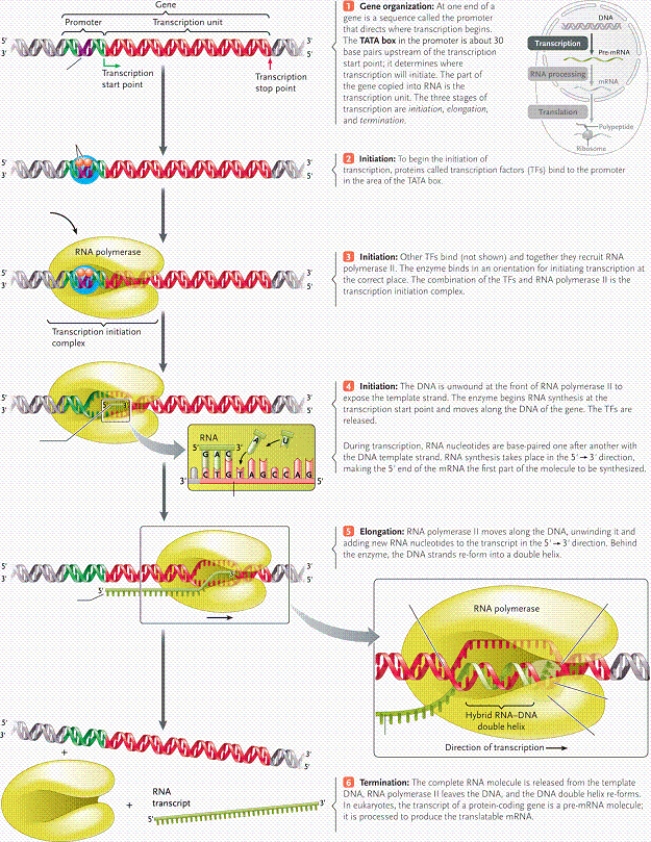 -In the figure of transcription, what is the name of item B?
 (Multiple Choice)
4.8/5 (74)
(74) Which of the following processes best explains the diversity of human á-tropomyosin proteins?
(Multiple Choice)
4.9/5 (94)
(94) How is the formation of the peptide bond catalyzed during translation?
(Multiple Choice)
4.8/5 (84)
(84) Which region of the DNA does RNA polymerase interact with during transcription initiation?
(Multiple Choice)
4.8/5 (84)
(84) Individuals with the genetic condition sickle cell anemia have hemoglobin coded with the gene that codes for valine instead of glutamic acid. What kind of mutation does this condition result from?
(Multiple Choice)
4.8/5 (92)
(92) The studies of alkaptonuria provided the first evidence of a connection between genes and metabolism. Who conducted these studies?
(Multiple Choice)
4.8/5 (75)
(75) For each item or event, indicate the process it is associated with.
-TATA box
(Multiple Choice)
4.9/5 (81)
(81) How many letters are in the RNA "alphabet" of the genetic code?
(Multiple Choice)
4.9/5 (89)
(89)
-In the figure of transcription, what is the name of item D?
-In the figure of transcription, what is the name of item D? (Multiple Choice)
4.9/5 (87)
(87) What is implied by the concept that the genetic code is universal?
a.It is a recent evolutionary development.
b.It is different in every type of organism.
c.It frequently changes.
d.It was established early in evolution.
(Essay)
4.9/5 (66)
(66) What is the function of the 3' poly-A sequence in eukaryotic mRNA?
(Multiple Choice)
5.0/5 (88)
(88) For each item or event, indicate the process it is associated with.
-ER membrane
(Multiple Choice)
4.8/5 (89)
(89) 
Filters
- Essay(0)
- Multiple Choice(0)
- Short Answer(0)
- True False(0)
- Matching(0)