



 Chat with AI
Exam 6: Cellular Respiration

Exam 1: Light and Life118 Questions
Exam 2: The Cell: an Overview158 Questions
Exam 3: Defining Life and Its Origins59 Questions
Exam 4: Energy and Enzymes80 Questions
Exam 5: Cell Membranes and Signalling85 Questions
Exam 6: Cellular Respiration64 Questions
Exam 7: Photosynthesis100 Questions
Exam 8: Cell Cycles93 Questions
Exam 9: Genetic Recombination99 Questions
Exam 10: Mendel, Genes, and Inheritance86 Questions
Exam 11: Genes, Chromosomes, and Human Genetics79 Questions
Exam 12: Dna Structure, Replication, and Organization74 Questions
Exam 13: Gene Structure and Expression106 Questions
Exam 14: Control of Gene Expression97 Questions
Exam 15: Dna Technologies91 Questions
Exam 16: Genomes and Proteomes48 Questions
Exam 17: Evolution: the Development of the Theory85 Questions
Exam 18: Microevolution: Changes Within Populations84 Questions
Exam 19: Species and Macroevolution90 Questions
Exam 20: Understanding the History of Life on Earth76 Questions
Exam 21: Humans and Evolution57 Questions
Exam 22: Bacteria and Archaea80 Questions
Exam 23: Viruses, Viroids, and Prions: Infectious Biological Particles41 Questions
Exam 24: Protists100 Questions
Exam 25: Fungi81 Questions
Exam 26: Plants80 Questions
Exam 27: Diversity of Animals 1: Sponges, Radiata, Platyhelminthes, and Protostomes88 Questions
Exam 28: Diversity of Animals 2: Deuterostomes: Vertebrates and Their Closest Relatives88 Questions
Exam 29: Population Ecology65 Questions
Exam 30: Population Interactions and Community Ecology71 Questions
Exam 31: Ecosystems67 Questions
Exam 32: Conservation of Biodiversity41 Questions
Exam 33: Putting Selection to Work94 Questions
Exam 34: Organization of the Plant Body70 Questions
Exam 35: Transport in Plants80 Questions
Exam 36: Reproduction and Development in Flowering Plants70 Questions
Exam 37: Plant Nutrition99 Questions
Exam 38: Plant Signals and Responses to the Environment95 Questions
Exam 39: Introduction to Animal Organization and Physiology65 Questions
Exam 40: Transport in Animals: the Circulatory System73 Questions
Exam 41: Reproduction in Animals102 Questions
Exam 42: Animal Development85 Questions
Exam 43: Control of Animal Processes: Neural Control103 Questions
Exam 44: Control of Animal Processes: Neural Control103 Questions
Exam 45: Control of Animal Processes: Neural Integration157 Questions
Exam 46: Muscles, Skeletons, and Body Movements71 Questions
Exam 47: Animal Behaviour126 Questions
Exam 48: Animal Nutrition108 Questions
Exam 49: Gas Exchange: the Respiratory System57 Questions
Exam 50: Regulating the Internal Environment73 Questions
Exam 51: Defences Against Disease117 Questions
Exam 52: Conservation and Evolutionary Physiology60 Questions
Select questions type


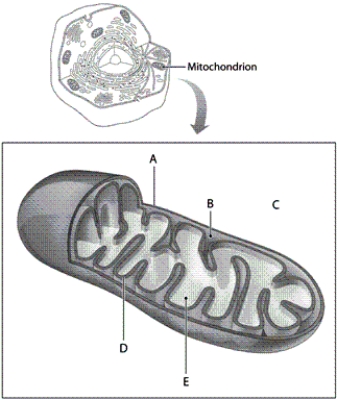 Refer to the above illustration of a mitochondrion. Match the labelled parts of the mitochondrion with the steps of cellular respiration. A labelled part may be used once, more than once, or not at all.
-ATP synthesis
Refer to the above illustration of a mitochondrion. Match the labelled parts of the mitochondrion with the steps of cellular respiration. A labelled part may be used once, more than once, or not at all.
-ATP synthesis (Multiple Choice)
4.8/5  (74)
(74) Suppose that the pH of the matrix was significantly lower than the inner mitochondrial space. How would the ATP synthase function differently?
(Multiple Choice)
4.8/5 (72)
(72)
Refer to the above illustration of a mitochondrion. Match the labelled parts of the mitochondrion with the steps of cellular respiration. A labelled part may be used once, more than once, or not at all.
-pyruvate oxidation
Refer to the above illustration of a mitochondrion. Match the labelled parts of the mitochondrion with the steps of cellular respiration. A labelled part may be used once, more than once, or not at all.
-pyruvate oxidation (Multiple Choice)
4.8/5 (83)
(83) Which of the following molecules is responsible for carrying the acetyl group from pyruvate into the citric acid cycle?
(Multiple Choice)
4.8/5 (84)
(84) During glycolysis, ATP is produced by oxidative phosphorylation.
(True/False)
4.9/5 (71)
(71) In the process of aerobic metabolism, carbon-containing molecules are broken down. What is the energy from the electrons used for?
(Multiple Choice)
4.8/5 (80)
(80) Glycolysis can take place in the absence of which of the following small molecules?
(Multiple Choice)
4.7/5 (78)
(78) For every glucose molecule that goes through cellular respiration, how many times is a carbon molecule fully oxidized to CO2 in the citric acid cycle?
(Multiple Choice)
4.7/5 (77)
(77)
Refer to the above illustration of a mitochondrion. Match the labelled parts of the mitochondrion with the steps of cellular respiration. A labelled part may be used once, more than once, or not at all.
-oxidative phosphorylation
Refer to the above illustration of a mitochondrion. Match the labelled parts of the mitochondrion with the steps of cellular respiration. A labelled part may be used once, more than once, or not at all.
-oxidative phosphorylation (Multiple Choice)
4.9/5 (80)
(80) Which of the following processes actually produces a significant quantity of ATP?
(Multiple Choice)
4.8/5 (71)
(71) Which molecules are responsible for delivering the high-energy electrons from the citric acid cycle to the electron transfer system?
(Multiple Choice)
4.8/5 (66)
(66) What is the fate of CoA after it delivers an acetyl group into the citric acid cycle?
(Multiple Choice)
5.0/5 (87)
(87) If, during a chemical reaction, a molecule loses hydrogens, it could be described as being oxidized.
(True/False)
4.9/5 (88)
(88) The electrons that are present in NADH and FADH2 are very high energy and theoretically sufficient to produce ATP alone. Why then have biological systems evolved a way that uses the various steps of cellular respiration to produce ATP?
(Multiple Choice)
4.7/5 (82)
(82) 
Filters
- Essay(0)
- Multiple Choice(0)
- Short Answer(0)
- True False(0)
- Matching(0)