



 Chat with AI
Exam 17: Energy in Thermal Processes: the First Law of Thermodynamics

Exam 1: Introduction and Vectors69 Questions
Exam 2: Motion in One Dimension55 Questions
Exam 3: Motion in Two Dimensions82 Questions
Exam 4: The Laws of Motion97 Questions
Exam 5: More Applications of Newtons Laws80 Questions
Exam 6: Energy of a System81 Questions
Exam 7: Conservation of Energy77 Questions
Exam 8: Momentum and Collisions84 Questions
Exam 9: Relativity31 Questions
Exam 10: Rotational Motion121 Questions
Exam 11: Gravity,planetary Orbits,and the Hydrogen Atom62 Questions
Exam 12: Oscillatory Motion44 Questions
Exam 13: Mechanical Waves56 Questions
Exam 14: Superposition and Standing Waves57 Questions
Exam 15: Fluid Mechanics48 Questions
Exam 16: Temperature and the Kinetic Theory of Gases54 Questions
Exam 17: Energy in Thermal Processes: the First Law of Thermodynamics69 Questions
Exam 18: Heat Engines,entropy,and the Second Law of Thermodynamics51 Questions
Exam 19: Electric Forces and Electric Fields156 Questions
Exam 20: Electric Potential and Capacitance158 Questions
Exam 21: Current and Direct Current Circuits113 Questions
Exam 22: Magnetic Forces and Magnetic Fields157 Questions
Exam 23: Faradays Law and Inductance76 Questions
Exam 24: Electromagnetic Waves41 Questions
Exam 25: Reflection and Refraction of Light34 Questions
Exam 26: Image Formation by Mirrors and Lenses41 Questions
Exam 27: Wave Optics72 Questions
Exam 28: Quantum Physics69 Questions
Exam 29: Atomic Physics35 Questions
Exam 30: Nuclear Physics62 Questions
Exam 31: Particle Physics31 Questions
Select questions type


The molar specific heat at constant volume at 0 C of an ideal monatomic gas is
(Multiple Choice)
4.8/5  (76)
(76) One gram of water is heated from 0 C to 100 C at a constant pressure of 1 atm.Determine the approximate change in internal energy (in cal)of the water.
(Multiple Choice)
4.7/5 (88)
(88) Which of the following substances has the greatest specific heat?
(Multiple Choice)
4.9/5 (94)
(94) A gas expands as shown in the graph.If the heat taken in during this process is 1.02 * 106 J and 1 atm = 1.01 * 105 N/m2,the change in internal energy of the gas (in J)is 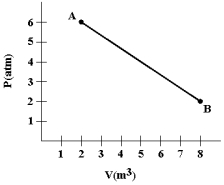
(Multiple Choice)
4.9/5 (84)
(84) The Earth intercepts 1.27 *1017 W of radiant energy from the Sun.Suppose the Earth,of volume 1.08 * 1021 m3,was composed of water.How long would it take for the Earth at 0 C to reach 100 C,if none of the energy was radiated or reflected back out into space?
(Multiple Choice)
4.7/5 (85)
(85) An 8 000-kg aluminum flagpole 100-m high is heated by the sun from a temperature of 10 C to 20 C.Find the increase in internal energy (in J)of the aluminum.(The coefficient of linear expansion is 24 * 10 - 6 ( C) - 1,the density is 2.7* 103 kg/m3,and the specific heat of aluminum is 0.215 cal/g. C. )
(Multiple Choice)
4.7/5 (65)
(65) Five moles of an ideal gas expands isothermally at 100 C to five times its initial volume.Find the heat flow into the system.
(Multiple Choice)
4.8/5 (76)
(76) The work done in the expansion from an initial to a final state
(Multiple Choice)
4.8/5 (81)
(81) 
Filters
- Essay(0)
- Multiple Choice(0)
- Short Answer(0)
- True False(0)
- Matching(0)