



 Chat with AI
Exam 19: Electric Forces and Electric Fields

Exam 1: Introduction and Vectors69 Questions
Exam 2: Motion in One Dimension55 Questions
Exam 3: Motion in Two Dimensions82 Questions
Exam 4: The Laws of Motion97 Questions
Exam 5: More Applications of Newtons Laws80 Questions
Exam 6: Energy of a System81 Questions
Exam 7: Conservation of Energy77 Questions
Exam 8: Momentum and Collisions84 Questions
Exam 9: Relativity31 Questions
Exam 10: Rotational Motion121 Questions
Exam 11: Gravity,planetary Orbits,and the Hydrogen Atom62 Questions
Exam 12: Oscillatory Motion44 Questions
Exam 13: Mechanical Waves56 Questions
Exam 14: Superposition and Standing Waves57 Questions
Exam 15: Fluid Mechanics48 Questions
Exam 16: Temperature and the Kinetic Theory of Gases54 Questions
Exam 17: Energy in Thermal Processes: the First Law of Thermodynamics69 Questions
Exam 18: Heat Engines,entropy,and the Second Law of Thermodynamics51 Questions
Exam 19: Electric Forces and Electric Fields156 Questions
Exam 20: Electric Potential and Capacitance158 Questions
Exam 21: Current and Direct Current Circuits113 Questions
Exam 22: Magnetic Forces and Magnetic Fields157 Questions
Exam 23: Faradays Law and Inductance76 Questions
Exam 24: Electromagnetic Waves41 Questions
Exam 25: Reflection and Refraction of Light34 Questions
Exam 26: Image Formation by Mirrors and Lenses41 Questions
Exam 27: Wave Optics72 Questions
Exam 28: Quantum Physics69 Questions
Exam 29: Atomic Physics35 Questions
Exam 30: Nuclear Physics62 Questions
Exam 31: Particle Physics31 Questions
Select questions type


Two planes of charge with no thickness,A and B,are parallel and vertical.The electric field in region I to the left of plane A has magnitude and points to the left.The electric field in the region to the right of B has magnitude and points to the right.The electric field in the region between the two planes has magnitude and points to the right.The surface charge density on planes A and B respectively is
(Multiple Choice)
4.9/5  (66)
(66) A point charge +Q is located on the x axis at x = a,and a second point charge -Q is located on the x axis at x = -a.A Gaussian surface with radius r = 2a is centered at the origin.The flux through this Gaussian surface is
(Multiple Choice)
4.8/5 (78)
(78) Charge of uniform density (20 nC/m2)is distributed over a cylindrical surface (radius = 1.0 cm),and a second coaxial surface (radius = 3.0 cm)carries a uniform charge density of -12 nC/m2.Determine the magnitude of the electric field at a point 2.0 cm from the symmetry axis of the two surfaces.
(Multiple Choice)
4.9/5 (86)
(86) Two imaginary spherical surfaces of radius R and 2R respectively surround a positive point charge Q located at the center of the concentric spheres.When compared to the number of field lines N1 going through the sphere of radius R,the number of electric field lines N2 going through the sphere of radius 2R is
(Multiple Choice)
4.8/5 (76)
(76) Enrico says that positive charge is created when you rub a glass rod with silk,and that negative charge is simply the absence of positive charge.Rosetta says that negative charge is created and that positive charge is the absence of positive charge.(She has heard that Ben Franklin should have reversed the signs he associated with the charges. )Which one,if either,is correct?
(Multiple Choice)
4.9/5 (85)
(85) A Geiger counter is like an electroscope that discharges whenever ions formed by a radioactive particle produce a conducting path.A typical Geiger counter consists of a thin conducting wire of radius 0.002 cm stretched along the axis of a conducting cylinder of radius 2.0 cm.The wire and the cylinder carry equal and opposites charges of 8.0 *10 - 10 C all along their length of 10.0 cm.What is the magnitude of the electric field at the surface of the wire?
(Short Answer)
4.8/5 (79)
(79) Which one of the following is not an expression for electric charge?
(Multiple Choice)
4.8/5 (100)
(100) Charge of uniform density (0.30 nC/m2)is distributed over the xy plane,and charge of uniform density (-0.40 nC/m2)is distributed over the yz plane.What is the magnitude of the resulting electric field at any point not in either of the two charged planes?
(Multiple Choice)
4.8/5 (79)
(79) If Q = 25 C,q = 10 C,and L = 40 cm in the figure,what is the magnitude of the electrostatic force on q? 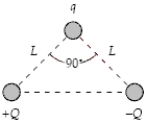
(Multiple Choice)
4.9/5 (77)
(77) A charge Q is placed on the x axis at x = +4.0 m.A second charge q is located at the origin.If Q = +75 nC and q = -8.0 nC,what is the magnitude of the electric field on the y axis at y = +3.0 m?
(Multiple Choice)
4.9/5 (91)
(91) A proton moving at 3 * 104 m/s is projected at an angle of 30 above a horizontal plane.If an electric field of 400 N/C is directed downwards,how long does it take the proton to return to the horizontal plane? (HINT: Ignore gravity. )[mProton = 1.67 *10 - 27 kg,qProton = +1.6 *10 - 19 C.]
(Short Answer)
4.9/5 (84)
(84) Identical point charges Q are placed at each of the four corners of a 3.0 m * 4.0 m rectangle.If Q = 40 C,what is the magnitude of the electrostatic force on any one of the charges?
(Multiple Choice)
4.8/5 (73)
(73) When a positive charge q is placed in the field created by two other charges Q1 and Q2,each a distance r away from q,the acceleration of q is
(Multiple Choice)
4.8/5 (74)
(74) Two tiny metal spheres are fixed to the ends of a non-conducting string of length .Equal charges,+q,are placed on the metal spheres.Randall says that the force on the string has magnitude .Tilden says that the tension in the string has magnitude .Which one,if either,is correct?
(Multiple Choice)
4.8/5 (87)
(87) A positive point charge q is placed at the center of an uncharged metal sphere insulated from the ground.The outside of the sphere is then grounded as shown.Then the ground wire is removed.A is the inner surface and B is the outer surface.Which statement is correct? 
(Multiple Choice)
4.9/5 (86)
(86) Three point charges,two positive and one negative,each having a magnitude of 20 C are placed at the vertices of an equilateral triangle (30 cm on a side).What is the magnitude of the electrostatic force on one of the positive charges?
(Multiple Choice)
4.7/5 (83)
(83) Two identical pith balls supported by insulating threads hang side by side and close together,as shown below. 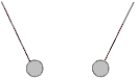 One is positively charged;the other is neutral.We can conclude that
 (Multiple Choice)
4.8/5 (88)
(88) A uniform linear charge of 2.0 nC/m is distributed along the x axis from x = 0 to x = 3 m.What is the x component of the electric field at y = 2 m on the y axis?
(Multiple Choice)
4.9/5 (80)
(80) A long cylindrical conductor (radius = 1.0 mm)carries a charge density of 4.0 pC/m and is inside a coaxial,hollow,cylindrical conductor (inner radius = 3.0 mm,outer radius = 4.0 mm)that has a total charge of -8.0 pC/m.What is the magnitude of the electric field 2.0 mm from the axis of these conductors?
(Multiple Choice)
4.8/5 (71)
(71) A charge of 8.0 pC is distributed uniformly on a spherical surface (radius = 2.0 cm),and a second charge of -3.0 pC is distributed uniformly on a concentric spherical surface (radius = 4.0 cm).Determine the magnitude of the electric field 5.0 cm from the center of the two surfaces.
(Multiple Choice)
5.0/5 (86)
(86) 
Filters
- Essay(0)
- Multiple Choice(0)
- Short Answer(0)
- True False(0)
- Matching(0)