



 Chat with AI
Exam 19: Electric Forces and Electric Fields

Exam 1: Introduction and Vectors69 Questions
Exam 2: Motion in One Dimension55 Questions
Exam 3: Motion in Two Dimensions82 Questions
Exam 4: The Laws of Motion97 Questions
Exam 5: More Applications of Newtons Laws80 Questions
Exam 6: Energy of a System81 Questions
Exam 7: Conservation of Energy77 Questions
Exam 8: Momentum and Collisions84 Questions
Exam 9: Relativity31 Questions
Exam 10: Rotational Motion121 Questions
Exam 11: Gravity,planetary Orbits,and the Hydrogen Atom62 Questions
Exam 12: Oscillatory Motion44 Questions
Exam 13: Mechanical Waves56 Questions
Exam 14: Superposition and Standing Waves57 Questions
Exam 15: Fluid Mechanics48 Questions
Exam 16: Temperature and the Kinetic Theory of Gases54 Questions
Exam 17: Energy in Thermal Processes: the First Law of Thermodynamics69 Questions
Exam 18: Heat Engines,entropy,and the Second Law of Thermodynamics51 Questions
Exam 19: Electric Forces and Electric Fields156 Questions
Exam 20: Electric Potential and Capacitance158 Questions
Exam 21: Current and Direct Current Circuits113 Questions
Exam 22: Magnetic Forces and Magnetic Fields157 Questions
Exam 23: Faradays Law and Inductance76 Questions
Exam 24: Electromagnetic Waves41 Questions
Exam 25: Reflection and Refraction of Light34 Questions
Exam 26: Image Formation by Mirrors and Lenses41 Questions
Exam 27: Wave Optics72 Questions
Exam 28: Quantum Physics69 Questions
Exam 29: Atomic Physics35 Questions
Exam 30: Nuclear Physics62 Questions
Exam 31: Particle Physics31 Questions
Select questions type


A long nonconducting cylinder (radius = 12 cm)has a charge of uniform density (5.0 nC/m3)distributed throughout its volume.Determine the magnitude of the electric field 15 cm from the axis of the cylinder.
(Multiple Choice)
4.8/5  (78)
(78) A charge of 0.80 nC is placed at the center of a cube that measures 4.0 m along each edge.What is the electric flux through one face of the cube?
(Multiple Choice)
4.7/5 (80)
(80) A charge of 80 nC is uniformly distributed along the x axis from x = 0 to x = 2.0 m.Determine the magnitude of the electric field at a point on the x axis with x = 8.0 m.
(Multiple Choice)
4.8/5 (93)
(93) An uncharged metal sphere is placed on an insulating puck on a frictionless table.While being held parallel to the table,a rod with a charge q is brought close to the sphere,but does not touch it.As the rod is brought in,the sphere
(Multiple Choice)
4.8/5 (78)
(78) Charge of uniform density (80 nC/m3)is distributed throughout a hollow cylindrical region formed by two coaxial cylindrical surfaces of radii 1.0 mm and 3.0 mm.Determine the magnitude of the electric field at a point which is 4.0 mm from the symmetry axis.
(Multiple Choice)
5.0/5 (76)
(76) A negatively charged particle is moving in the +x-direction when it enters a region with a uniform electric field pointing in the +x-direction.Which graph gives its position as a function of time correctly? (Its initial position is x = 0 at t = 0. )
(Multiple Choice)
4.8/5 (88)
(88) A point charge Q is placed on the x axis at x = 2.0 m.A second point charge,-Q,is placed at x = 3.0 m.If Q = 40 C,what is the magnitude of the electrostatic force on a 30- C charge placed at the origin?
(Multiple Choice)
4.9/5 (76)
(76) A hemispherical surface (half of a spherical surface)of radius R is located in a uniform electric field of magnitude E that is parallel to the axis of the hemisphere.What is the magnitude of the electric flux through the hemisphere surface?
(Multiple Choice)
4.9/5 (67)
(67) A charge of uniform volume density (40 nC/m3)fills a cube with 8.0-cm edges.What is the total electric flux through the surface of this cube?
(Multiple Choice)
4.9/5 (79)
(79) Two infinite,uniformly charged,flat surfaces are mutually perpendicular.One of the sheets has a charge density of +60 pC/m2,and the other carries a charge density of -80 pC/m2.What is the magnitude of the electric field at any point not on either surface?
(Multiple Choice)
5.0/5 (81)
(81) Three identical point charges Q are placed at the vertices of an equilateral triangle (length of each side = 2.0 m).If Q = 60 C,what is the magnitude of the electrostatic force on any one of the charges?
(Multiple Choice)
4.8/5 (76)
(76) Whitney says that Gauss's Law can be used to find the electric field of a sufficiently symmetrical distribution of charge as long as over the whole Gaussian surface.Algie says that the electric field must be a constant vector over the entire Gaussian surface.Which one,if either,is correct?
(Multiple Choice)
4.8/5 (68)
(68) A +2.0-nC point charge is placed at one corner of a square (1.5 m on a side),and a -3.0-nC charge is placed on a corner diagonally away from the first charge.What is the magnitude of the electric field at either of the two unoccupied corners?
(Multiple Choice)
4.7/5 (92)
(92) If a = 60 cm,b = 80 cm,Q = -6.0 nC,and q = 3.0 nC in the figure,what is the magnitude of the electric field at point P? 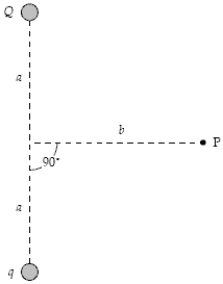
(Multiple Choice)
4.7/5 (73)
(73) A charge of 5.0 pC is distributed uniformly on a spherical surface (radius = 2.0 cm),and a second charge of -2.0 pC is distributed uniformly on a concentric spherical surface (radius = 4.0 cm).Determine the magnitude of the electric field 3.0 cm from the center of the two surfaces.
(Multiple Choice)
4.7/5 (81)
(81) In a diagram of charges and electric field lines charge has twelve field lines going outward from it and charge has three field lines going into it.If one of the charges is 100 nC,what is the other one?
(Multiple Choice)
4.7/5 (88)
(88) The electric field in the region of space shown is given by N/C where y is in m.What is the magnitude of the electric flux through the top face of the cube shown? 
(Multiple Choice)
4.8/5 (74)
(74) The electric flux through the two adjacent spherical surfaces shown below is known to be the same.  It is also known that there is no charge inside either spherical surface.We can conclude that
 (Multiple Choice)
4.8/5 (87)
(87) Three point charges are positioned on the x axis.If the charges and corresponding positions are +32 C at x = 0,+20 C at x = 40 cm,and -60 C at x = 60 cm,what is the magnitude of the electrostatic force on the +32- C charge?
(Multiple Choice)
4.7/5 (86)
(86) The nucleus of lead-208, ,has 82 protons within a sphere of radius 6.34 *10 - 15.Each electric charge has a value of 1.60 *10 - 19 C.Assuming that the protons create a spherically symmetric distribution of charge,calculate the electric field at the surface of the nucleus.
(Short Answer)
4.9/5 (75)
(75) 
Filters
- Essay(0)
- Multiple Choice(0)
- Short Answer(0)
- True False(0)
- Matching(0)