



 Chat with AI
Exam 30: Nuclear Physics

Exam 1: Introduction and Vectors69 Questions
Exam 2: Motion in One Dimension55 Questions
Exam 3: Motion in Two Dimensions82 Questions
Exam 4: The Laws of Motion97 Questions
Exam 5: More Applications of Newtons Laws80 Questions
Exam 6: Energy of a System81 Questions
Exam 7: Conservation of Energy77 Questions
Exam 8: Momentum and Collisions84 Questions
Exam 9: Relativity31 Questions
Exam 10: Rotational Motion121 Questions
Exam 11: Gravity,planetary Orbits,and the Hydrogen Atom62 Questions
Exam 12: Oscillatory Motion44 Questions
Exam 13: Mechanical Waves56 Questions
Exam 14: Superposition and Standing Waves57 Questions
Exam 15: Fluid Mechanics48 Questions
Exam 16: Temperature and the Kinetic Theory of Gases54 Questions
Exam 17: Energy in Thermal Processes: the First Law of Thermodynamics69 Questions
Exam 18: Heat Engines,entropy,and the Second Law of Thermodynamics51 Questions
Exam 19: Electric Forces and Electric Fields156 Questions
Exam 20: Electric Potential and Capacitance158 Questions
Exam 21: Current and Direct Current Circuits113 Questions
Exam 22: Magnetic Forces and Magnetic Fields157 Questions
Exam 23: Faradays Law and Inductance76 Questions
Exam 24: Electromagnetic Waves41 Questions
Exam 25: Reflection and Refraction of Light34 Questions
Exam 26: Image Formation by Mirrors and Lenses41 Questions
Exam 27: Wave Optics72 Questions
Exam 28: Quantum Physics69 Questions
Exam 29: Atomic Physics35 Questions
Exam 30: Nuclear Physics62 Questions
Exam 31: Particle Physics31 Questions
Select questions type


How many grams of U-235 must be fissioned every day to produce 1 000 MW of electricity in a nuclear power plant that is 1/3 efficient? [Assume 208 MeV/fission and 1 MeV = 1.6 *10 - 13 J]
(Short Answer)
4.7/5  (85)
(85) Find the ratio of the binding energy per nucleon for helium ( )to uranium-238 ( ). Assume:
M p = 1.007 825 u
M n = 1.008 665 u
MHe = 4.002 603 u
MU = 238.050 786 u
U = 1.66 *10 - 27 kg
(Multiple Choice)
4.9/5 (83)
(83) It is often possible to use atomic masses when calculating the binding energy of a nucleus.This is not true for calculating the Q value for the e+ decay process since
(Multiple Choice)
4.7/5 (76)
(76) How much kinetic energy must a deuterium ion (charge 1.6 * 10 - 19 C)have to approach to within 10 - 14 m of another deuterium ion? (1 MeV = 1.6*10 - 13 J)
(Short Answer)
4.9/5 (72)
(72) The Q value for the following reaction, ,is (in MeV) m(alpha)= 4.002 603 u
M(Be)= 9.012 182 u
M(n)= 1.008 665 u
M(C)= 12.000 00 u
1 u = 1.66 *10 - 27 kg
(Multiple Choice)
4.8/5 (95)
(95) An alpha particle is emitted from a radioactive source with an energy of 5 MeV.How fast is it moving (in m/s)? (m = 4.002 603 u,1 u = 1.66 *10-27 kg. )
(Multiple Choice)
4.8/5 (62)
(62) When a neutron decays,a proton and an electron are observed.When the electrons emitted from a sample of neutrons are observed,they are found to have different kinetic energies.This was accounted for by
(Multiple Choice)
4.9/5 (90)
(90) The theory of nuclear astrophysics is that all the heavy elements like uranium are formed in the interior of massive stars.These stars eventually explode,releasing these elements into space.If we assume that at the time of the explosion there were equal amount of U-235 and U-238,how long ago did the star(s)explode that released the elements that formed our Earth? The present U-235/U-238 ratio is 0.007 0.[The half-lives of U-235 and U-238 are 0.7 * 109 yr and 4.47 * 109 yr.]
(Short Answer)
4.7/5 (74)
(74) The isotope,tritium,has a half-life of 12.3 years.Assume we have 10 kg of the substance.What will be the initial decay rate,at t = 0 (in decays/s)?
(Multiple Choice)
4.8/5 (88)
(88) What value of Z (atomic number)and A (mass number)result in the following -decay?
(Multiple Choice)
4.7/5 (68)
(68) Because we know that the half-lives of many radioactive isotopes are millions of years,we can deduce that
(Multiple Choice)
5.0/5 (76)
(76) What value of Z (atomic number)and A (mass number)result in the following -decay?
(Multiple Choice)
4.9/5 (70)
(70) How many radioactive atoms are present in a sample that has an activity of 0.5 Ci and a half-life of 10 years? (1 curie = 3.7 * 1010 decays/s)
(Multiple Choice)
4.8/5 (86)
(86) What is the disintegration energy (in MeV)associated with this spontaneous decay? mNd = 143.910 083 u mCe = 139.905 434 u
MHe = 4.002 603 u
1 u = 1.66 *10 - 27 kg
(Multiple Choice)
4.9/5 (85)
(85) The chart below shows part of the radioactive series beginning with the isotope .The isotope marked with an X is 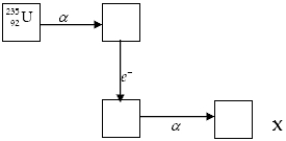
(Multiple Choice)
4.9/5 (73)
(73) One of the naturally occurring radioactive series begins with .Which of the following isotopes is the stable isotope at the end of this series?
(Multiple Choice)
4.8/5 (82)
(82) Find the number of nuclei per unit volume (n = nuclei/cm3)for lead. atomic weight = 202.7
Density = 11.5 g/cm3
Avogadro's number = 6.02 *1023
(Multiple Choice)
4.7/5 (78)
(78) When a nucleus at rest spontaneously splits into fragments of mass m1 and m2,the ratio of the velocity of m1 to the velocity of m2 is
(Multiple Choice)
4.8/5 (74)
(74) Approximately how much uranium (in kg)must undergo fission per day to provide 1 000 MW of power? (Assume an efficiency of 30%).The nuclear reaction is . m(n)= 1.008 665 u
M(U)= 235.043 915 u
M(Ba)= 140.913 9 u
M(Kr)= 91.897 3 u
U = 1.66 *10 - 27 kg
(Multiple Choice)
4.9/5 (72)
(72) Find the binding energy (in MeV)of carbon-12. Assume:
MC = 12.000 000 u
M p = 1.007 825 u
M n = 1.008 665 u
U = 1.66 *10 - 27 kg
(Multiple Choice)
4.9/5 (80)
(80) 
Filters
- Essay(0)
- Multiple Choice(0)
- Short Answer(0)
- True False(0)
- Matching(0)