



 Chat with AI
Exam 20: Mineral and Energy Resources

Exam 1: An Introduction to Geology and Plate Tectonics198 Questions
Exam 2: Minerals: The Building Blocks of Rocks185 Questions
Exam 3: Igneous Rocks190 Questions
Exam 4: Volcanoes and Volcanic Processes155 Questions
Exam 5: Weathering and Soil157 Questions
Exam 6: Sedimentary Rocks234 Questions
Exam 7: Metamorphism and Metamorphic Rocks143 Questions
Exam 8: Geologic Time143 Questions
Exam 9: Crustal Deformation145 Questions
Exam 10: Earthquakes and Earth's Interior185 Questions
Exam 11: The Ocean Floor172 Questions
Exam 12: Plate Tectonics: The Framework for Modern Geology162 Questions
Exam 13: Mountain Building and Continental Frameworks161 Questions
Exam 14: Mass Wasting: The Work of Gravity131 Questions
Exam 15: Running Water139 Questions
Exam 16: Groundwater159 Questions
Exam 17: Glaciers and Glaciation183 Questions
Exam 18: Deserts and Winds132 Questions
Exam 19: Shorelines153 Questions
Exam 20: Mineral and Energy Resources159 Questions
Select questions type


Hematite and magnetite are the dominant ore minerals in ________.
(Multiple Choice)
4.8/5  (78)
(78) Diamonds are mined from a rare ultramafic rock called ________.
(Multiple Choice)
4.9/5 (66)
(66) Chalcopyrite and bornite are sulphide ore minerals of ________.
(Short Answer)
4.8/5 (79)
(79) Typical of developed industrial nations, Canada consumes more non-metallic resources like aggregate, gypsum, potash, and sulfur than it does metals and metallic resources like copper, molybdenum, and gold.
(True/False)
4.8/5 (85)
(85) Lignite, known as brown coal, has a much higher energy content, and lower ash and sulphur content, than anthracite or bituminous coals which were predominantly used in the past.
(True/False)
4.7/5 (78)
(78) Where was the first commercial use of geothermal heat in Canada?
(Multiple Choice)
4.8/5 (77)
(77) Chemical and bacterial decomposition of ________ in mine tailings produces sulphuric acid that attacks other sulphide minerals, to releasing toxic levels of heavy metals to the surface environment, and seeps of contaminated water called acid mine drainage.
(Multiple Choice)
4.8/5 (72)
(72) Where of the following are wind turbines not common in Canada?
(Multiple Choice)
4.8/5 (83)
(83) In which tectonic setting did Pb and Zn deposits like the Sullivan mine, BC, form?
(Short Answer)
5.0/5 (77)
(77) Metamorphic deposits of ________ provide the carbon used in pencils and solid lubricant.
(Multiple Choice)
4.9/5 (81)
(81) Examine the words and/or phrases for each question below and determine the relationship among the majority of words/phrases.
-Choose the option that does not fit the pattern.
(Multiple Choice)
4.7/5 (82)
(82) The majority of coal currently mined in Canada comes from Mesozoic deposits in ________.
(Multiple Choice)
5.0/5 (64)
(64) Refer to the Canadian metallic deposits map (fig.20.4)to answer the question(s)below.
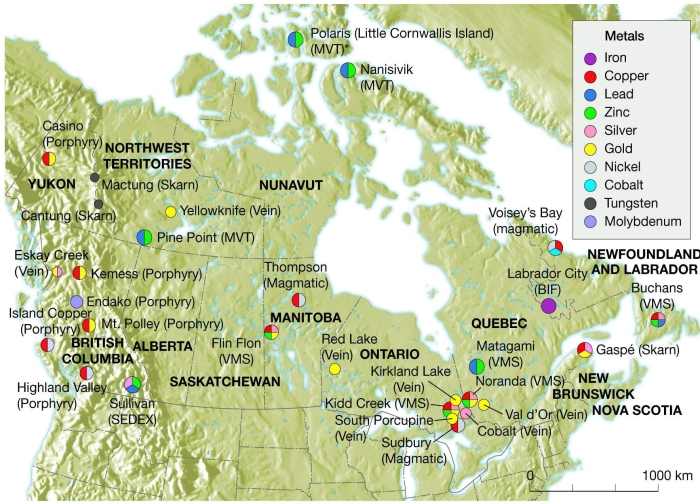 -Put a square on the map surrounding any two deposits likely formed by contact metamorphism.
 (Short Answer)
4.7/5 (77)
(77) Examine the words and/or phrases for each question below and determine the relationship among the majority of words/phrases.
-Choose the option that does not fit the pattern.
(Multiple Choice)
4.9/5 (91)
(91) What is the principal compositional difference between wet gas and dry gas, and what is the difference in environmental conditions that controls their formation?
(Essay)
4.9/5 (65)
(65) Examine the words and/or phrases for each question below and determine the relationship among the majority of words/phrases.
-Choose the option that does not fit the pattern.
(Multiple Choice)
4.8/5 (84)
(84) Heavy oil sand deposits are actually broken up shale beds impregnated with viscous, crude oil.
(True/False)
4.9/5 (80)
(80) 
Filters
- Essay(0)
- Multiple Choice(0)
- Short Answer(0)
- True False(0)
- Matching(0)