



 Chat with AI
Exam 19: Shorelines

Exam 1: An Introduction to Geology and Plate Tectonics198 Questions
Exam 2: Minerals: The Building Blocks of Rocks185 Questions
Exam 3: Igneous Rocks190 Questions
Exam 4: Volcanoes and Volcanic Processes155 Questions
Exam 5: Weathering and Soil157 Questions
Exam 6: Sedimentary Rocks234 Questions
Exam 7: Metamorphism and Metamorphic Rocks143 Questions
Exam 8: Geologic Time143 Questions
Exam 9: Crustal Deformation145 Questions
Exam 10: Earthquakes and Earth's Interior185 Questions
Exam 11: The Ocean Floor172 Questions
Exam 12: Plate Tectonics: The Framework for Modern Geology162 Questions
Exam 13: Mountain Building and Continental Frameworks161 Questions
Exam 14: Mass Wasting: The Work of Gravity131 Questions
Exam 15: Running Water139 Questions
Exam 16: Groundwater159 Questions
Exam 17: Glaciers and Glaciation183 Questions
Exam 18: Deserts and Winds132 Questions
Exam 19: Shorelines153 Questions
Exam 20: Mineral and Energy Resources159 Questions
Select questions type


________ form when waves that approach the beach at an angle and produce a net current direction that is parallel to the shore, resulting in beach drift.
(Multiple Choice)
4.7/5  (71)
(71) Which one of the following is not directly related to wave refraction?
(Multiple Choice)
4.8/5 (71)
(71) Wave-cut cliffs and wave-cut platforms are good evidence for an erosional coastline.
(True/False)
4.8/5 (87)
(87) Rocks are directly shattered by the crashing weight of the breaking waves themselves.
(True/False)
4.8/5 (74)
(74) A natural sand bar or sand/gravel ridge exposed at low tide that connects one island to another island, or an island to the mainland, is called a ________.
(Multiple Choice)
5.0/5 (68)
(68) Defined by breaking waves in the surf zone, which two terms describe the directions of water movement associated with a wave breaking on the beach?
(Short Answer)
4.8/5 (81)
(81) Sea level has been slowly rising since the large Pleistocene ice sheets melted away.
(True/False)
5.0/5 (93)
(93) A ________ is a structure built parallel to the shoreline to dissipate much of the energy from incoming waves.
(Short Answer)
5.0/5 (76)
(76) A ________ is a manmade structure, extending at right angles to the beach, built to trap sand moving parallel to the beach.
(Short Answer)
4.9/5 (75)
(75) Building protective structures to halt a receding shoreline benefits only a few stakeholders and seriously degrades or destroys natural beaches.
(True/False)
4.9/5 (86)
(86) Carefully examine the illustration below.
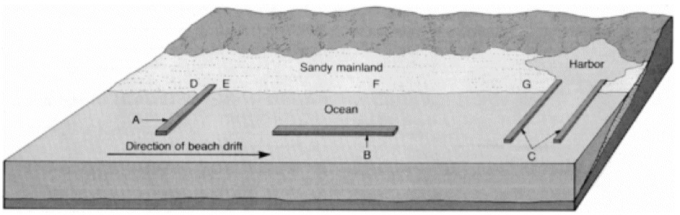 a)What name is given to walls like the wall above that is labeled A? ______________________________
b)What name is given to walls like the wall above that is labeled B? ______________________________
c)What name is given to walls like the wall above that is labeled C? ______________________________
In the future, what will eventually happen to the beach at the following locations?
d)Location D ___________________________________________________________
e)Location E ____________________________________________________________
f)Location F ____________________________________________________________
g)Location G ____________________________________________________________
a)What name is given to walls like the wall above that is labeled A? ______________________________
b)What name is given to walls like the wall above that is labeled B? ______________________________
c)What name is given to walls like the wall above that is labeled C? ______________________________
In the future, what will eventually happen to the beach at the following locations?
d)Location D ___________________________________________________________
e)Location E ____________________________________________________________
f)Location F ____________________________________________________________
g)Location G ____________________________________________________________ (Short Answer)
4.7/5 (68)
(68) A ________ is a shoreline stabilization feature that protects shorelines from the pounding of waves by creating an area of quiet water behind it.
(Multiple Choice)
4.9/5 (87)
(87) As a deep-water wave enters shallow water, the wave slows down and rotates toward being parallel with the shoreline.This process is known as ________.
(Short Answer)
4.7/5 (79)
(79) What is the path followed by a sand grain from a succession of waves impinging obliquely onto a beach?
(Multiple Choice)
5.0/5 (63)
(63) 
Filters
- Essay(0)
- Multiple Choice(0)
- Short Answer(0)
- True False(0)
- Matching(0)