



 Chat with AI
Exam 17: Glaciers and Glaciation

Exam 1: An Introduction to Geology and Plate Tectonics198 Questions
Exam 2: Minerals: The Building Blocks of Rocks185 Questions
Exam 3: Igneous Rocks190 Questions
Exam 4: Volcanoes and Volcanic Processes155 Questions
Exam 5: Weathering and Soil157 Questions
Exam 6: Sedimentary Rocks234 Questions
Exam 7: Metamorphism and Metamorphic Rocks143 Questions
Exam 8: Geologic Time143 Questions
Exam 9: Crustal Deformation145 Questions
Exam 10: Earthquakes and Earth's Interior185 Questions
Exam 11: The Ocean Floor172 Questions
Exam 12: Plate Tectonics: The Framework for Modern Geology162 Questions
Exam 13: Mountain Building and Continental Frameworks161 Questions
Exam 14: Mass Wasting: The Work of Gravity131 Questions
Exam 15: Running Water139 Questions
Exam 16: Groundwater159 Questions
Exam 17: Glaciers and Glaciation183 Questions
Exam 18: Deserts and Winds132 Questions
Exam 19: Shorelines153 Questions
Exam 20: Mineral and Energy Resources159 Questions
Select questions type


All unconsolidated glacial sediments irrespective of grain size, sorting, or depositional process are referred to as till.
(True/False)
4.9/5  (76)
(76) Would most features of alpine glaciation be preserved in the geologic record? Why or why not? What about continental glaciation?
(Essay)
4.7/5 (83)
(83) Rock flour consists of silt-sized rock and mineral particles produced by glacial abrasion.
(True/False)
4.8/5 (80)
(80) Briefly describe how glaciers and ice ages relate to two global cycles.
(Essay)
4.9/5 (75)
(75) Sand and gravel deposited by glacial meltwater streams are known as outwash till or stratified till.
(True/False)
4.7/5 (76)
(76) Lake Winnipeg in Manitoba is the shrunken remnant of glacial Lake Agassiz which used to be the largest Pleistocene lake in North America.
(True/False)
4.8/5 (83)
(83) An ice carved, asymmetrical bedrock knob with the steep side downhill is called a ________.
(Multiple Choice)
4.9/5 (73)
(73) Headward erosion by alpine glaciers on two sides of a mountain ridge can remove enough rock to intersect forming a pass called a ________.
(Multiple Choice)
4.7/5 (75)
(75) Valleys deeply eroded by alpine glaciers have what characteristic, cross-valley profile?
(Short Answer)
4.9/5 (84)
(84) What term describes open fissures in the brittle, surface ice of a glacier?
(Short Answer)
4.8/5 (88)
(88) Which one of the following statements concerning glacial deposits is false?
(Multiple Choice)
5.0/5 (63)
(63) The focal point of a valley glacier's growth is a bowl shaped depression called a ________.
(Multiple Choice)
4.8/5 (75)
(75) Match the features on the illustration below to the correct answer for each one.
A.kame
B.outwash plain
C.esker
D.end moraine
E.drumlin
F.kettle
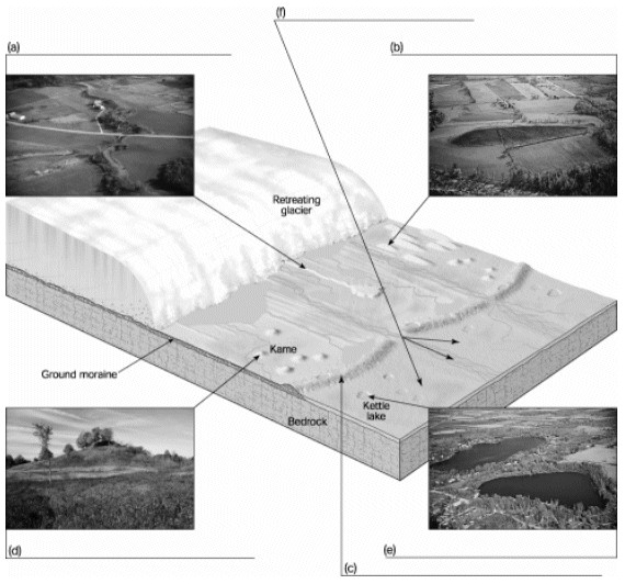
(Short Answer)
4.9/5 (79)
(79) Which of the following is the correct listing of the classical North American glacial stages from oldest to youngest?
(Multiple Choice)
4.9/5 (73)
(73) The ________ is not the name of a Pleistocene glacial episode in North America.
(Multiple Choice)
5.0/5 (76)
(76) Eskers and kames are associated with meltwater streams; they are composed of stratified sand and gravel.
(True/False)
4.8/5 (80)
(80) The big quartzite rock sitting on the prairie at Okotoks, Alberta, and similar, smaller blocks strung out over 600 kilometres from their eroded bedrock source near Mt.Edith Cavell in Jasper National Park, make up ________.
(Multiple Choice)
4.9/5 (77)
(77) Compared to earlier or subsequent streams in the same valleys, alpine glaciers move ________ but carry ________ sediment.
(Multiple Choice)
4.9/5 (79)
(79) What are two problems with Paul Hoffman's "Snowball Earth Hypothesis"?
(Essay)
4.8/5 (81)
(81) 
Filters
- Essay(0)
- Multiple Choice(0)
- Short Answer(0)
- True False(0)
- Matching(0)