



 Chat with AI
Exam 28: Electromagnetic Induction

Exam 1: Units, Physical Quantities, and Vectors107 Questions
Exam 2: Motion Along a Straight Line59 Questions
Exam 3: Motion in Two or Three Dimensions50 Questions
Exam 4: Newtons Laws of Motion44 Questions
Exam 5: Applying Newtons Laws95 Questions
Exam 6: Work and Kinetic Energy54 Questions
Exam 7: Potential Energy and Energy Conservation55 Questions
Exam 8: Momentum, Impulse, and Collisions50 Questions
Exam 9: Rotation of Rigid Bodies26 Questions
Exam 10: Equilibrium and Elasticity50 Questions
Exam 11: Fluid Mechanics50 Questions
Exam 12: Gravitation50 Questions
Exam 13: Periodic Motion50 Questions
Exam 14: Mechanical Waves44 Questions
Exam 15: Sound and Hearing66 Questions
Exam 16: Temperature and Heat63 Questions
Exam 17: Thermal Properties of Matter58 Questions
Exam 18: The First Law of Thermodynamics52 Questions
Exam 19: The Second Law of Thermodynamics50 Questions
Exam 20: Electric Charge and Electric Field58 Questions
Exam 21: Gausss Law41 Questions
Exam 22: Electric Potential55 Questions
Exam 23: Capacitance and Dielectrics52 Questions
Exam 24: Current, Resistance, and Electromotive Force50 Questions
Exam 25: Direct-Current Circuits53 Questions
Exam 26: Magnetic Field and Magnetic Forces36 Questions
Exam 27: Sources of Magnetic Field51 Questions
Exam 28: Electromagnetic Induction39 Questions
Exam 29: Inductance26 Questions
Exam 30: Alternating Current49 Questions
Exam 31: Electromagnetic Waves47 Questions
Exam 32: The Nature and Propagation of Light28 Questions
Exam 33: Geometric Optics81 Questions
Exam 34: Interference33 Questions
Exam 35: Diffraction49 Questions
Exam 36: Relativity51 Questions
Exam 37: Photons: Light Waves Behaving As Particles38 Questions
Exam 38: Particles Behaving As Waves52 Questions
Exam 39: Quantum Mechanics40 Questions
Exam 40: Atomic Structure41 Questions
Exam 41: Molecules and Condensed Matter31 Questions
Exam 42: Nuclear Physics89 Questions
Exam 43: Particle Physics and Cosmology44 Questions
Select questions type


A closed loop conductor that forms a circle with a radius of 2.0 m is located in a uniform but changing magnetic field. If the maximum emf induced in the loop is 5.0 V, what is the maximum rate at which the magnetic field strength is changing if the magnetic field is oriented perpendicular to the plane in which the loop lies?
(Multiple Choice)
4.7/5  (88)
(88) In the figure, two parallel wires carry currents of magnitude I in opposite directions. A rectangular loop is midway between the wires. The current I is decreasing with time. The induced current through the resistor R is 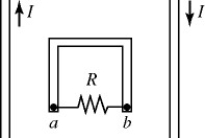
(Multiple Choice)
4.9/5 (73)
(73) The three loops of wire shown in the figure are all subject to the same uniform magnetic field  that does not vary with time. Loop 1 oscillates back and forth as the bob in a pendulum, loop 2 rotates about a vertical axis, and loop 3 oscillates up and down at the end of a spring. Which loop, or loops, will have an emf induced in them?
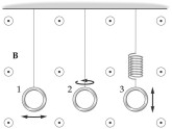
that does not vary with time. Loop 1 oscillates back and forth as the bob in a pendulum, loop 2 rotates about a vertical axis, and loop 3 oscillates up and down at the end of a spring. Which loop, or loops, will have an emf induced in them? (Multiple Choice)
4.9/5 (93)
(93) A circular loop of wire lies in the plane of the paper. An increasing magnetic field points out of the paper. What is the direction of the induced current in the loop?
(Multiple Choice)
5.0/5 (66)
(66) A rectangular coil having N turns and measuring 15 cm by 25 cm is rotating in a uniform 1.6-T magnetic field with a frequency of 75 Hz. The rotation axis is perpendicular to the direction of the field. If the coil develops a sinusoidal emf of maximum value 56.9 V, what is the value of N?
(Multiple Choice)
4.9/5 (87)
(87) A circular coil of radius 5.0 cm and resistance 0.20 Ω is placed in a uniform magnetic field perpendicular to the plane of the coil. The magnitude of the field changes with time according to B = 0.50e-20t T. What is the magnitude of the current induced in the coil at the time t = 2.0 s?
(Multiple Choice)
4.8/5 (82)
(82) The figure shows a bar magnet moving vertically upward toward a horizontal coil. The poles of the bar magnets are labeled X and Y. As the bar magnet approaches the coil it induces an electric current in the direction indicated on the figure (counter-clockwise as viewed from above). What are the correct polarities of the magnet? 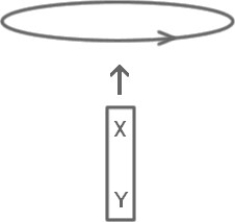
(Multiple Choice)
4.8/5 (61)
(61) A circular metal ring is situated above a long straight wire, as shown in the figure. The straight wire has a current flowing to the right, and the current is increasing in time at a constant rate. Which statement is true? 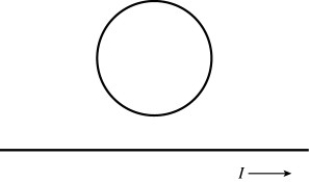
(Multiple Choice)
4.7/5 (84)
(84) A conducting bar slides without friction on two parallel horizontal rails that are 50 cm apart and connected by a wire at one end. The resistance of the bar and the rails is constant and equal to 0.10 Ω. A uniform magnetic field is perpendicular to the plane of the rails. A 0.080-N force parallel to the rails is required to keep the bar moving at a constant speed of 0.50 m/s. What is the magnitude of the magnetic field?
(Multiple Choice)
4.9/5 (73)
(73) The long straight wire in the figure carries a current I that is decreasing with time at a constant rate. The circular loops A, B, and C all lie in a plane containing the wire. The induced emf in each of the loops A, B, and C is such that 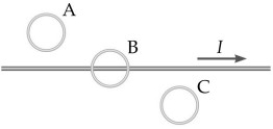
(Multiple Choice)
4.9/5 (72)
(72) A bar magnet is held vertically with its upper end a little bit below the center of a horizontal metal ring. The upper end of the magnet is its north pole, as shown in the figure. The bar magnet is now dropped. An observer views the ring from above its center. To this observer, how will the induced current in the ring behave as the magnet falls? 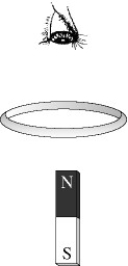
(Multiple Choice)
4.8/5 (88)
(88) A loop of radius r = 3.0 cm is placed parallel to the xy-plane in a uniform magnetic field  = 0.75 T
 ) The resistance of the loop is 18 Ω. Starting at t = 0, the magnitude of the field decreases uniformly to zero in 0.15 seconds. What is the magnitude of the electric current produced in the loop during that time?
= 0.75 T
) The resistance of the loop is 18 Ω. Starting at t = 0, the magnitude of the field decreases uniformly to zero in 0.15 seconds. What is the magnitude of the electric current produced in the loop during that time? (Multiple Choice)
4.9/5 (70)
(70) As shown in the figure, a wire and a 10-Ω resistor are used to form a circuit in the shape of a square, 20 cm by 20 cm. A uniform but nonsteady magnetic field is directed into the plane of the circuit. The magnitude of the magnetic field is decreased from 1.50 T to 0.50 T in a time interval of 63 ms. The average induced current and its direction through the resistor, in this time interval, are closest to 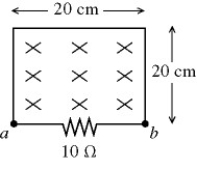
(Multiple Choice)
4.9/5 (82)
(82) Wire is wound on a square frame, 30 cm by 30 cm, to form a coil of 7 turns. The frame is mounted on a horizontal shaft through its center (perpendicular to the plane of the diagram), as shown in the figure. The coil is in clockwise rotation, with a period of 0.060 s. A uniform, horizontal, magnetic field of magnitude 0.40 T is present. At a given instant, the plane of the coil forms a 60° angle with the horizontal, as shown. At that instant, what is the magnitude of the emf induced in the coil? 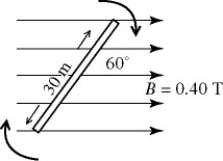
(Multiple Choice)
4.9/5 (81)
(81) A uniform magnetic field is applied perpendicular to the plane of a 60-turn circular coil with a radius of 6.0 cm and a resistance of 0.60 Ω. If the magnetic field increases uniformly from 0.20 T to 1.8 T in 0.20 s, what is the magnitude of the emf induced in the coil?
(Multiple Choice)
4.9/5 (77)
(77) A conducting bar moves along frictionless conducting rails connected to a 4.00-Ω resistor as shown in the figure. The length of the bar is 1.60 m and a uniform magnetic field of 2.20 T is applied perpendicular to the paper pointing outward, as shown.
(a) What is the applied force required to move the bar to the right with a constant speed of 6.00 m/s?
(b) At what rate is energy dissipated in the 4.00 Ω resistor? 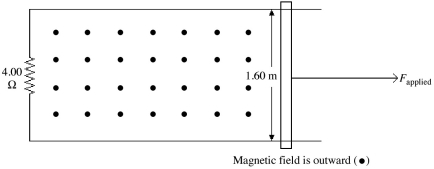
(Short Answer)
4.8/5 (83)
(83) In the figure, a straight wire carries a current I. The wire passes through the center of a toroidal coil. If the current in the wire is quickly reduced to zero, the induced current through the resistor R is 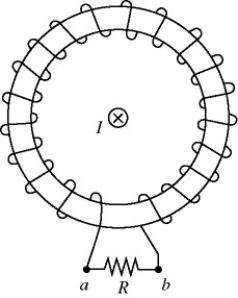
(Multiple Choice)
4.9/5 (87)
(87) Suppose that you wish to construct a simple ac generator having an output of 12 V maximum when rotated at 60 Hz. A uniform magnetic field of 0.050 T is available. If the area of the rotating coil is 100 cm2, how many turns do you need?
(Multiple Choice)
5.0/5 (75)
(75) A ten-loop coil having an area of 0.23 m2 and a very large resistance is in a 0.047-T uniform magnetic field oriented so that the maximum flux goes through the coil. The coil is then rotated so that the flux through it goes to zero in 0.34 s. What is the magnitude of the average emf induced in the coil during the 0.34 s?
(Multiple Choice)
4.9/5 (81)
(81) 
Filters
- Essay(0)
- Multiple Choice(0)
- Short Answer(0)
- True False(0)
- Matching(0)