



 Chat with AI
Exam 22: Electric Potential

Exam 1: Units, Physical Quantities, and Vectors107 Questions
Exam 2: Motion Along a Straight Line59 Questions
Exam 3: Motion in Two or Three Dimensions50 Questions
Exam 4: Newtons Laws of Motion44 Questions
Exam 5: Applying Newtons Laws95 Questions
Exam 6: Work and Kinetic Energy54 Questions
Exam 7: Potential Energy and Energy Conservation55 Questions
Exam 8: Momentum, Impulse, and Collisions50 Questions
Exam 9: Rotation of Rigid Bodies26 Questions
Exam 10: Equilibrium and Elasticity50 Questions
Exam 11: Fluid Mechanics50 Questions
Exam 12: Gravitation50 Questions
Exam 13: Periodic Motion50 Questions
Exam 14: Mechanical Waves44 Questions
Exam 15: Sound and Hearing66 Questions
Exam 16: Temperature and Heat63 Questions
Exam 17: Thermal Properties of Matter58 Questions
Exam 18: The First Law of Thermodynamics52 Questions
Exam 19: The Second Law of Thermodynamics50 Questions
Exam 20: Electric Charge and Electric Field58 Questions
Exam 21: Gausss Law41 Questions
Exam 22: Electric Potential55 Questions
Exam 23: Capacitance and Dielectrics52 Questions
Exam 24: Current, Resistance, and Electromotive Force50 Questions
Exam 25: Direct-Current Circuits53 Questions
Exam 26: Magnetic Field and Magnetic Forces36 Questions
Exam 27: Sources of Magnetic Field51 Questions
Exam 28: Electromagnetic Induction39 Questions
Exam 29: Inductance26 Questions
Exam 30: Alternating Current49 Questions
Exam 31: Electromagnetic Waves47 Questions
Exam 32: The Nature and Propagation of Light28 Questions
Exam 33: Geometric Optics81 Questions
Exam 34: Interference33 Questions
Exam 35: Diffraction49 Questions
Exam 36: Relativity51 Questions
Exam 37: Photons: Light Waves Behaving As Particles38 Questions
Exam 38: Particles Behaving As Waves52 Questions
Exam 39: Quantum Mechanics40 Questions
Exam 40: Atomic Structure41 Questions
Exam 41: Molecules and Condensed Matter31 Questions
Exam 42: Nuclear Physics89 Questions
Exam 43: Particle Physics and Cosmology44 Questions
Select questions type


Which statements are true for an electron moving in the direction of an electric field? (There may be more than one correct choice.)
(Multiple Choice)
4.9/5  (76)
(76) Two equal positive charges are held in place at a fixed distance. If you put a third positive charge midway between these two charges, its electrical potential energy of the system (relative to infinity) is zero because the electrical forces on the third charge due to the two fixed charges just balance each other.
(True/False)
4.8/5 (86)
(86) An extremely long thin wire carries a uniform linear charge density of 358 nC/m. Find the potential difference between points 5.0 m and 6.0 m from the wire, provided they are not near either end of the wire. (k = 1/4πε0 = 8.99 × 10⁹ N ∙ m2/C2)
(Multiple Choice)
4.8/5 (91)
(91) If the potential in a region is given by V(x,y,z) = xy - 3z-2, then the y component of the electric field in that region is
(Multiple Choice)
4.9/5 (78)
(78) Two positive point charges +4.00 μC and +2.00 μC are placed at the opposite corners of a rectangle as shown in the figure. (k = 1/4πε0 = 8.99 × 10⁹ N ∙ m2/C2) 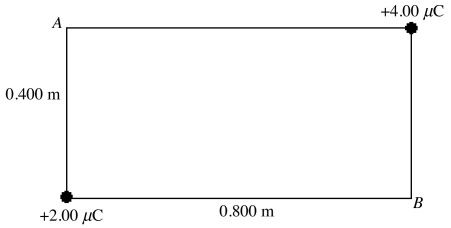 (a) What is the potential at point A (relative to infinity) due to these charges?
(b) What is the potential at point B (relative to infinity) due to these charges?
(a) What is the potential at point A (relative to infinity) due to these charges?
(b) What is the potential at point B (relative to infinity) due to these charges? (Short Answer)
4.7/5 (78)
(78) The potential as a function of position x is shown in the graph in the figure. Which statement about the electric field is true? 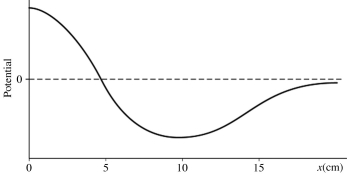
(Multiple Choice)
4.8/5 (79)
(79) A very small object carrying -6.0 μC of charge is attracted to a large, well-anchored, positively charged object. How much kinetic energy does the negatively charged object gain if the potential difference through which it moves is 3.0 mV? (k = 1/4πε0 = 8.99 × 10⁹ N ∙ m2/C2)
(Multiple Choice)
4.8/5 (83)
(83) An alpha particle is a nucleus of helium. It has twice the charge and four times the mass of the proton. When they were very far away from each other, but headed toward directly each other, a proton and an alpha particle each had an initial speed of 0.0030c, where c is the speed of light. What is their distance of closest approach? Hint: There are two conserved quantities. Make use of both of them. (c = 3.00 × 10⁸ m/s, k = 1/4πε0 = 8.99 × 10⁹ N ∙ m2/C2, e = 1.60 × 10⁻¹⁹ C, mproton = 1.67 x 10⁻²⁷ kg)
(Multiple Choice)
4.9/5 (90)
(90) If the electric potential at a point in space is zero, then the electric field at that point must also be zero.
(True/False)
4.8/5 (85)
(85) Two point charges of +2.0 μC and -6.0 μC are located on the x-axis at x = -1.0 cm and x = +2.0 cm respectively. Where should a third charge of +3.0-μC be placed on the +x-axis so that the potential at the origin is equal to zero? (k = 1/4πε0 = 8.99 × 10⁹ N ∙ m2/C2)
(Multiple Choice)
4.8/5 (81)
(81) A conducting sphere of radius R carries an excess positive charge and is very far from any other charges. Which one of the following graphs best illustrates the potential (relative to infinity) produced by this sphere as a function of the distance r from the center of the sphere?
(Multiple Choice)
4.8/5 (72)
(72) A conducting sphere of radius 20.0 cm carries an excess charge of +15.0 µC, and no other charges are present. (k = 1/4πε0 = 8.99 × 10⁹ N ∙ m2/C2) The potential (relative to infinity) due to this sphere at a point 12.0 cm from its center is closest to
(Multiple Choice)
4.9/5 (68)
(68) If the electrical potential in a region is constant, the electric field must be zero everywhere in that region.
(True/False)
4.7/5 (74)
(74) A conducting sphere contains positive charge distributed uniformly over its surface. Which statements about the potential due to this sphere are true? All potentials are measured relative to infinity. (There may be more than one correct choice.)
(Multiple Choice)
4.9/5 (83)
(83) A tiny object carrying a charge of +3.00 μC and a second tiny charged object are initially very far apart. If it takes 29.0 J of work to bring them to a final configuration in which the +3.00 μC object i is at x = 1.00 mm, y = 1.00 mm, and the other charged object is at x = 1.00 mm, y = 3.00 mm, find the magnitude of the charge on the second object. (k = 1/4πε0 = 8.99 × 10⁹ N ∙ m2/C2)
(Multiple Choice)
4.9/5 (77)
(77) 
Filters
- Essay(0)
- Multiple Choice(0)
- Short Answer(0)
- True False(0)
- Matching(0)