



 Chat with AI
Exam 21: Gausss Law

Exam 1: Units, Physical Quantities, and Vectors107 Questions
Exam 2: Motion Along a Straight Line59 Questions
Exam 3: Motion in Two or Three Dimensions50 Questions
Exam 4: Newtons Laws of Motion44 Questions
Exam 5: Applying Newtons Laws95 Questions
Exam 6: Work and Kinetic Energy54 Questions
Exam 7: Potential Energy and Energy Conservation55 Questions
Exam 8: Momentum, Impulse, and Collisions50 Questions
Exam 9: Rotation of Rigid Bodies26 Questions
Exam 10: Equilibrium and Elasticity50 Questions
Exam 11: Fluid Mechanics50 Questions
Exam 12: Gravitation50 Questions
Exam 13: Periodic Motion50 Questions
Exam 14: Mechanical Waves44 Questions
Exam 15: Sound and Hearing66 Questions
Exam 16: Temperature and Heat63 Questions
Exam 17: Thermal Properties of Matter58 Questions
Exam 18: The First Law of Thermodynamics52 Questions
Exam 19: The Second Law of Thermodynamics50 Questions
Exam 20: Electric Charge and Electric Field58 Questions
Exam 21: Gausss Law41 Questions
Exam 22: Electric Potential55 Questions
Exam 23: Capacitance and Dielectrics52 Questions
Exam 24: Current, Resistance, and Electromotive Force50 Questions
Exam 25: Direct-Current Circuits53 Questions
Exam 26: Magnetic Field and Magnetic Forces36 Questions
Exam 27: Sources of Magnetic Field51 Questions
Exam 28: Electromagnetic Induction39 Questions
Exam 29: Inductance26 Questions
Exam 30: Alternating Current49 Questions
Exam 31: Electromagnetic Waves47 Questions
Exam 32: The Nature and Propagation of Light28 Questions
Exam 33: Geometric Optics81 Questions
Exam 34: Interference33 Questions
Exam 35: Diffraction49 Questions
Exam 36: Relativity51 Questions
Exam 37: Photons: Light Waves Behaving As Particles38 Questions
Exam 38: Particles Behaving As Waves52 Questions
Exam 39: Quantum Mechanics40 Questions
Exam 40: Atomic Structure41 Questions
Exam 41: Molecules and Condensed Matter31 Questions
Exam 42: Nuclear Physics89 Questions
Exam 43: Particle Physics and Cosmology44 Questions
Select questions type


Four dipoles, each consisting of a +10-µC charge and a -10-µC charge, are located in the xy-plane with their centers 1.0 mm from the origin, as shown. A sphere passes through the dipoles, as shown in the figure. What is the electric flux through the sphere due to these dipoles? (ε0 = 8.85 × 10⁻¹² C2/N ∙ m2) 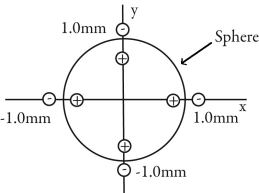
(Multiple Choice)
4.9/5  (68)
(68) Consider a spherical Gaussian surface of radius R centered at the origin. A charge Q is placed inside the sphere. To maximize the magnitude of the flux of the electric field through the Gaussian surface, the charge should be located
(Multiple Choice)
4.9/5 (79)
(79) If a rectangular area is rotated in a uniform electric field from the position where the maximum electric flux goes through it to an orientation where only half the flux goes through it, what has been the angle of rotation?
(Multiple Choice)
4.8/5 (74)
(74) A hollow conducting spherical shell has radii of 0.80 m and 1.20 m, as shown in the figure. The sphere carries a net excess charge of -500 nC. A point charge of +300 nC is present at the center. (k = 1/4πε0 = 8.99 × 10⁹ N ∙ m2/C) The radial component of the electric field at a point that is 0.60 m from the center is closest to 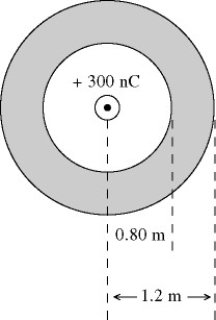
(Multiple Choice)
4.9/5 (89)
(89) A very large sheet of a conductor carries a uniform charge density of 4.00 pC/mm2 on its surfaces. What is the electric field strength 3.00 mm outside the surface of the conductor? (ε0 = 8.85 × 10⁻¹² C2/N ∙ m2)
(Multiple Choice)
4.9/5 (76)
(76) The cube of insulating material shown in the figure has one corner at the origin. Each side of the cube has length 0.080 m so the top face of the cube is parallel to the xz-plane and is at y = 0.080 m. It is observed that there is an electric field  that is in the +y direction and whose magnitude depends only on y. Use Gauss's law to calculate the net charge enclosed by the cube. (ε0 = 8.85 × 10⁻¹² C2/N ∙ m2)
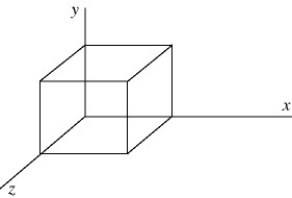
that is in the +y direction and whose magnitude depends only on y. Use Gauss's law to calculate the net charge enclosed by the cube. (ε0 = 8.85 × 10⁻¹² C2/N ∙ m2) (Short Answer)
5.0/5 (77)
(77) Two extremely large nonconducting horizontal sheets each carry uniform charge density on the surfaces facing each other. The upper sheet carries +5.00 µC/m2. The electric field midway between the sheets is 4.25 × 10⁵ N/C pointing downward. What is the surface charge density on the lower sheet? (ε0 = 8.85 × 10⁻¹² C2/N ∙ m2)
(Short Answer)
4.9/5 (84)
(84) The figure shows four Gaussian surfaces surrounding a distribtuion of charges. 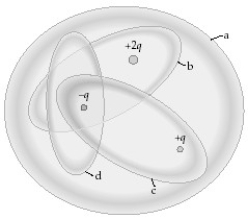 (a) Which Gaussian surfaces have an electric flux of +q/ε0 through them?
(b) Which Gaussian surfaces have no electric flux through them?
(a) Which Gaussian surfaces have an electric flux of +q/ε0 through them?
(b) Which Gaussian surfaces have no electric flux through them? (Short Answer)
5.0/5 (70)
(70) An uncharged conductor has a hollow cavity inside of it. Within this cavity there is a charge of +10 µC that does not touch the conductor. There are no other charges in the vicinity. Which statement about this conductor is true? (There may be more than one correct choice.)
(Multiple Choice)
5.0/5 (91)
(91) A nonuniform electric field is directed along the x-axis at all points in space. This magnitude of the field varies with x, but not with respect to y or z. The axis of a cylindrical surface, 0.80 m long and 0.20 m in diameter, is aligned parallel to the x-axis, as shown in the figure. The electric fields E1 and E2, at the ends of the cylindrical surface, have magnitudes of 9000 N/C and 5000 N/C respectively, and are directed as shown. (ε0 = 8.85 × 10⁻¹² C2/N ∙ m2) The charge enclosed by the cylindrical surface is closest to 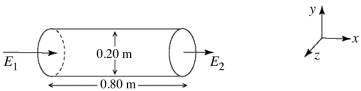
(Multiple Choice)
4.9/5 (88)
(88) An irregular conductor carries a surface charge density of -6.75 µC/m2 at and in the vicinity of a point P on the surface. An electron is released just above P outside the conductor. What are the magnitude and direction of its acceleration the instant after it is released? (ε0 = 8.85 × 10⁻¹² C2/N ∙ m2, e = 1.60 × 10⁻¹⁹ C, mel = 9.11 × 10⁻³¹ kg)
(Short Answer)
4.8/5 (78)
(78) A nonuniform electric field is directed along the x-axis at all points in space. This magnitude of the field varies with x, but not with respect to y or z. The axis of a cylindrical surface, 0.80 m long and 0.20 m in diameter, is aligned parallel to the x-axis, as shown in the figure. The electric fields E1 and E2, at the ends of the cylindrical surface, have magnitudes of 6000 N/C and 1000 N/C respectively, and are directed as shown. What is the net electric flux passing through the cylindrical surface? 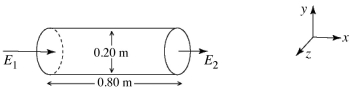
(Multiple Choice)
4.8/5 (77)
(77) If the electric flux through a closed surface is zero, the electric field at points on that surface must be zero.
(True/False)
4.8/5 (70)
(70) The cross section of a long coaxial cable is shown in the figure, with radii as given. The linear charge density on the inner conductor is -40 nC/m and the linear charge density on the outer conductor is -50 nC/m. The inner and outer cylindrical surfaces are respectively denoted by A, B, C, and D, as shown. (ε0 = 8.85 × 10⁻¹² C2/N ∙ m2) The magnitude of the electric field at a point that is 94 mm from the axis is closest to 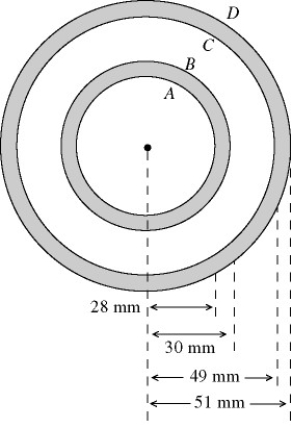
(Multiple Choice)
4.9/5 (87)
(87) As shown in the figure, a square insulating slab 5.0 mm thick measuring 2.0 m × 2.0 m has a charge of 8.0 × 10⁻¹¹ C distributed uniformly throughout its volume. Use Gauss's law to determine the electric field at point P, which is located within the slab beneath its center, 1.0 mm from one of the faces. (ε0 = 8.85 × 10⁻¹² C2/N ∙ m2) 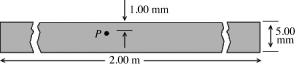
(Multiple Choice)
4.8/5 (93)
(93) A solid nonconducting sphere of radius R carries a uniform charge density throughout its volume. At a radial distance r1 = R/4 from the center, the electric field has a magnitude E0. What is the magnitude of the electric field at a radial distance r2 = 2R?
(Multiple Choice)
4.8/5 (70)
(70) A charge Q is uniformly spread over one surface of a very large nonconducting square elastic sheet having sides of length d. At a point P that is 1.25 cm outside the sheet, the magnitude of the electric field due to the sheet is E. If the sheet is now stretched so that its sides have length 2d, what is the magnitude of the electric field at P?
(Multiple Choice)
4.7/5 (79)
(79) An infinitely long nonconducting cylinder of radius R = 2.00 cm carries a uniform volume charge density of 18.0 μC/ m3. Calculate the electric field at distance r = 1.00 cm from the axis of the cylinder. (ε0 = 8.85 × 10⁻¹² C2/N ∙ m2)
(Multiple Choice)
4.8/5 (89)
(89) The cross section of a long coaxial cable is shown in the figure, with radii as given. The linear charge density on the inner conductor is -30 nC/m and the linear charge density on the outer conductor is -70 nC/m. The inner and outer cylindrical surfaces are respectively denoted by A, B, C, and D, as shown. (ε0 = 8.85 × 10⁻¹² C2/N ∙ m2) The radial component of the electric field at a point that 34 mm from the axis is closest to 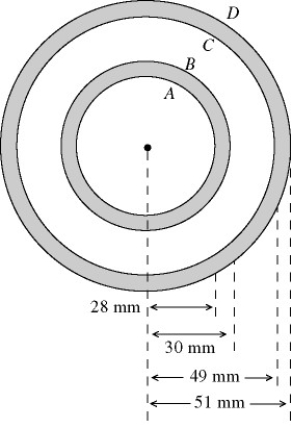
(Multiple Choice)
4.9/5 (73)
(73) Electric charge is uniformly distributed inside a nonconducting sphere of radius 0.30 m. The electric field at a point P, which is 0.50 m from the center of the sphere, is 15,000 N/C and is directed radially outward. What is the maximum magnitude of the electric field due to this sphere?
(Multiple Choice)
4.8/5 (88)
(88) 
Filters
- Essay(0)
- Multiple Choice(0)
- Short Answer(0)
- True False(0)
- Matching(0)