



 Chat with AI
Exam 20: Electric Charge and Electric Field

Exam 1: Units, Physical Quantities, and Vectors107 Questions
Exam 2: Motion Along a Straight Line59 Questions
Exam 3: Motion in Two or Three Dimensions50 Questions
Exam 4: Newtons Laws of Motion44 Questions
Exam 5: Applying Newtons Laws95 Questions
Exam 6: Work and Kinetic Energy54 Questions
Exam 7: Potential Energy and Energy Conservation55 Questions
Exam 8: Momentum, Impulse, and Collisions50 Questions
Exam 9: Rotation of Rigid Bodies26 Questions
Exam 10: Equilibrium and Elasticity50 Questions
Exam 11: Fluid Mechanics50 Questions
Exam 12: Gravitation50 Questions
Exam 13: Periodic Motion50 Questions
Exam 14: Mechanical Waves44 Questions
Exam 15: Sound and Hearing66 Questions
Exam 16: Temperature and Heat63 Questions
Exam 17: Thermal Properties of Matter58 Questions
Exam 18: The First Law of Thermodynamics52 Questions
Exam 19: The Second Law of Thermodynamics50 Questions
Exam 20: Electric Charge and Electric Field58 Questions
Exam 21: Gausss Law41 Questions
Exam 22: Electric Potential55 Questions
Exam 23: Capacitance and Dielectrics52 Questions
Exam 24: Current, Resistance, and Electromotive Force50 Questions
Exam 25: Direct-Current Circuits53 Questions
Exam 26: Magnetic Field and Magnetic Forces36 Questions
Exam 27: Sources of Magnetic Field51 Questions
Exam 28: Electromagnetic Induction39 Questions
Exam 29: Inductance26 Questions
Exam 30: Alternating Current49 Questions
Exam 31: Electromagnetic Waves47 Questions
Exam 32: The Nature and Propagation of Light28 Questions
Exam 33: Geometric Optics81 Questions
Exam 34: Interference33 Questions
Exam 35: Diffraction49 Questions
Exam 36: Relativity51 Questions
Exam 37: Photons: Light Waves Behaving As Particles38 Questions
Exam 38: Particles Behaving As Waves52 Questions
Exam 39: Quantum Mechanics40 Questions
Exam 40: Atomic Structure41 Questions
Exam 41: Molecules and Condensed Matter31 Questions
Exam 42: Nuclear Physics89 Questions
Exam 43: Particle Physics and Cosmology44 Questions
Select questions type


A metal sphere of radius 10 cm carries a charge of +2.0 μC uniformly distributed over its surface. What is the magnitude of the electric field due to this sphere at a point 5.0 cm outside the sphere's surface? (k = 1/4πε0 = 8.99 × 10⁹ N ∙ m2/C2)
(Multiple Choice)
4.8/5  (73)
(73) In the figure, all the charges are point charges and the charge in the middle is Q = -3.1 nC. For what charge q1 will charge q2 be in static equilibrium? 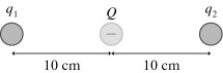
(Multiple Choice)
4.8/5 (69)
(69) In the figure, a small spherical insulator of mass 6.00 × 10⁻² kg and charge +0.400 μC is hung by a thin wire of negligible mass. A charge of -0.220 μC is held 0.290 m away from the sphere and directly to the right of it, so the wire makes an angle θ with the vertical, as shown. What is the angle θ? (k = 1/4πε0 = 8.99 × 10⁹ N ∙ m2/C2) 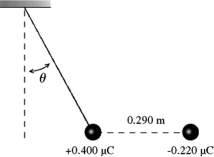
(Multiple Choice)
4.9/5 (89)
(89) A pair of charged conducting plates produces a uniform field of 12,000 N/C, directed to the right, between the plates. The separation of the plates is 40 mm. An electron is projected from plate A, directly toward plate B, with an initial velocity of vo = 2.0 × 10⁷ m/s, as shown in the figure. (e = 1.60 × 10⁻¹⁹ C, ε0 = 8.85 × 10⁻¹² C2/N ∙ m2, mel = 9.11 × 10⁻³¹ kg) The velocity of the electron as it strikes plate B is closest to 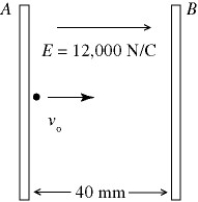
(Multiple Choice)
4.8/5 (76)
(76) Three equal negative point charges are placed at three of the corners of a square of side d as shown in the figure. Which of the arrows represents the direction of the net electric field at the center of the square? 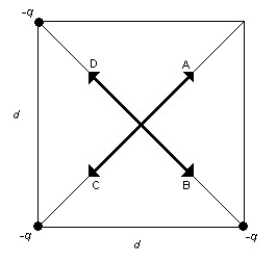
(Multiple Choice)
4.8/5 (81)
(81) When two point charges are 2.0 cm apart, each one experiences a 1.0-N electric force due to the other charge. If they are moved to a new separation of 8.0 cm, the electric force on each of them is closest to
(Multiple Choice)
4.8/5 (83)
(83) A 3.0-μC positive point charge is located at the origin and a 2.0-μC positive point charge is located at x = 0.00 m, y = 1.0 m. Find the coordinates of the point where the net electric field strength due to these charges is zero.
(Multiple Choice)
4.9/5 (62)
(62) Three +3.0-μC point charges are at the three corners of a square of side 0.50 m. The last corner is occupied by a -3.0-μC charge. Find the magnitude of the electric field at the center of the square. (k = 1/4πε0 = 8.99 × 10⁹ N ∙ m2/C2)
(Short Answer)
4.7/5 (70)
(70) Two large, flat, horizontally oriented plates are parallel to each other, a distance d apart. Half way between the two plates the electric field has magnitude E. If the separation of the plates is reduced to d/2 what is the magnitude of the electric field half way between the plates?
(Multiple Choice)
4.8/5 (82)
(82) A piece of plastic has a net charge of +2.00 μC. How many more protons than electrons does this piece of plastic have? (e = 1.60 × 10⁻¹⁹C)
(Multiple Choice)
4.9/5 (67)
(67) An electric dipole is made of two charges of equal magnitudes and opposite signs. The positive charge, q = 1.0 μC, is located at the point (x, y, z) = (0.00 cm, 1.0 cm, 0.00 cm), while the negative charge is located at the point (x, y, z) = (0.00 cm, -1.0 cm, 0.00 cm). How much work will be done by an electric field  = (3.0 × 10⁶ N/C) î to bring the dipole to its stable equilibrium position?
 (Multiple Choice)
5.0/5 (91)
(91) Two identical small charged spheres are a certain distance apart, and each one initially experiences an electrostatic force of magnitude F due to the other. With time, charge gradually leaks off of both spheres. When each of the spheres has lost half its initial charge, the magnitude of the electrostatic force will be
(Multiple Choice)
4.9/5 (76)
(76) A pair of charged conducting plates produces a uniform field of 12,000 N/C, directed to the right, between the plates. The separation of the plates is 40 mm. An electron is projected from plate A, directly toward plate B, with an initial velocity of v0 = 1.0 × 10⁷ m/s, as shown in the figure. (e = 1.60 × 10⁻¹⁹ C, ε0 = 8.85 × 10⁻¹² C2/N ∙ m2, mel = 9.11 × 10⁻³¹ kg) The distance of closest approach of the electron to plate B is nearest to 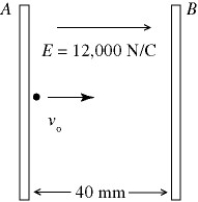
(Multiple Choice)
5.0/5 (89)
(89) A 5.0-μC point charge is placed at the 0.00 cm mark of a meter stick and a -4.0-μC point charge is placed at the 50 cm mark. At what point on a line joining the two charges is the electric field due to these charges equal to zero?
(Short Answer)
4.9/5 (75)
(75) A small sphere with a mass of 441 g is moving upward along the vertical +y-axis when it encounters an electric field of 5.00 N/C î. If, due to this field, the sphere suddenly acquires a horizontal acceleration of 13.0 m/s2 î, what is the charge that it carries?
(Multiple Choice)
4.9/5 (76)
(76) A point charge Q = -500 nC and two unknown point charges, q1 and q2, are placed as shown in the figure. The electric field at the origin O, due to charges Q, q1 and q2, is equal to zero. The charge q1 is closest to 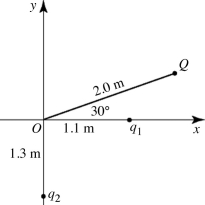
(Multiple Choice)
4.8/5 (79)
(79) Two very large, flat plates are parallel to each other. Plate A, located at y = 1.0 cm, is along the xz-plane and carries a uniform surface charge density -1.00 μC/m2. Plate B is located at y = -1.0 cm and carries a uniform surface charge density +2.00 μC/ m2. What is the electric field vector at the point having x, y, z coordinates (-0.50 cm, 0.00 cm, 0.00 cm)? (ε0 = 8.85 × 10⁻¹² C2/N ∙ m2)
(Multiple Choice)
4.8/5 (73)
(73) X and Y are two uncharged metal spheres on insulating stands, and are in contact with each other. A positively charged rod R is brought close to X as shown in Figure (a). 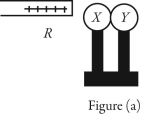 Sphere Y is now moved away from X, as in Figure (b).
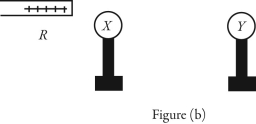 What are the final charge states of X and Y?
Sphere Y is now moved away from X, as in Figure (b).
What are the final charge states of X and Y? (Multiple Choice)
4.9/5 (80)
(80) 
Filters
- Essay(0)
- Multiple Choice(0)
- Short Answer(0)
- True False(0)
- Matching(0)