



 Chat with AI
Exam 19: The Second Law of Thermodynamics

Exam 1: Units, Physical Quantities, and Vectors107 Questions
Exam 2: Motion Along a Straight Line59 Questions
Exam 3: Motion in Two or Three Dimensions50 Questions
Exam 4: Newtons Laws of Motion44 Questions
Exam 5: Applying Newtons Laws95 Questions
Exam 6: Work and Kinetic Energy54 Questions
Exam 7: Potential Energy and Energy Conservation55 Questions
Exam 8: Momentum, Impulse, and Collisions50 Questions
Exam 9: Rotation of Rigid Bodies26 Questions
Exam 10: Equilibrium and Elasticity50 Questions
Exam 11: Fluid Mechanics50 Questions
Exam 12: Gravitation50 Questions
Exam 13: Periodic Motion50 Questions
Exam 14: Mechanical Waves44 Questions
Exam 15: Sound and Hearing66 Questions
Exam 16: Temperature and Heat63 Questions
Exam 17: Thermal Properties of Matter58 Questions
Exam 18: The First Law of Thermodynamics52 Questions
Exam 19: The Second Law of Thermodynamics50 Questions
Exam 20: Electric Charge and Electric Field58 Questions
Exam 21: Gausss Law41 Questions
Exam 22: Electric Potential55 Questions
Exam 23: Capacitance and Dielectrics52 Questions
Exam 24: Current, Resistance, and Electromotive Force50 Questions
Exam 25: Direct-Current Circuits53 Questions
Exam 26: Magnetic Field and Magnetic Forces36 Questions
Exam 27: Sources of Magnetic Field51 Questions
Exam 28: Electromagnetic Induction39 Questions
Exam 29: Inductance26 Questions
Exam 30: Alternating Current49 Questions
Exam 31: Electromagnetic Waves47 Questions
Exam 32: The Nature and Propagation of Light28 Questions
Exam 33: Geometric Optics81 Questions
Exam 34: Interference33 Questions
Exam 35: Diffraction49 Questions
Exam 36: Relativity51 Questions
Exam 37: Photons: Light Waves Behaving As Particles38 Questions
Exam 38: Particles Behaving As Waves52 Questions
Exam 39: Quantum Mechanics40 Questions
Exam 40: Atomic Structure41 Questions
Exam 41: Molecules and Condensed Matter31 Questions
Exam 42: Nuclear Physics89 Questions
Exam 43: Particle Physics and Cosmology44 Questions
Select questions type


You want to design an ideal Carnot heat engine that wastes only 35.0% of the heat that goes into it. The lowest cold-reservoir temperature available to you is +15.0°C. If 150.0 J of work is done per cycle, the heat input per cycle is closest to
(Multiple Choice)
4.9/5  (76)
(76) An automobile engine takes in 4000 J of heat and performs 1100 J of mechanical work in each cycle.
(a) Calculate the engine's efficiency.
(b) How much heat is "wasted" in each cycle?
(Short Answer)
4.9/5 (79)
(79) One of the most efficient engines built so far has the following characteristics:
combustion chamber temperature = 1900°C
exhaust temperature = 430°C
7.0 × 10⁹ cal of fuel produces 1.4 × 10¹⁰ J of work in one hour, where 1 cal = 4.19 J
(a) What is the actual efficiency of this engine?
(b) What is the Carnot efficiency of the engine?
(c) What is the power output of this engine?
(Short Answer)
4.9/5 (78)
(78) A Carnot engine operates between reservoirs at 550K and 300K, discarding 1500 J of heat in each cycle.
(a) What is the engine's efficiency?
(b) How much heat is supplied to the engine by the hot reservoir in each cycle?
(Short Answer)
4.8/5 (73)
(73) During each cycle of operation, a refrigerator absorbs 230 J of heat from the freezer and expels 356 J of heat to the room. How much work input is required in each cycle?
(Multiple Choice)
4.9/5 (80)
(80) A 2.00-kg block of ice at 0.00°C is dropped into a very large lake at 25.0°C and completely melts. For water, the heat of fusion is 3.35 × 10⁵ J/kg, the heat of vaporization is 2.25 × 10⁵ J/kg, and the specific heat is 4190 J/kg∙K. The net change in entropy of the system consisting of the ice and the lake due to this melting process is closest to
(Multiple Choice)
5.0/5 (67)
(67) An air conditioner with a coefficient of performance of 3.5 uses 30 kW of power. How much power is it discharging to the outdoors?
(Multiple Choice)
4.7/5 (90)
(90) An ideal reversible refrigerator keeps its inside compartment at 9.0°C. What is the high temperature, Th, needed to give this refrigerator a coefficient of performance of 3.7?
(Multiple Choice)
4.8/5 (83)
(83) A refrigerator removes heat from the freezing compartment at the rate of 20 kJ and ejects 24 kJ into a room per cycle. How much work is required in each cycle?
(Multiple Choice)
4.9/5 (80)
(80) A perfect Carnot engine operates between the temperatures of 300K and 700K, drawing 60 kJ of heat from the 700K reservoir in each cycle. How much heat is dumped into the 300K reservoir in each cycle?
(Multiple Choice)
4.8/5 (78)
(78) The compressor in a certain Carnot refrigerator performs 480 J of work to remove 150 J of heat from the interior of the refrigerator. How much heat must the coils behind the refrigerator discharge into the kitchen?
(Multiple Choice)
4.9/5 (81)
(81) What is the change in entropy of 10.0 moles of ideal monatomic gas that reversibly undergoes the isothermal expansion shown in the figure? The ideal gas constant is R = 8.314 J/(mol∙K). 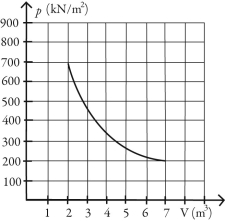
(Multiple Choice)
5.0/5 (76)
(76) A 2.0-kg block of aluminum at 50°C is dropped into 5.0 kg of water at 20°C and the temperature is allowed to stabilize. What is the total change in entropy during this process, assuming no heat is exchanged with the environment? The specific heat of aluminum is 910 J/(kg∙K) and the specific heat of water is 4190 J/(kg∙K).
(Multiple Choice)
4.9/5 (75)
(75) A nuclear fission power plant has an actual efficiency of 39%. If 0.25 MW of power are produced by the nuclear fission, how much electric power does the power plant output?
(Multiple Choice)
4.8/5 (83)
(83) A 610-g quantity of an ideal gas undergoes a reversible isothermal compression at a temperature of 330 K. The compression reduces the volume of the gas from 0.40 m3 initially, to 0.21 m3 finally. The molecular mass of the gas is 33.0 g/mol, and the ideal gas constant is R = 8.314 J/(mol∙K). The entropy change for the gas is closest to
(Multiple Choice)
4.7/5 (74)
(74) A brass rod, 75.0 cm long and having a cross-sectional area of 2.50 cm2, conducts heat from a large furnace at 375°C into a very large cold water bath at 10.0°C without losing any heat at the lateral surface of the rod. Steady state has been established, and the thermal conductivity of brass is 109 W/m∙K. The rate at which the entropy of the system (furnace plus water) is changing is closest to
(Multiple Choice)
4.8/5 (88)
(88) A Carnot engine is operated as a heat pump to heat a room in the winter. The heat pump delivers heat to the room at the rate of 34 kJ per second and maintains the room at a temperature of 293 K when the outside temperature is 229 K. The power requirement for the heat pump under these operating conditions is closest to
(Multiple Choice)
5.0/5 (86)
(86) A heat engine with an efficiency of 30.0% performs 2500 J of work. How much heat is discharged to the lower temperature reservoir?
(Multiple Choice)
4.8/5 (83)
(83) A real (non-Carnot) heat engine, operating between heat reservoirs at temperatures of 650 K and 270 K, performs 4.3 kJ of net work and rejects 8.0 kJ of heat in a single cycle. The thermal efficiency of this heat engine is closest to
(Multiple Choice)
4.9/5 (76)
(76) A hot piece of iron is thrown into the ocean and its temperature eventually stabilizes. Which of the following statements concerning this process is correct? (There may be more than one correct choice.)
(Multiple Choice)
4.8/5 (82)
(82) 
Filters
- Essay(0)
- Multiple Choice(0)
- Short Answer(0)
- True False(0)
- Matching(0)