



 Chat with AI
Exam 3: Matrices

Exam 1: Linear Equations and Functions245 Questions
Exam 2: Quadratic and Other Special Functions120 Questions
Exam 3: Matrices230 Questions
Exam 4: Inequalities and Linear Programming119 Questions
Exam 5: Exponential and Logarithmic Functions109 Questions
Exam 6: Mathematics of Finance131 Questions
Exam 7: Introduction to Probability180 Questions
Exam 8: Further Topics in Probability and Data Description114 Questions
Exam 9: Derivatives249 Questions
Exam 10: Derivatives172 Questions
Exam 11: Derivatives Continued139 Questions
Exam 12: Indefinite Integrals120 Questions
Exam 13: Definite Integrals - Techniques370 Questions
Exam 13: A: Definite Integrals - Techniques370 Questions
Exam 14: Functions of Two or More Variables122 Questions
Exam 15: Algebraic Concepts 240 Questions
Exam 15: Algebraic Concepts 374 Questions
Exam 15: Algebraic Concepts 496 Questions
Exam 15: Algebraic Concepts 599 Questions
Select questions type


Use inverse matrices to solve the system of linear equations. 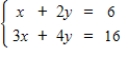
(Multiple Choice)
4.8/5  (87)
(87) Suppose that a government study showed that 80% of urban families remained in an urban area in the next generation (and 20% moved to a rural area), whereas 70% of rural families remained in a rural area in the next generation (and 30% moved to an urban area). This means that if  represents the current percents of urban families u0 and of rural families r0, then
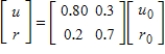 represents the percents of urban families u and rural families r one generation from now. Currently the population is 70% urban and 30% rural. Find the percents in each group one generation before this one.
represents the current percents of urban families u0 and of rural families r0, then represents the percents of urban families u and rural families r one generation from now. Currently the population is 70% urban and 30% rural. Find the percents in each group one generation before this one. (Multiple Choice)
4.8/5 (91)
(91) Suppose the development department of a firm charges 10% of its total monthly costs to the promotional department, and the promotional department charges 5% of its total monthly costs to the development department. The direct costs of the development department are $25,400, and the direct costs of the promotional department are $9,400. The solution to the matrix equation 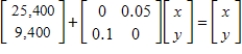 or the column matrix
 gives the total costs for each department. Note that this equation can be written in the form
 or
 , which is the form for an open economy. Find the total costs for each department in this (micro)economy.
or the column matrix gives the total costs for each department. Note that this equation can be written in the form or , which is the form for an open economy. Find the total costs for each department in this (micro)economy. (Multiple Choice)
4.9/5 (88)
(88) Suppose the technology matrix for a closed model of a simple economy is given by 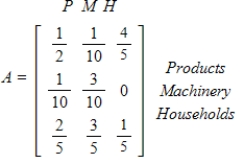
Find the gross productions for the industries.
Find the gross productions for the industries.
(Multiple Choice)
4.8/5 (72)
(72) 
Use the following matrices to perform the indicated matrix operations, if possible. 

(Multiple Choice)
4.9/5 (71)
(71) A psychologist studying the effects of nutrition on the behavior of laboratory rats is feeding one group a combination of three foods: I, II, and III. Each of these foods contains three additives, A, B, and C, that are being used in the study. Each additive is a certain percentage of each of the foods as follows:
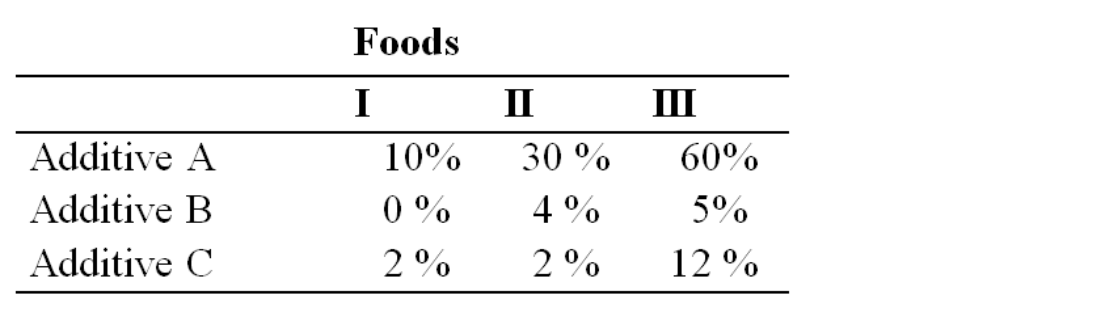
If the diet requires 53 g per day of A,
 g per day of B, and
 g per day of C, find the number of grams per day of each food that must be used.
If the diet requires 53 g per day of A, g per day of B, and g per day of C, find the number of grams per day of each food that must be used. (Multiple Choice)
4.8/5 (73)
(73) The following tables give the capital expenditures and gross operating costs of manufacturing establishments for pollution abatement, in millions of dollars. Use a calculator or spreadsheet to find the sum of the matrices containing these data. This will yield the total costs of manufacturing establishments for air, water, and solid contained waste pollution abatement for the years 2002-2005.


(Multiple Choice)
4.8/5 (78)
(78) Use inverse matrices and the graphing calculator to find the solution of the system of equations. 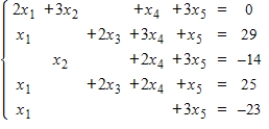
(Multiple Choice)
4.8/5 (102)
(102) The given matrix is an augmented matrix representing a system of linear equations. Find the solution of the system. 
(Multiple Choice)
4.9/5 (79)
(79) 
If the code matrix is  , find the matrix that can be used to decode the message 47, 36, 35, 28, 92, 69, 63, 93, 74, 56, 71, 57, 17, 17, 16. (Because A and A-1 are 3 × 3 matrices, use triples of numbers.)
 (Multiple Choice)
4.8/5 (91)
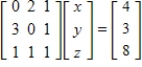
(91) 
Suppose the economy of an underdeveloped country has an agricultural industry and an oil industry, with technology matrix A. 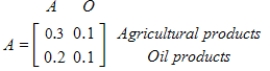
If surpluses of 0 units of agricultural products and 610 units of oil products are desired, find the gross production of each industry to the nearest unit.
If surpluses of 0 units of agricultural products and 610 units of oil products are desired, find the gross production of each industry to the nearest unit.
(Multiple Choice)
4.8/5 (68)
(68)  .

The following technology matrix describes the relationship of certain industries within the economy to each other. (A&F, agriculture and food; RM, raw materials; M, manufacturing; F, fuels industry; U, utilities; SI, service industries) 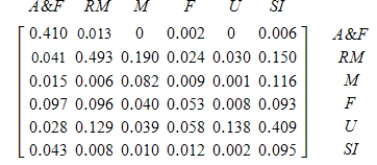
For each 1,000 units of raw materials produced, how many units of agricultural and food products were required?
For each 1,000 units of raw materials produced, how many units of agricultural and food products were required?
(Multiple Choice)
4.9/5 (64)
(64) Use technology to solve the system of equations, if a solution exists. 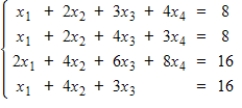
(Multiple Choice)
4.8/5 (81)
(81) The inverse of matrix A is given. Use the inverse to solve for X. 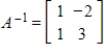 Solve
 .
Solve .
(Multiple Choice)
4.9/5 (79)
(79) A system of equations may have a unique solution, an infinite number of solutions, or no solution. Use matrices to find the general solution of the following system. 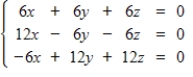
(Multiple Choice)
4.9/5 (78)
(78) Set up the system of equations and then solve it by using inverse matrices. Transportation Ace Trucking Company has an order for three products, A, B, and C to be delivered. The table gives the volume in cubic feet, the weight in pounds, and the value for insurance in dollars for a unit of each of the products. If the carrier can carry 8,000 cu ft and 12,400 lb and is insured for $55,800, how many units of each product can be carried?
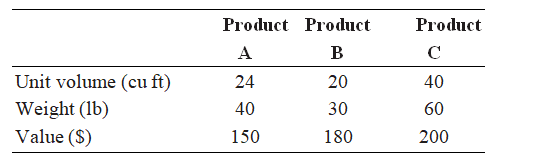
(Multiple Choice)
4.8/5 (82)
(82) 
Filters
- Essay(0)
- Multiple Choice(0)
- Short Answer(0)
- True False(0)
- Matching(0)