



 Chat with AI
Exam 3: Matrices

Exam 1: Linear Equations and Functions245 Questions
Exam 2: Quadratic and Other Special Functions120 Questions
Exam 3: Matrices230 Questions
Exam 4: Inequalities and Linear Programming119 Questions
Exam 5: Exponential and Logarithmic Functions109 Questions
Exam 6: Mathematics of Finance131 Questions
Exam 7: Introduction to Probability180 Questions
Exam 8: Further Topics in Probability and Data Description114 Questions
Exam 9: Derivatives249 Questions
Exam 10: Derivatives172 Questions
Exam 11: Derivatives Continued139 Questions
Exam 12: Indefinite Integrals120 Questions
Exam 13: Definite Integrals - Techniques370 Questions
Exam 13: A: Definite Integrals - Techniques370 Questions
Exam 14: Functions of Two or More Variables122 Questions
Exam 15: Algebraic Concepts 240 Questions
Exam 15: Algebraic Concepts 374 Questions
Exam 15: Algebraic Concepts 496 Questions
Exam 15: Algebraic Concepts 599 Questions
Select questions type


Use row operations on the augmented matrix to solve the given system of linear equations. 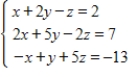
(Multiple Choice)
4.8/5  (77)
(77) In the analysis of traffic flow, a certain city estimates the following situation for the "square" of its downtown district. In the following figure, the arrows indicate the flow of traffic. If x1 represents the number of cars traveling between intersections A and B, x2 represents the number of cars traveling between B and C, x3 the number between C and D, and x4 the number between D and A, we can formulate equations based on the principle that the number of vehicles entering an intersection equals the number leaving it. That is, for intersection A we obtain  Formulate equations for the traffic at B, C, and D. Solve the system of these four equations.
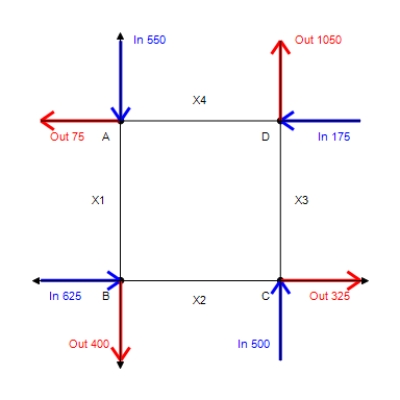
Formulate equations for the traffic at B, C, and D. Solve the system of these four equations.
(Multiple Choice)
4.8/5 (78)
(78) The following tables give the rank and number of registered dogs for the top ten breeds for 1995 and their 2002 data. Which breed had the largest increase in the number of registrations?


(Multiple Choice)
4.8/5 (77)
(77) Use row operations on the augmented matrix to solve the given system of linear equations.
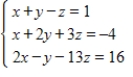
(Multiple Choice)
4.8/5 (80)
(80) Use inverse matrices to find the solution of the system of equations. 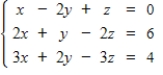
(Multiple Choice)
4.9/5 (81)
(81) A botanist can purchase plant food of four different types, I, II, III, and IV. Each food comes in the same size bag, and the following table summarizes the number of grams of each of three nutrients that each bag contains.
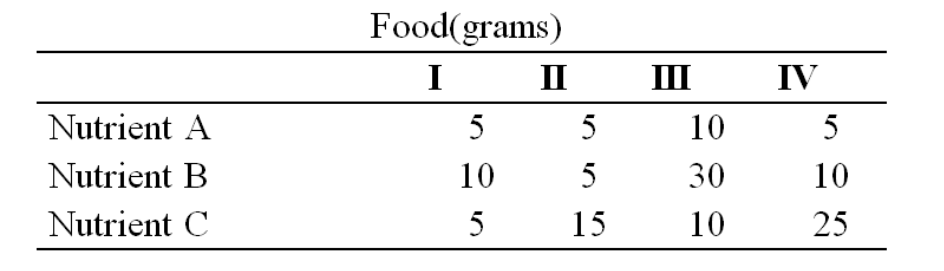 The botanist wants to use a food that has these nutrients in a different proportion and determines that he will need a total of
 of A,
 of B, and
 of C. Let x = Type I bags, y = Type II bags, z = Type III bags, and w = Type IV bags, where x, y, z, and w are non-negative amounts.
Find a general solution that will determine the number of bags of each type of food that should be ordered.
The botanist wants to use a food that has these nutrients in a different proportion and determines that he will need a total of of A, of B, and of C. Let x = Type I bags, y = Type II bags, z = Type III bags, and w = Type IV bags, where x, y, z, and w are non-negative amounts.
Find a general solution that will determine the number of bags of each type of food that should be ordered.
(Multiple Choice)
4.8/5 (84)
(84) 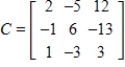 and
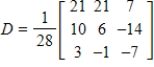 , are C and D inverse matrices?
In order to rank the five members of its chess team for play against another school, the coach draws the following diagram. An arrow from 1 to 2 means player 1 has defeated player 2.

(Multiple Choice)
4.7/5 (78)
(78) One sector of an economy consists of a mining industry and a manufacturing industry, with technology matrix A. 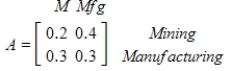
Surpluses of 32 units of mining output and 263 units of manufacturing output are desired. Find the gross production of each industry.
Surpluses of 32 units of mining output and 263 units of manufacturing output are desired. Find the gross production of each industry.
(Multiple Choice)
4.9/5 (92)
(92) A log carrier has a body made from a 4-ft length of reinforced cloth having a patch on each side and a dowel slid through each end to act as handles. The parts-listing matrix for the log carrier is given by 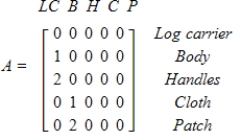
How many of each primary assembly items are required to fill an order for 500 log carriers and 30 handles?
How many of each primary assembly items are required to fill an order for 500 log carriers and 30 handles?
(Multiple Choice)
4.9/5 (76)
(76) 
Filters
- Essay(0)
- Multiple Choice(0)
- Short Answer(0)
- True False(0)
- Matching(0)