



 Chat with AI
Exam 9: Derivatives

Exam 1: Linear Equations and Functions245 Questions
Exam 2: Quadratic and Other Special Functions120 Questions
Exam 3: Matrices230 Questions
Exam 4: Inequalities and Linear Programming119 Questions
Exam 5: Exponential and Logarithmic Functions109 Questions
Exam 6: Mathematics of Finance131 Questions
Exam 7: Introduction to Probability180 Questions
Exam 8: Further Topics in Probability and Data Description114 Questions
Exam 9: Derivatives249 Questions
Exam 10: Derivatives172 Questions
Exam 11: Derivatives Continued139 Questions
Exam 12: Indefinite Integrals120 Questions
Exam 13: Definite Integrals - Techniques370 Questions
Exam 13: A: Definite Integrals - Techniques370 Questions
Exam 14: Functions of Two or More Variables122 Questions
Exam 15: Algebraic Concepts 240 Questions
Exam 15: Algebraic Concepts 374 Questions
Exam 15: Algebraic Concepts 496 Questions
Exam 15: Algebraic Concepts 599 Questions
Select questions type


Use analytic methods to find the limit as  for the given function.
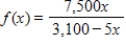
for the given function. (Multiple Choice)
4.9/5  (84)
(84) If an IRA is a variable-rate investment for 20 years at rate r percent per year, compounded monthly, then the future value S that accumulates from an initial investment of $1,000 is 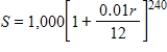 . What is the rate of change of S with respect to r and what does it tell us if the interest rate is 7%? Round your answer to two decimal places.
 (Multiple Choice)
4.9/5 (78)
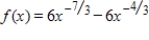
(78) Find the derivative of the given function. Simplify and express the answer using positive exponents only. 
(Multiple Choice)
4.8/5 (76)
(76) 
Write the equation of the line tangent to the graph of f (x) at 
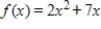
(Multiple Choice)
4.7/5 (69)
(69) Total revenue is in dollars and x is the number of units. Suppose that the total revenue function for a commodity is 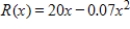 Find
 , and explain what this value represents. Round your answer to two decimal places.
Find , and explain what this value represents. Round your answer to two decimal places. (Multiple Choice)
4.9/5 (98)
(98) Graph the marginal profit function for the profit function  where P(x) is in dollars and x is the number of units. At what level of production and sales will profit be at a maximum?
 (Multiple Choice)
4.9/5 (84)
(84) Determine whether the given function is continuous. If it is not, identify where it is discontinuous. You can verify your conclusions by graphing the function with a graphing utility, if one is available. 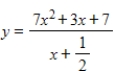
(Multiple Choice)
4.9/5 (73)
(73) A certain calling card costs 6.8 cents per minute to make a call, rounded up to the nearest minute. However, when the card is used at a pay phone, there is an additional 68 cent connection fee. If  is the charge from a pay phone for a call lasting t minutes, create a table of charges for calls lasting close to 1 minute and use it to find the following limit, if it exists. Round your answer to the nearest cent.

is the charge from a pay phone for a call lasting t minutes, create a table of charges for calls lasting close to 1 minute and use it to find the following limit, if it exists. Round your answer to the nearest cent. (Multiple Choice)
4.8/5 (79)
(79) Use analytic methods to evaluate the limit and determine which type of asymptote (if any) it represents. You can verify your conclusion by graphing the function with a graphing utility, if one is available. 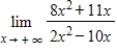
(Multiple Choice)
4.9/5 (95)
(95) The graph of a company's profit function is shown. For the given problem, use the graph to answer the following questions about points A, B, and C. Rank from smallest to largest the marginal profit at these points. 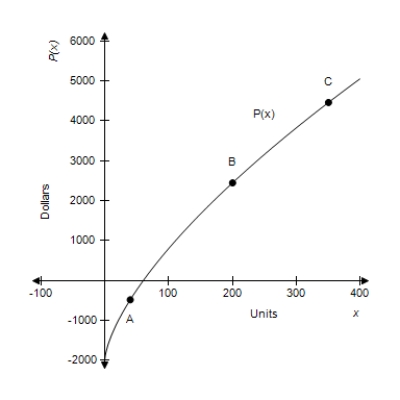
(Multiple Choice)
4.9/5 (86)
(86) Suppose that the revenue (in dollars) from the sale of a product is given by  , where x is the number of units sold. How fast is the marginal revenue
 changing when

, where x is the number of units sold. How fast is the marginal revenue changing when (Multiple Choice)
4.8/5 (81)
(81) Use properties of limits and algebraic methods to find the limit, if it exists. 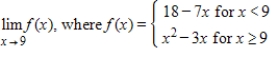
(Multiple Choice)
4.7/5 (82)
(82) Because the derivative of a function represents both the slope of the tangent to the curve and the instantaneous rate of change of the function, it is possible to use information about one to gain information about the other. In this problem, use the graph of the function  given in the figure.
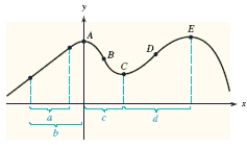 Over what interval(s) (a) through (d) is the rate of change of f (x) negative?
given in the figure. Over what interval(s) (a) through (d) is the rate of change of f (x) negative? (Multiple Choice)
4.7/5 (78)
(78) The following table shows the numbers of U.S. cellular subscriberships (in millions) from 1985 to 2002.
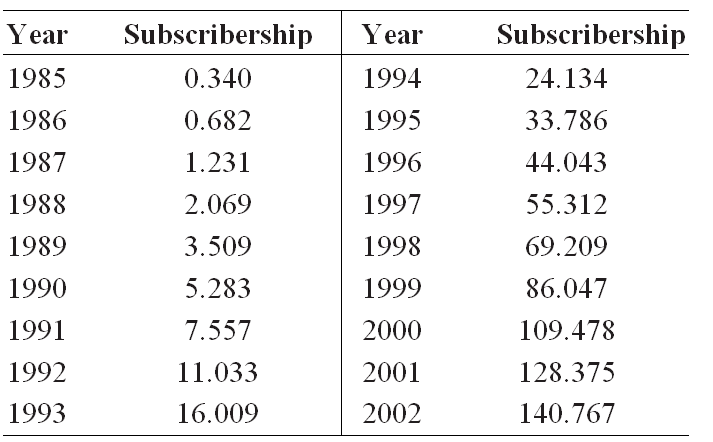 Source: The CTIA Semi-Annual Wireless Industry Survey
Assume that the number of U.S. cellular subscriberships, in millions, can be modeled by the function
 , where t is the number of years past 1980. Find the function that models the instantaneous rate of change of the U.S. cellular subscriberships.
Source: The CTIA Semi-Annual Wireless Industry Survey
Assume that the number of U.S. cellular subscriberships, in millions, can be modeled by the function , where t is the number of years past 1980. Find the function that models the instantaneous rate of change of the U.S. cellular subscriberships.
(Multiple Choice)
4.8/5 (92)
(92) For the given function, find the slope of the tangent line at  .
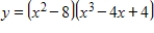
. (Multiple Choice)
4.8/5 (88)
(88) Find the derivative of the given function. Simplify and express the answer using positive exponents only. 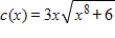
(Multiple Choice)
4.8/5 (75)
(75) Complete the table and use it to predict the limit, if it exists. 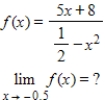
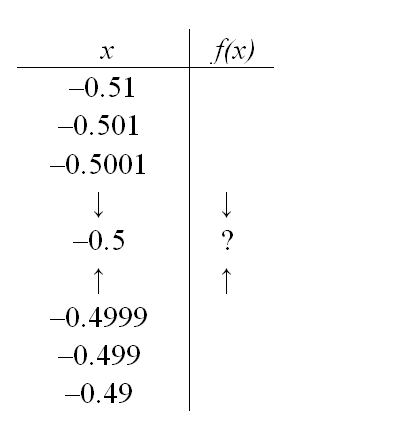
(Multiple Choice)
4.8/5 (81)
(81) A graph of  is shown and a c-value is given. For this problem, use the graph to find
 .

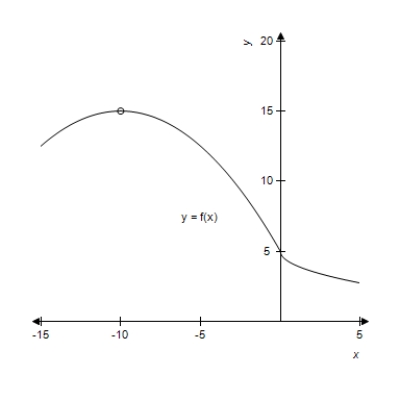
is shown and a c-value is given. For this problem, use the graph to find . (Multiple Choice)
4.9/5 (77)
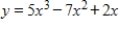
(77) 

Filters
- Essay(0)
- Multiple Choice(0)
- Short Answer(0)
- True False(0)
- Matching(0)