



 Chat with AI
Exam 9: Derivatives

Exam 1: Linear Equations and Functions245 Questions
Exam 2: Quadratic and Other Special Functions120 Questions
Exam 3: Matrices230 Questions
Exam 4: Inequalities and Linear Programming119 Questions
Exam 5: Exponential and Logarithmic Functions109 Questions
Exam 6: Mathematics of Finance131 Questions
Exam 7: Introduction to Probability180 Questions
Exam 8: Further Topics in Probability and Data Description114 Questions
Exam 9: Derivatives249 Questions
Exam 10: Derivatives172 Questions
Exam 11: Derivatives Continued139 Questions
Exam 12: Indefinite Integrals120 Questions
Exam 13: Definite Integrals - Techniques370 Questions
Exam 13: A: Definite Integrals - Techniques370 Questions
Exam 14: Functions of Two or More Variables122 Questions
Exam 15: Algebraic Concepts 240 Questions
Exam 15: Algebraic Concepts 374 Questions
Exam 15: Algebraic Concepts 496 Questions
Exam 15: Algebraic Concepts 599 Questions
Select questions type


 for

The table gives the yearly U.S. federal budget deficit (as a negative value) or surplus (as a positive value) in billions of dollars from 1990 to 2004.
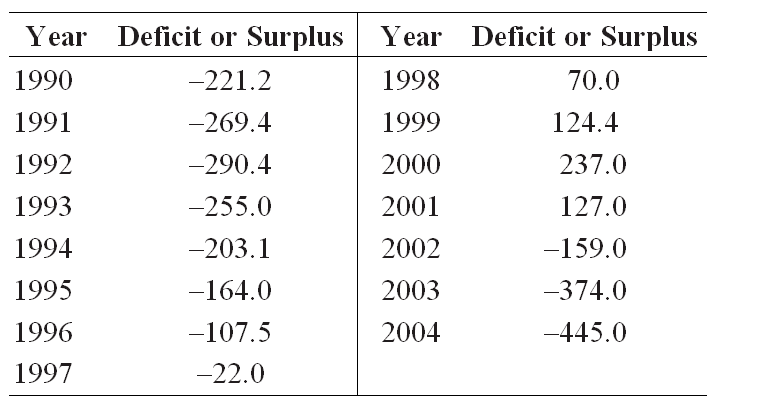 Source: Budget of the United States Government
Assume the federal budget deficit (or surplus) can be modeled with the function
 , where D is in billions of dollars and t is the number of years past 1980. Use the model to find and interpret the instantaneous rate of change of the U.S. federal deficit (or surplus) in 1995.
Source: Budget of the United States Government
Assume the federal budget deficit (or surplus) can be modeled with the function , where D is in billions of dollars and t is the number of years past 1980. Use the model to find and interpret the instantaneous rate of change of the U.S. federal deficit (or surplus) in 1995.
(Multiple Choice)
4.9/5  (87)
(87) Find the coordinates of points where the graph of  has horizontal tangents. As a check, graph
 and see whether the points you found look as though they have horizontal tangents.

has horizontal tangents. As a check, graph and see whether the points you found look as though they have horizontal tangents. (Multiple Choice)
4.8/5 (84)
(84) 
At the indicated point, find the instantaneous rate of change of the function. 
(Multiple Choice)
4.8/5 (83)
(83) Use properties of limits and algebraic methods to find the limit, if it exists. 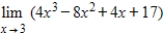
(Multiple Choice)
4.8/5 (70)
(70) Graph the function with a graphing utility and use it to predict the limit. Check your work either by using the table feature of the graphing utility or by finding the limit algebraically. 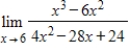
(Multiple Choice)
4.8/5 (81)
(81) The monthly charge in dollars for x kilowatt-hours (kWh) of electricity used by a residential consumer of Excelsior Electric Membership Corporation from November through June is given by the function 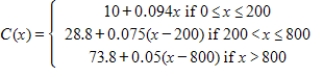 . What is the monthly charge if 1,700 kWh of electricity is consumed in a month? Round your answer to two decimal places.
 (Multiple Choice)
4.9/5 (82)
(82)  for
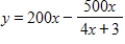
At the indicated point, find the slope of the tangent to the curve. 
(Multiple Choice)
4.8/5 (69)
(69) 
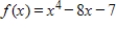
Find the derivative of the given function. Simplify and express the answer using positive exponents only. 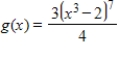
(Multiple Choice)
4.9/5 (91)
(91) Let 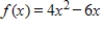 . Use the definition of derivative and the Procedure/Example table in this section to verify that
 . Then, find the instantaneous rate of change of f (x) at
 .
. Use the definition of derivative and the Procedure/Example table in this section to verify that . Then, find the instantaneous rate of change of f (x) at . (Multiple Choice)
4.9/5 (93)
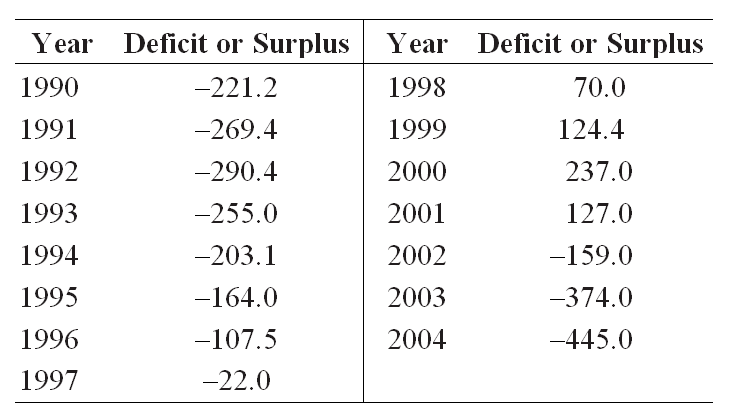
(93) The table gives the yearly U.S. federal budget deficit (as a negative value) or surplus (as a positive value) in billions of dollars from 1990 to 2004.
 Source: Budget of the United States Government
Assume the federal budget deficit (or surplus) can be modeled with the function
 , where D is in billions of dollars and t is the number of years past 1980. Use the data to find an average rate of change that approximates the instantaneous rate in 1996.
Source: Budget of the United States Government
Assume the federal budget deficit (or surplus) can be modeled with the function , where D is in billions of dollars and t is the number of years past 1980. Use the data to find an average rate of change that approximates the instantaneous rate in 1996.
(Multiple Choice)
4.8/5 (82)
(82) For the function in this problem, approximate  near the point
 by graphing the function on a graphing utility. Then, zoom in near the point until the graph appears straight, pick two points, and find the slope of the line you see. Round your answer to three decimal places.
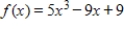
near the point by graphing the function on a graphing utility. Then, zoom in near the point until the graph appears straight, pick two points, and find the slope of the line you see. Round your answer to three decimal places. (Multiple Choice)
4.8/5 (91)
(91) Complete the table and use it to predict the limit, if it exists. 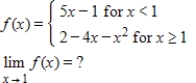
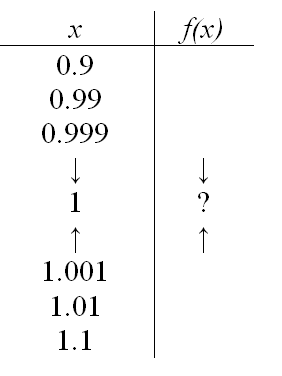
(Multiple Choice)
4.9/5 (84)
(84) For the given function, find the instantaneous rate of change of the function at  .

. (Multiple Choice)
4.8/5 (59)
(59) If the total revenue function for a toy is  dollars and the total cost function is
 dollars. What is the instantaneous rate of change of profit if 10 units are produced and sold? Explain its meaning.
dollars and the total cost function is dollars. What is the instantaneous rate of change of profit if 10 units are produced and sold? Explain its meaning. (Multiple Choice)
4.8/5 (71)
(71) Use the numerical derivative feature of a graphing utility to approximate the given second derivative to two decimal places. Round your answer to two decimal places. 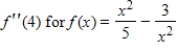
(Multiple Choice)
4.7/5 (89)
(89) In the figure given in this problem, at points A and E draw an approximate tangent line and then use it to answer the following question. Is  greater at point A or at point E?
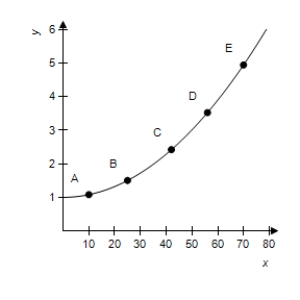
greater at point A or at point E? (Multiple Choice)
4.7/5 (76)
(76) 
Filters
- Essay(0)
- Multiple Choice(0)
- Short Answer(0)
- True False(0)
- Matching(0)