



 Chat with AI
Exam 8: The Trigonometric Functions

Exam 1: The Derivative189 Questions
Exam 2: Applications of the Derivative93 Questions
Exam 3: Techniques of Differentiation69 Questions
Exam 4: Logarithm Functions135 Questions
Exam 5: Applications of the Exponential and Natural Logarithm Functions73 Questions
Exam 6: The Definite Integral135 Questions
Exam 7: Functions of Several Variables119 Questions
Exam 8: The Trigonometric Functions128 Questions
Exam 9: Techniques of Integration178 Questions
Exam 10: Differential Equations126 Questions
Exam 11: Taylor Polynomials and Infinite Series132 Questions
Exam 12: Probability and Calculus92 Questions
Select questions type


Give the values of tan t and sec t, where t is the radian measure of the angle shown. 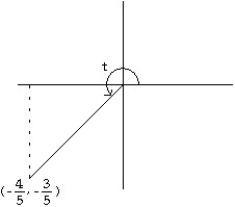 Enter just where a represents tan t and b represents sec t with any fractions reduced of form (no labels and no approximations).
 (Short Answer)
4.9/5  (80)
(80) f(t) = Enter your answer without parentheses or labels, use a multiplication dot between the last two functions.
(Short Answer)
5.0/5 (79)
(79) Find the slope of the tangent line to the graph of y = cos at the origin.
Enter just an integer.
(Short Answer)
5.0/5 (71)
(71) f(x) = x
Enter your answer without parentheses, no labels, use the multiplication dot between functions of x.
(Short Answer)
4.9/5 (66)
(66) ( )Enter sine terms before cosine terms with parentheses around arguments.
(Short Answer)
4.7/5 (69)
(69) (3t)Enter sines before cosines with parentheses around arguments.
(Short Answer)
4.9/5 (83)
(83) Determine the value of sin t and cos t when t = 3π.
Enter your answer as just a, b where a represents sin t and b represents cos t (no labels)
(Short Answer)
4.9/5 (86)
(86) f(x) = sec Enter your answer without parentheses or labels. Use the multiplication dot between the last two functions of x.
(Short Answer)
4.9/5 (71)
(71) The size of an animal population at time t is given by , where t is the number of months from June 1, 1980. At what rate is the animal population changing on June 1, 1981?
Enter your answer as a quotient reduced form with π in the numerator (no units).
(Short Answer)
4.8/5 (74)
(74) f(t) = csc Enter your answer without parentheses or labels. No multiplication dots. Enter your answer as a quotient leaving in that form.
(Short Answer)
4.8/5 (81)
(81) cos(cos x)Enter sines before cosines with parentheses around arguments and a multiplication dot between the first two terms.
(Short Answer)
4.9/5 (68)
(68) 
Filters
- Essay(0)
- Multiple Choice(0)
- Short Answer(0)
- True False(0)
- Matching(0)