



 Chat with AI
Exam 19: Job Order Costing

Exam 1: Introduction to Accounting and Business190 Questions
Exam 2: Analyzing Transactions224 Questions
Exam 3: The Adjusting Process179 Questions
Exam 4: Completing the Accounting Cycle194 Questions
Exam 5: Accounting Systems160 Questions
Exam 6: Accounting for Merchandising Businesses215 Questions
Exam 7: Inventories165 Questions
Exam 8: Sarbanes-Oxley, Internal Control, and Cash176 Questions
Exam 9: Receivables140 Questions
Exam 10: Fixed Assets and Intangible Assets170 Questions
Exam 11: Current Liabilities and Payroll169 Questions
Exam 12: Accounting for Partnerships and Limited Liability Companies190 Questions
Exam 13: Corporations: Organization, Stock Transactions, and Dividends165 Questions
Exam 14: Long-Term Liabilities: Bonds and Notes185 Questions
Exam 15: Investments and Fair Value Accounting133 Questions
Exam 16: Statement of Cash Flows160 Questions
Exam 17: Financial Statement Analysis185 Questions
Exam 18: Managerial Accounting Concepts and Principles173 Questions
Exam 19: Job Order Costing173 Questions
Exam 20: Process Cost Systems177 Questions
Exam 21: Cost Behavior and Cost-Volume-Profit Analysis215 Questions
Exam 22: Budgeting188 Questions
Exam 23: Performance Evaluation Using Variances From Standard Costs161 Questions
Exam 24: Performance Evaluation for Decentralized Operations200 Questions
Exam 25: Differential Analysis and Product Pricing162 Questions
Exam 26: Capital Investment Analysis179 Questions
Select questions type


Which of the following costs are NOT included in finished goods inventory?
(Multiple Choice)
4.9/5  (76)
(76) If the underapplied factory overhead amount is material, it is transferred to Cost of Goods Sold at the end of the fiscal year.
(True/False)
4.8/5 (85)
(85) Job order cost accounting systems can be used only for companies that manufacture a product.
(True/False)
4.9/5 (69)
(69) In a job order cost accounting system, the entry to record the flow of direct materials into production is:
(Multiple Choice)
4.8/5 (84)
(84) Job order cost systems can be used to compare unit costs of similar jobs to determine if costs are staying within expected ranges.
(True/False)
4.7/5 (77)
(77) A summary of the materials requisitions completed during a period serves as the basis for transferring the cost of the materials from the controlling account in the general ledger to the controlling accounts for:
(Multiple Choice)
4.7/5 (79)
(79) A manufacturing company applies factory overhead based on direct labor hours. At the beginning of the year, it estimated that factory overhead costs would be $360,000 and direct labor hours would be 30,000. Actual factory overhead costs incurred were $377,200, and actual direct labor hours were 36,000. What is the amount of overapplied or underapplied manufacturing overhead at the end of the year?
(Multiple Choice)
4.8/5 (84)
(84) Which of the following would be most likely to use process costing?
(Multiple Choice)
4.8/5 (77)
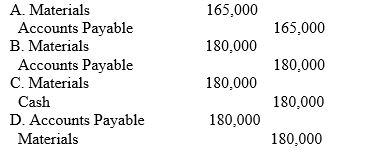
(77) Materials purchased on account during the month amounted to $180,000. Materials requisitioned and placed in production totaled $165,000. From the following, select the entry to record the transaction on the day the materials were bought.
(Short Answer)
4.9/5 (93)
(93) On November 14th the Milling Department has accepted Job 111407A for 1,000 pounds of Cereal Mix. The bill of materials (BOM) for the Cereal Mix is:
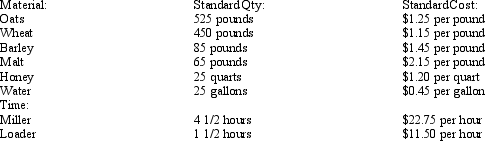 Manufacturing overhead is applied at $5.75 per pound completed, and $75.75 of materials are returned to Raw Materials Inventory. The recipe produced 1,025 pounds of cereal mix.

Manufacturing overhead is applied at $5.75 per pound completed, and $75.75 of materials are returned to Raw Materials Inventory. The recipe produced 1,025 pounds of cereal mix.
(Essay)
4.9/5 (75)
(75) Discuss the use of job order costing for professional services businesses. What are the similarities and differences between service and manufacturing business job order costing?
(Essay)
4.8/5 (78)
(78) The amount of time spent by an employee in the factory is usually recorded on:
(Multiple Choice)
4.9/5 (79)
(79) The recording of the jobs shipped and customers billed would include a credit to:
(Multiple Choice)
4.8/5 (76)
(76) In the job order system, the finished goods account is the controlling account for the factory overhead ledger.
(True/False)
4.9/5 (84)
(84) All of the following are examples of activity bases except:
(Multiple Choice)
4.9/5 (63)
(63) Prepare the journal entry for materials and labor, based on the following:

(Essay)
4.7/5 (93)
(93) Which of the following would record the labor costs to an individual job?
(Multiple Choice)
4.8/5 (100)
(100) Activity-based costing is a method of accumulating and allocating costs by department.
(True/False)
4.7/5 (85)
(85) Generally accepted accounting principles require companies to use only one factory overhead rate for product costing.
(True/False)
4.8/5 (85)
(85) Cavy Company completed 26,000 units during the year at a cost of $2,139,800. The beginning finished goods inventory was 5,000 units at $405,000. Determine the cost of goods sold for 20,000 units, assuming a FIFO cost flow.
(Essay)
4.8/5 (83)
(83) 
Filters
- Essay(0)
- Multiple Choice(0)
- Short Answer(0)
- True False(0)
- Matching(0)