



 Chat with AI
Exam 19: Job Order Costing

Exam 1: Introduction to Accounting and Business190 Questions
Exam 2: Analyzing Transactions224 Questions
Exam 3: The Adjusting Process179 Questions
Exam 4: Completing the Accounting Cycle194 Questions
Exam 5: Accounting Systems160 Questions
Exam 6: Accounting for Merchandising Businesses215 Questions
Exam 7: Inventories165 Questions
Exam 8: Sarbanes-Oxley, Internal Control, and Cash176 Questions
Exam 9: Receivables140 Questions
Exam 10: Fixed Assets and Intangible Assets170 Questions
Exam 11: Current Liabilities and Payroll169 Questions
Exam 12: Accounting for Partnerships and Limited Liability Companies190 Questions
Exam 13: Corporations: Organization, Stock Transactions, and Dividends165 Questions
Exam 14: Long-Term Liabilities: Bonds and Notes185 Questions
Exam 15: Investments and Fair Value Accounting133 Questions
Exam 16: Statement of Cash Flows160 Questions
Exam 17: Financial Statement Analysis185 Questions
Exam 18: Managerial Accounting Concepts and Principles173 Questions
Exam 19: Job Order Costing173 Questions
Exam 20: Process Cost Systems177 Questions
Exam 21: Cost Behavior and Cost-Volume-Profit Analysis215 Questions
Exam 22: Budgeting188 Questions
Exam 23: Performance Evaluation Using Variances From Standard Costs161 Questions
Exam 24: Performance Evaluation for Decentralized Operations200 Questions
Exam 25: Differential Analysis and Product Pricing162 Questions
Exam 26: Capital Investment Analysis179 Questions
Select questions type


When the goods are sold, their costs are transferred from Work in Process to Finished Goods.
(True/False)
4.8/5  (79)
(79) The inventory accounts generally maintained by a manufacturing firm are only finished goods and materials.
(True/False)
4.8/5 (86)
(86) In a job order cost accounting system for a service business, materials costs are normally included as part of overhead.
(True/False)
4.9/5 (88)
(88) Selected accounts with some debits and credits omitted are presented as follows: 
 If the balance of Work in Process at August 31 is $220,000, what was the amount debited to Work in Process for factory overhead in August, assuming a factory overhead rate of 30% of direct labor costs?
 (Multiple Choice)
4.9/5 (84)
(84) Match each of the following terms with the phrase that most closely describes it. Each answer may be used only once.

(Essay)
4.8/5 (78)
(78) Perpetual inventory controlling accounts and subsidiary ledgers are maintained for materials, work in process, and finished goods in cost accounting systems.
(True/False)
4.8/5 (67)
(67) Information about costs developed through a job order cost system can not be used to evaluate an organization's cost performance.
(True/False)
4.9/5 (76)
(76) A difference in quantity of materials used on two comparable jobs may be caused by:
(Multiple Choice)
4.7/5 (85)
(85) Zeke Company is a manufacturing company that has worked on several production jobs during the 1st quarter of the year. Below is a list of all the jobs for the quarter: 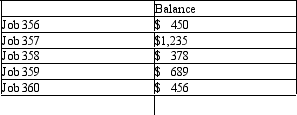 Job 356, 357, 358 & 359 were completed. Jobs 356 & 357 were sold at a profit of $500 on each job.
What is Gross Margin for Zeke Company as of the end of the 1st quarter?
Job 356, 357, 358 & 359 were completed. Jobs 356 & 357 were sold at a profit of $500 on each job.
What is Gross Margin for Zeke Company as of the end of the 1st quarter? (Multiple Choice)
4.8/5 (86)
(86) Which of the following is the correct flow of manufacturing costs?
(Multiple Choice)
4.9/5 (81)
(81) Interim financial statements for a manufacturing business would report overapplied factory overhead as a deferred item on the balance sheet.
(True/False)
4.7/5 (77)
(77) Which of the following is not a characteristic of a job order costing system?
(Multiple Choice)
4.9/5 (87)
(87) As product costs are incurred in the manufacturing process, they are accounted for as assets and reported on the balance sheet as inventory.
(True/False)
4.9/5 (80)
(80) A service organization will not use the job order costing method because it has no direct materials.
(True/False)
4.9/5 (74)
(74) Factory overhead is applied to production using a predetermined overhead rate.
(True/False)
4.9/5 (83)
(83) A process cost accounting system provides for a separate record of the cost of each particular quantity of product that passes through the factory.
(True/False)
4.8/5 (74)
(74) Costs that are treated as assets until the product is sold are called:
(Multiple Choice)
4.8/5 (81)
(81) 
Filters
- Essay(0)
- Multiple Choice(0)
- Short Answer(0)
- True False(0)
- Matching(0)