



 Chat with AI
Exam 21: Cost Behavior and Cost-Volume-Profit Analysis

Exam 1: Introduction to Accounting and Business190 Questions
Exam 2: Analyzing Transactions224 Questions
Exam 3: The Adjusting Process179 Questions
Exam 4: Completing the Accounting Cycle194 Questions
Exam 5: Accounting Systems160 Questions
Exam 6: Accounting for Merchandising Businesses215 Questions
Exam 7: Inventories165 Questions
Exam 8: Sarbanes-Oxley, Internal Control, and Cash176 Questions
Exam 9: Receivables140 Questions
Exam 10: Fixed Assets and Intangible Assets170 Questions
Exam 11: Current Liabilities and Payroll169 Questions
Exam 12: Accounting for Partnerships and Limited Liability Companies190 Questions
Exam 13: Corporations: Organization, Stock Transactions, and Dividends165 Questions
Exam 14: Long-Term Liabilities: Bonds and Notes185 Questions
Exam 15: Investments and Fair Value Accounting133 Questions
Exam 16: Statement of Cash Flows160 Questions
Exam 17: Financial Statement Analysis185 Questions
Exam 18: Managerial Accounting Concepts and Principles173 Questions
Exam 19: Job Order Costing173 Questions
Exam 20: Process Cost Systems177 Questions
Exam 21: Cost Behavior and Cost-Volume-Profit Analysis215 Questions
Exam 22: Budgeting188 Questions
Exam 23: Performance Evaluation Using Variances From Standard Costs161 Questions
Exam 24: Performance Evaluation for Decentralized Operations200 Questions
Exam 25: Differential Analysis and Product Pricing162 Questions
Exam 26: Capital Investment Analysis179 Questions
Select questions type


If fixed costs are $240,000, the unit selling price is $32, and the unit variable costs are $20, what are the old and new break-even sales (units) if the unit selling price increases by $4?
(Multiple Choice)
4.9/5  (75)
(75) Manley Co. manufactures office furniture. During the most productive month of the year, 4,500 desks were manufactured at a total cost of $86,625. In its slowest month, the company made 1,800 desks at a cost of $49,500. Using the high-low method of cost estimation, total fixed costs are:
(Multiple Choice)
4.8/5 (81)
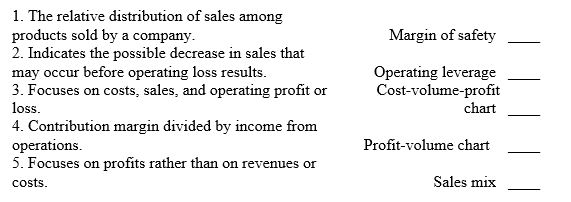
(81) 
Absorption costing is required for financial reporting under generally accepted accounting principles.
(True/False)
4.9/5 (86)
(86) A rental cost of $20,000 plus $.70 per machine hour of use is an example of a mixed cost.
(True/False)
4.9/5 (80)
(80) Which of the following statements is true regarding fixed and variable costs?
(Multiple Choice)
5.0/5 (78)
(78) The range of activity over which changes in cost are of interest to management is called the relevant range.
(True/False)
4.9/5 (63)
(63) Bobby Company has fixed costs of $160,000. The unit selling price, variable cost per unit, and contribution margin per unit for the company's two products are provided below.
 The sales mix for product X and Y is 60% and 40% respectively. Determine the break-even point in units of X and Y.
 (Essay)
4.8/5 (98)
(98) Which of the following describes the behavior of the variable cost per unit?
(Multiple Choice)
4.9/5 (77)
(77) Cost-volume-profit analysis cannot be used if which of the following occurs?
(Multiple Choice)
4.8/5 (77)
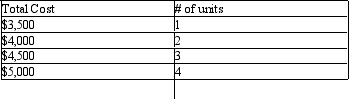
(77) 
If fixed costs are $750,000 and variable costs are 60% of sales, what is the break-even point in sales dollars?
(Multiple Choice)
4.8/5 (79)
(79) Copper Hill Inc. manufactures laser printers within a relevant range of production of 70,000 to 100,000 printers per year. The following partially completed manufacturing cost schedule has been prepared:
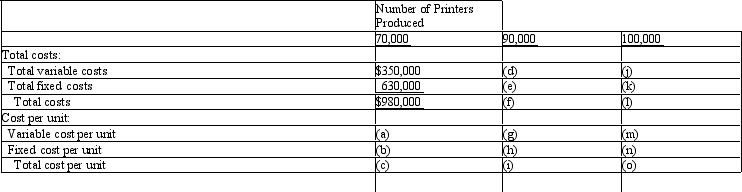 Complete the preceding cost schedule, identifying each cost by the appropriate letter (a) through (o).
 (Essay)
5.0/5 (87)
(87) If variable costs per unit increased because of an increase in hourly wage rates, the break-even point would:
(Multiple Choice)
4.8/5 (86)
(86) The manufacturing cost of Mocha Industries for three months of the year are provided below:
 Using the high-low method, determine the (a) variable cost per unit, and (b) the total fixed costs.
 (Essay)
4.8/5 (76)
(76) Explain how variable costing net income will be different than absorption costing net income under the following situations:
(1) A company had no beginning or ending inventory. During the year they produced and sold 10,000 units.
(2) A company had no beginning inventory. During the year they produced 10,000 units and sold 8,000 units.
(3) A company had 2,000 units in beginning inventory. During the year they produced 10,000 units and sold 12,000 units.
(Essay)
4.8/5 (93)
(93) The Tom Company reports the following data.
 Determine Tom Company's operating leverage.
 (Essay)
4.9/5 (77)
(77) 
Filters
- Essay(0)
- Multiple Choice(0)
- Short Answer(0)
- True False(0)
- Matching(0)