



 Chat with AI
Exam 21: Cost Behavior and Cost-Volume-Profit Analysis

Exam 1: Introduction to Accounting and Business190 Questions
Exam 2: Analyzing Transactions224 Questions
Exam 3: The Adjusting Process179 Questions
Exam 4: Completing the Accounting Cycle194 Questions
Exam 5: Accounting Systems160 Questions
Exam 6: Accounting for Merchandising Businesses215 Questions
Exam 7: Inventories165 Questions
Exam 8: Sarbanes-Oxley, Internal Control, and Cash176 Questions
Exam 9: Receivables140 Questions
Exam 10: Fixed Assets and Intangible Assets170 Questions
Exam 11: Current Liabilities and Payroll169 Questions
Exam 12: Accounting for Partnerships and Limited Liability Companies190 Questions
Exam 13: Corporations: Organization, Stock Transactions, and Dividends165 Questions
Exam 14: Long-Term Liabilities: Bonds and Notes185 Questions
Exam 15: Investments and Fair Value Accounting133 Questions
Exam 16: Statement of Cash Flows160 Questions
Exam 17: Financial Statement Analysis185 Questions
Exam 18: Managerial Accounting Concepts and Principles173 Questions
Exam 19: Job Order Costing173 Questions
Exam 20: Process Cost Systems177 Questions
Exam 21: Cost Behavior and Cost-Volume-Profit Analysis215 Questions
Exam 22: Budgeting188 Questions
Exam 23: Performance Evaluation Using Variances From Standard Costs161 Questions
Exam 24: Performance Evaluation for Decentralized Operations200 Questions
Exam 25: Differential Analysis and Product Pricing162 Questions
Exam 26: Capital Investment Analysis179 Questions
Select questions type


A firm operated at 80% of capacity for the past year, during which fixed costs were $210,000, variable costs were 70% of sales, and sales were $1,000,000. Operating profit was:
(Multiple Choice)
4.9/5  (64)
(64) If fixed costs are $490,000, the unit selling price is $35, and the unit variable costs are $20, what is the break-even sales (units) if fixed costs are reduced by $40,000?
(Multiple Choice)
4.8/5 (90)
(90) If fixed costs are $850,000 and variable costs are 60% of sales, what is the break-even point (dollars)?
(Multiple Choice)
4.9/5 (70)
(70) With the aid of computer software, managers can vary assumptions regarding selling prices, costs, and volume and can immediately see the effects of each change on the break-even point and profit. This is called:
(Multiple Choice)
4.8/5 (79)
(79) The manufacturing cost of Prancer Industries for three months of the year are provided below:  Using the high-low method, the variable cost per unit, and the total fixed costs are:
 (Multiple Choice)
4.8/5 (77)
(77) 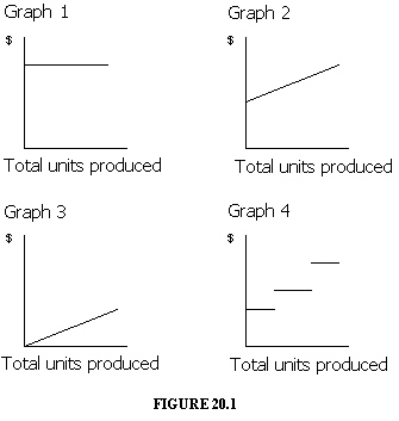 Which of the graphs in Figure 20-1 illustrates the behavior of a total variable cost?
 (Multiple Choice)
4.8/5 (89)
(89) If sales total $2,000,000, fixed costs total $800,000, and variable costs are 60% of sales, the contribution margin ratio is 60%.
(True/False)
4.8/5 (79)
(79) Currently, the unit selling price is $50, the variable cost, $34, and the total fixed costs, $108,000. A proposal is being evaluated to increase the selling price to $54.

(Essay)
4.7/5 (67)
(67) Kissimmee Paint Co. reported the following data for the month of July. There were no beginning inventories and all units were completed (no work in process).

 In the month of July, 28,000 of the 30,000 units manufactured were sold at a price of $80 per unit.

In the month of July, 28,000 of the 30,000 units manufactured were sold at a price of $80 per unit.
(Essay)
4.8/5 (84)
(84) Rental charges of $40,000 per year plus $3 for each machine hour over 18,000 hours is an example of a fixed cost.
(True/False)
4.9/5 (63)
(63) As production increases, what would you expect to happen to fixed cost per unit?
(Multiple Choice)
4.9/5 (73)
(73) What ratio indicates the percentage of each sales dollar that is available to cover fixed costs and to provide a profit?
(Multiple Choice)
4.8/5 (93)
(93) The point where the sales line and the total costs line intersect on the cost-volume-profit chart represents:
(Multiple Choice)
4.8/5 (93)
(93) Douglas Company has a contribution margin ratio of 30%. If Douglas has $336,420 in fixed costs, what amount of sales will need to be generated in order for the company to break even?
(Essay)
4.8/5 (85)
(85) 
Filters
- Essay(0)
- Multiple Choice(0)
- Short Answer(0)
- True False(0)
- Matching(0)