



 Chat with AI
Exam 26: Capital Investment Analysis

Exam 1: Introduction to Accounting and Business190 Questions
Exam 2: Analyzing Transactions224 Questions
Exam 3: The Adjusting Process179 Questions
Exam 4: Completing the Accounting Cycle194 Questions
Exam 5: Accounting Systems160 Questions
Exam 6: Accounting for Merchandising Businesses215 Questions
Exam 7: Inventories165 Questions
Exam 8: Sarbanes-Oxley, Internal Control, and Cash176 Questions
Exam 9: Receivables140 Questions
Exam 10: Fixed Assets and Intangible Assets170 Questions
Exam 11: Current Liabilities and Payroll169 Questions
Exam 12: Accounting for Partnerships and Limited Liability Companies190 Questions
Exam 13: Corporations: Organization, Stock Transactions, and Dividends165 Questions
Exam 14: Long-Term Liabilities: Bonds and Notes185 Questions
Exam 15: Investments and Fair Value Accounting133 Questions
Exam 16: Statement of Cash Flows160 Questions
Exam 17: Financial Statement Analysis185 Questions
Exam 18: Managerial Accounting Concepts and Principles173 Questions
Exam 19: Job Order Costing173 Questions
Exam 20: Process Cost Systems177 Questions
Exam 21: Cost Behavior and Cost-Volume-Profit Analysis215 Questions
Exam 22: Budgeting188 Questions
Exam 23: Performance Evaluation Using Variances From Standard Costs161 Questions
Exam 24: Performance Evaluation for Decentralized Operations200 Questions
Exam 25: Differential Analysis and Product Pricing162 Questions
Exam 26: Capital Investment Analysis179 Questions
Select questions type


Which of the following is not an advantage of the average rate of return method?
(Multiple Choice)
4.9/5  (85)
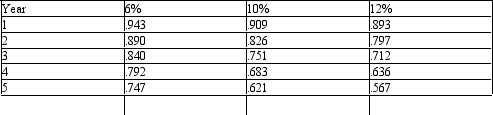
(85) Project A requires an original investment of $65,000. The project will yield cash flows of $15,000 per year for seven years. Project B has a calculated net present value of $5,500 over a five year life. Project A could be sold at the end of five years for a price of $30,000. (a) Using the proper table below determine the net present value of Project A over a five-year life with salvage value assuming a minimum rate of return of 12%. (b) Which project provides the greatest net present value?
Below is a table for the present value of $1 at compound interest.
 Below is a table for the present value of an annuity of $1 at compound interest.
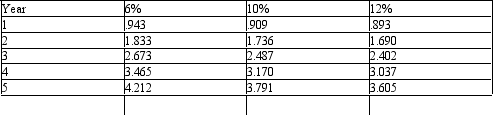
Below is a table for the present value of an annuity of $1 at compound interest.
(Essay)
4.8/5 (79)
(79) Proposals M and N each cost $600,000, have 6-year lives, and have expected total cash flows of $750,000. Proposal M is expected to provide equal annual net cash flows of $125,000, while the net cash flows for Proposal N are as follows:
 Determine the cash payback period for each proposal.
 (Essay)
4.9/5 (69)
(69) Match each of the following terms with the best definition given below.
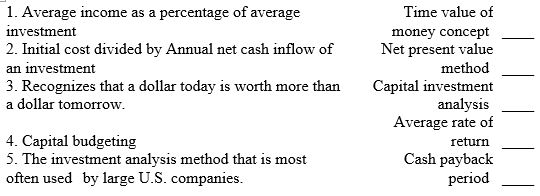
(Essay)
4.8/5 (73)
(73) If a proposed expenditure of $70,000 for a fixed asset with a 4-year life has an annual expected net cash flow and net income of $32,000 and $12,000, respectively, the cash payback period is 2.5 years.
(True/False)
4.9/5 (58)
(58) Methods that ignore present value in capital investment analysis include the internal rate of return method.
(True/False)
4.9/5 (82)
(82) The method of analyzing capital investment proposals that divides the estimated average annual income by the average investment is:
(Multiple Choice)
4.8/5 (63)
(63) A company is considering the purchase of a new machine for $48,000. Management expects that the machine can produce sales of $16,000 each year for the next 10 years. Expenses are expected to include direct materials, direct labor, and factory overhead totaling $8,000 per year plus depreciation of $4,000 per year. All revenues and expenses except depreciation are on a cash basis. The payback period for the machine is 12 years.
(True/False)
4.8/5 (86)
(86) The management of River Corporation is considering the purchase of a new machine costing $380,000. The company's desired rate of return is 6%. The present value factor for an annuity of $1 at interest of 6% for 5 years is 4.212. In addition to the foregoing information, use the following data in determining the acceptability in this situation: 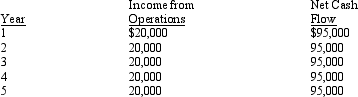 The cash payback period for this investment is:
 (Multiple Choice)
4.7/5 (79)
(79) The excess of the cash flowing in from revenues over the cash flowing out for expenses is termed net discounted cash flow.
(True/False)
4.7/5 (80)
(80) The accounting rate of return is a measure of profitability computed by dividing the average annual cash flows from an asset by the average amount invested in the asset.
(True/False)
4.9/5 (89)
(89) A project is estimated to cost $273,840 and provide annual cash flows of $60,000 for seven years. Determine the internal rate of return for this project, using the following table.
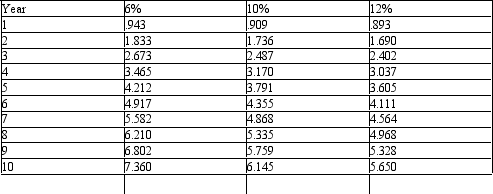
(Essay)
4.9/5 (75)
(75) Which method of evaluating capital investment proposals uses present value concepts to compute the rate of return from the net cash flows expected from capital investment proposals?
(Multiple Choice)
4.8/5 (75)
(75) A series of equal cash flows at fixed intervals is termed an annuity.
(True/False)
4.9/5 (89)
(89) In calculating the present value of an investment in equipment, the present value of the terminal residual value should be added to the cash inflows.
(True/False)
4.8/5 (74)
(74) The present value factor for an annuity of $1 is determined using which of the following formulas?
(Multiple Choice)
4.8/5 (80)
(80) When several alternative investment proposals of the same amount are being considered, the one with the largest net present value is the most desirable. If the alternative proposals involve different amounts of investment, it is useful to prepare a relative ranking of the proposals by using a(n):
(Multiple Choice)
4.9/5 (90)
(90) Methods that ignore present value in capital investment analysis include the average rate of return method.
(True/False)
4.9/5 (76)
(76) By converting dollars to be received in the future into current dollars, the present value methods take into consideration that money:
(Multiple Choice)
4.9/5 (87)
(87) 
Filters
- Essay(0)
- Multiple Choice(0)
- Short Answer(0)
- True False(0)
- Matching(0)