



 Chat with AI
Exam 26: Capital Investment Analysis

Exam 1: Introduction to Accounting and Business190 Questions
Exam 2: Analyzing Transactions224 Questions
Exam 3: The Adjusting Process179 Questions
Exam 4: Completing the Accounting Cycle194 Questions
Exam 5: Accounting Systems160 Questions
Exam 6: Accounting for Merchandising Businesses215 Questions
Exam 7: Inventories165 Questions
Exam 8: Sarbanes-Oxley, Internal Control, and Cash176 Questions
Exam 9: Receivables140 Questions
Exam 10: Fixed Assets and Intangible Assets170 Questions
Exam 11: Current Liabilities and Payroll169 Questions
Exam 12: Accounting for Partnerships and Limited Liability Companies190 Questions
Exam 13: Corporations: Organization, Stock Transactions, and Dividends165 Questions
Exam 14: Long-Term Liabilities: Bonds and Notes185 Questions
Exam 15: Investments and Fair Value Accounting133 Questions
Exam 16: Statement of Cash Flows160 Questions
Exam 17: Financial Statement Analysis185 Questions
Exam 18: Managerial Accounting Concepts and Principles173 Questions
Exam 19: Job Order Costing173 Questions
Exam 20: Process Cost Systems177 Questions
Exam 21: Cost Behavior and Cost-Volume-Profit Analysis215 Questions
Exam 22: Budgeting188 Questions
Exam 23: Performance Evaluation Using Variances From Standard Costs161 Questions
Exam 24: Performance Evaluation for Decentralized Operations200 Questions
Exam 25: Differential Analysis and Product Pricing162 Questions
Exam 26: Capital Investment Analysis179 Questions
Select questions type


Norton Company is considering a project that will require an initial investment of $750,000 and will return $200,000 each year for five years.
Required:
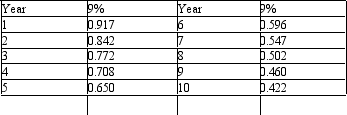
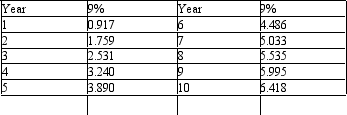
If taxes are ignored and the required rate of return is 9%, what is the project's net present value? Based on this analysis, should Norton Company proceed with the project?
Below is a table for the present value of $1 at compound interest.
 Below is a table for the present value of an annuity of $1 at compound interest.
Below is a table for the present value of an annuity of $1 at compound interest.
(Essay)
4.8/5  (75)
(75) Below is a table for the present value of $1 at compound interest. 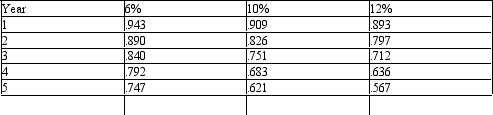 Below is a table for the present value of an annuity of $1 at compound interest.
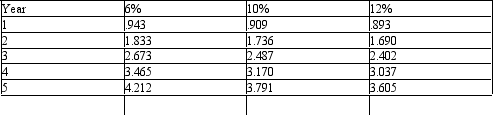 Using the tables above, what is the present value of $6,000 (rounded to the nearest dollar) to be received at the end of each of the next 4 years, assuming an earnings rate of 10%?
Below is a table for the present value of an annuity of $1 at compound interest.
Using the tables above, what is the present value of $6,000 (rounded to the nearest dollar) to be received at the end of each of the next 4 years, assuming an earnings rate of 10%? (Multiple Choice)
4.9/5 (77)
(77) A qualitative characteristic that may impact upon capital investment analysis is employee morale.
(True/False)
4.9/5 (84)
(84) Using the following partial table of present value of $1 at compound interest, determine the present value of $20,000 to be received four years hence, with earnings at the rate of 10% a year: 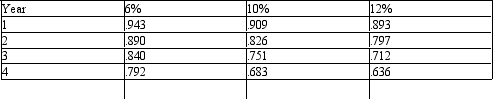
(Multiple Choice)
4.8/5 (88)
(88) Proposals A and B each cost $500,000 and have 5-year lives. Proposal A is expected to provide equal annual net cash flows of $109,000, while the net cash flows for Proposal B are as follows:
 Determine the cash payback period for each proposal. Round answers to two decimal places.
 (Essay)
4.9/5 (75)
(75) The management of Charlton Corporation is considering the purchase of a new machine costing $380,000. The company's desired rate of return is 6%. The present value factor for an annuity of $1 at interest of 6% for 5 years is 4.212. In addition to the foregoing information, use the following data in determining the acceptability in this situation: 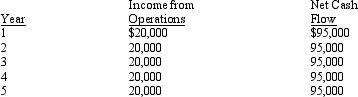 The cash payback period for this investment is:
 (Multiple Choice)
4.8/5 (96)
(96) The cash payback method of capital investment analysis is one of the methods referred to as a present value method.
(True/False)
4.8/5 (80)
(80) In capital rationing, alternative proposals that survive initial and secondary screening are normally evaluated in terms of:
(Multiple Choice)
4.9/5 (89)
(89) Determine the average rate of return for a project that is estimated to yield total income of $250,000 over four years, cost $480,000, and has a $20,000 residual value.
(Essay)
4.8/5 (85)
(85) In calculating the net present value of an investment in equipment, the required investment and its terminal residual value should be subtracted from the present value of all future cash inflows.
(True/False)
4.9/5 (84)
(84) The excess of the cash flowing in from revenues over the cash flowing out for expenses is termed net cash flow.
(True/False)
4.9/5 (94)
(94) A qualitative characteristic that may impact upon capital investment analysis is manufacturing productivity.
(True/False)
4.9/5 (72)
(72) The production department is proposing the purchase of an automatic insertion machine. They have identified 3 machines and have asked the accountant to analyze them to determine the best average rate of return. 
(Multiple Choice)
4.9/5 (92)
(92) The method of analyzing capital investment proposals in which the estimated average annual income is divided by the average investment is the average rate of return method.
(True/False)
4.8/5 (78)
(78) The accounting rate of return method of analyzing capital budgeting decisions measures the average rate of return from using the asset over its entire life.
(True/False)
4.8/5 (67)
(67) Dickerson Co. is evaluating a project requiring a capital expenditure of $810,000. The project has an estimated life of four years and no salvage value. The estimated net income and net cash flow from the project are as follows:
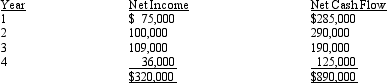 The company's minimum desired rate of return is 12%. The present value of $1 at compound interest of 12% for 1, 2, 3, and 4 years is .893, .797, .712, and .636, respectively.
Required:
Determine the average rate of return on investment, including the effect of depreciation on the investment.
The company's minimum desired rate of return is 12%. The present value of $1 at compound interest of 12% for 1, 2, 3, and 4 years is .893, .797, .712, and .636, respectively.
Required:
Determine the average rate of return on investment, including the effect of depreciation on the investment. (Essay)
5.0/5 (90)
(90) The amount of the average investment for a proposed investment of $90,000 in a fixed asset, with a useful life of four years, straight-line depreciation, no residual value, and an expected total net income of $21,600 for the 4 years, is:
(Multiple Choice)
5.0/5 (81)
(81) A company is considering the purchase of a new piece of equipment for $90,000. Predicted annual cash inflows from the investment are $36,000 (year 1), $30,000 (year 2), $18,000 (year 3), $12,000 (year 4), and $6,000 (year 5). The average income from operations over the 5-year life is $20,400. The payback period is 3.5 years.
(True/False)
4.9/5 (85)
(85) The primary advantages of the average rate of return method are its ease of computation and the fact that:
(Multiple Choice)
4.9/5 (69)
(69) The time expected to pass before the net cash flows from an investment would return its initial cost is called the amortization period.
(True/False)
4.7/5 (85)
(85) 
Filters
- Essay(0)
- Multiple Choice(0)
- Short Answer(0)
- True False(0)
- Matching(0)