



 Chat with AI
Exam 15: Shareholders Equity: Capital Contributions and Distributions

Exam 1: Introduction to Business Activities and Overview of Financial Statements and the Reporting Process139 Questions
Exam 2: The Basics of Record Keeping and Financial Statement Preparation: Balance Sheet115 Questions
Exam 3: The Basics of Record Keeping and Financial Statement Preparation: Income Statement129 Questions
Exam 4: Balance Sheet: Presenting and Analyzing Resources and Financing120 Questions
Exam 5: Income Statement: Reporting Results of Operating Activities109 Questions
Exam 6: Statement of Cash Flows140 Questions
Exam 7: Introduction to Financial Statement Analysis166 Questions
Exam 8: Revenue Recognition, Receivables, and Advances From Customers138 Questions
Exam 9: Working Capital167 Questions
Exam 10: Long-Lived Tangible and Intangible Assets182 Questions
Exam 11: Notes, Bonds, and Leases139 Questions
Exam 12: Liabilities: Off-Balance Sheet Financing, Retirement Benefits, and Income Taxes117 Questions
Exam 13: Marketable Securities and Derivatives144 Questions
Exam 14: Intercorporate Investments in Common Stock103 Questions
Exam 15: Shareholders Equity: Capital Contributions and Distributions199 Questions
Exam 16: Statement of Cash Flows: Another Look146 Questions
Exam 17: Synthesis and Extensions246 Questions
Select questions type


Firms use the par value method when management and the governing board do not intend to reissue shares within a reasonable amount of time or when jurisdiction-specific corporation laws define reacquired shares as retired shares.
(True/False)
4.8/5  (81)
(81) Discuss why firms may issue capital stock (preferred or common) for cash or for noncash assets. Discuss the issuance of capital stock for services received.
(Essay)
4.8/5 (83)
(83) Selected data from the comparative balance sheets of Mock Company as of December 31, Year 1, and Year 2 appear below:
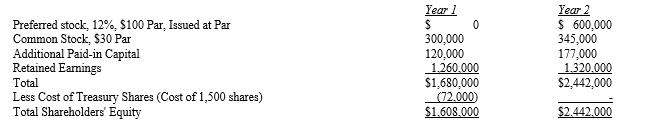 The following transactions occurred during Year 2:
a. March 1, Year 2: The company resold the Treasury shares on the market for $57 per share.
b. June 30, Year 2: The company declared and issued a 10-percent stock dividend at a time when the market price was $63 per share.
c. September 15, Year 2: The company issued additional shares of common stock on the open market for cash.
d. November 16, Year 2: The company issued new preferred shares on the open market for cash.
e. December 31, Year 2: Net income for Year 2 was $195,000. The company declared and paid cash dividends of $72,000 on the last day of the year.
Required:
Prepare journal entries for each of the transactions and events affecting these shareholders' equity accounts during Year 2.
The following transactions occurred during Year 2:
a. March 1, Year 2: The company resold the Treasury shares on the market for $57 per share.
b. June 30, Year 2: The company declared and issued a 10-percent stock dividend at a time when the market price was $63 per share.
c. September 15, Year 2: The company issued additional shares of common stock on the open market for cash.
d. November 16, Year 2: The company issued new preferred shares on the open market for cash.
e. December 31, Year 2: Net income for Year 2 was $195,000. The company declared and paid cash dividends of $72,000 on the last day of the year.
Required:
Prepare journal entries for each of the transactions and events affecting these shareholders' equity accounts during Year 2. (Essay)
4.7/5 (66)
(66) Evenrude Corporation is a new company about to issue stock.The corporation sells 2,000 shares of common stock (par value $2) at $10 per share.The journal entry to record this transaction is:
(Multiple Choice)
4.8/5 (87)
(87) Which of the following is/are true regarding stock warrants?
(Multiple Choice)
4.8/5 (81)
(81) A firm must pay all current and previously postponed preferred dividends before it can pay any dividends on common shares, thus the preferred shares have the feature called
(Multiple Choice)
4.9/5 (82)
(82) Describe convertible preferred share features from the perspective of the preferred shareholders and the issuing firms. Preferred shares may provide for redemption by the issuing firm in the future. What types of redemption rights or obligations do redeemable preferred shares carry?
(Essay)
4.9/5 (87)
(87) (CMA adapted, Dec 89 #8) On January 1, Year 1, Toga Corporation granted stock options to top management.The options were exercisable within 4 years from the date of grant only if the employee was still in Toga's employ.When computing year-end earnings per share at December 31, Year 1, Toga should
(Multiple Choice)
4.7/5 (92)
(92) Which of the following is issued to shareholders by a corporation as evidence of the ownership of rights to acquire its unissued or treasury stock?
(Multiple Choice)
4.8/5 (68)
(68) Most publicly traded firms operate as corporations.The corporate form has which of the following advantage(s)?
(Multiple Choice)
4.9/5 (65)
(65) Excerpts from the Statement of Financial Position for Baldwin Corporation as of September 30, Year 5, are presented below.
Cash \ 950,000 Accounts receivable (net) 1,675,000 Inventories 2.806.000 Total current assets \ 5.431.000 Accounts payable \ 1,004,000 Accrued liabilities 785,000 Total current liabilities \1 ,789,000 The Board of directors of Baldwin Corporation met on October 4, Year 5, and declared regular quarterly cash dividends amounting to $750,000 ($0.60 per share).The dividend is payable on October 25, Year 5, to all shareholders of record as of October 12, Year 5.
Assume that the only transactions to affect Baldwin Corporation during October Year 5 are the dividend transactions and that the closing entries have been made.
(CMA adapted, Dec 89 #17) Refer to the Baldwin Corporation example.If the dividend declared by Baldwin Corporation had been a ten percent stock dividend instead of a cash dividend, Baldwin's total shareholders' equity would have been
(Multiple Choice)
4.8/5 (91)
(91) Treasury stock or treasury shares are shares a firm has previously issued and later reacquired. Which of the following is/are not true?
(Multiple Choice)
4.8/5 (87)
(87) IFRS does not require firms to allocate a portion of the issue price of convertible bonds and convertible preferred stock to the conversion feature.
(True/False)
4.9/5 (83)
(83) How would total stockholders' equity be affected by the declaration of each of the following? Stock Stock
Dividend Split
(Multiple Choice)
4.8/5 (87)
(87) Both U.S.GAAP and IFRS do not require firms to recognize the fair value of employee stock options in the accounting records.
(True/False)
4.9/5 (78)
(78) 
Filters
- Essay(0)
- Multiple Choice(0)
- Short Answer(0)
- True False(0)
- Matching(0)