



 Chat with AI
Exam 14: Intercorporate Investments in Common Stock

Exam 1: Introduction to Business Activities and Overview of Financial Statements and the Reporting Process139 Questions
Exam 2: The Basics of Record Keeping and Financial Statement Preparation: Balance Sheet115 Questions
Exam 3: The Basics of Record Keeping and Financial Statement Preparation: Income Statement129 Questions
Exam 4: Balance Sheet: Presenting and Analyzing Resources and Financing120 Questions
Exam 5: Income Statement: Reporting Results of Operating Activities109 Questions
Exam 6: Statement of Cash Flows140 Questions
Exam 7: Introduction to Financial Statement Analysis166 Questions
Exam 8: Revenue Recognition, Receivables, and Advances From Customers138 Questions
Exam 9: Working Capital167 Questions
Exam 10: Long-Lived Tangible and Intangible Assets182 Questions
Exam 11: Notes, Bonds, and Leases139 Questions
Exam 12: Liabilities: Off-Balance Sheet Financing, Retirement Benefits, and Income Taxes117 Questions
Exam 13: Marketable Securities and Derivatives144 Questions
Exam 14: Intercorporate Investments in Common Stock103 Questions
Exam 15: Shareholders Equity: Capital Contributions and Distributions199 Questions
Exam 16: Statement of Cash Flows: Another Look146 Questions
Exam 17: Synthesis and Extensions246 Questions
Select questions type


If Barton Company purchases a minority active interest in Laramie Company for $150,000, Barton will make which of the following entries to record the purchase using the equity method?

Free
(Multiple Choice)
4.9/5  (89)
(89) Correct Answer: Verified
B
Assume that P uses the equity method of accounting for its investment in S.Solve for the unknown in each of the following independent cases:
CASEA CASE B CASE C P's ownership of S A 30\% 40\% Investment in beginning of year \ 100 B \ 130 Investment in end of year 105 \ 128 C S's income (loss) 100 90 40 S's dividends paid 80 30 20
Free
(Short Answer)
4.7/5 (89)
(89) Correct Answer:Verified
Verifieda. 25%
b. $110
c. $138
In 2013, Kentucky Inc. purchased stock as follows:
(a) Acquired 2,000 shares of Gallen Corp. common stock (par value $20) in exchange for 1,200 shares of Kentucky Inc. preferred stock (par value $30). The preferred stock had a market value of $75 per share on the date of the exchange.
(b) Purchased 800 shares of Carlton Corp. common stock (par value $10) at $70 per share, plus a brokerage fee of $800.
At December 31, 2013, the market values of the securities were as follows:
 The investments in common stock are classified by Kentucky Inc. as available-for-sale securities accounted for by the cost method. The fiscal year of Kentucky ends on December 31.
(1) Prepare all entries relating to the investments in common stock for 2013.
(2) Prepare the entry to record the sale of 200 shares of Carlton Corp. common stock on January 15, 2014, at $74 per share.
(3) Prepare the entry to reclassify the remaining 600 shares of Carlton Corp. common stock from available-for-sale securities to trading securities on January 31, 2014. The stock was selling at $67 per share on that date.
The investments in common stock are classified by Kentucky Inc. as available-for-sale securities accounted for by the cost method. The fiscal year of Kentucky ends on December 31.
(1) Prepare all entries relating to the investments in common stock for 2013.
(2) Prepare the entry to record the sale of 200 shares of Carlton Corp. common stock on January 15, 2014, at $74 per share.
(3) Prepare the entry to reclassify the remaining 600 shares of Carlton Corp. common stock from available-for-sale securities to trading securities on January 31, 2014. The stock was selling at $67 per share on that date.
Free
(Essay)
4.8/5 (88)
(88) Correct Answer:Verified
Verified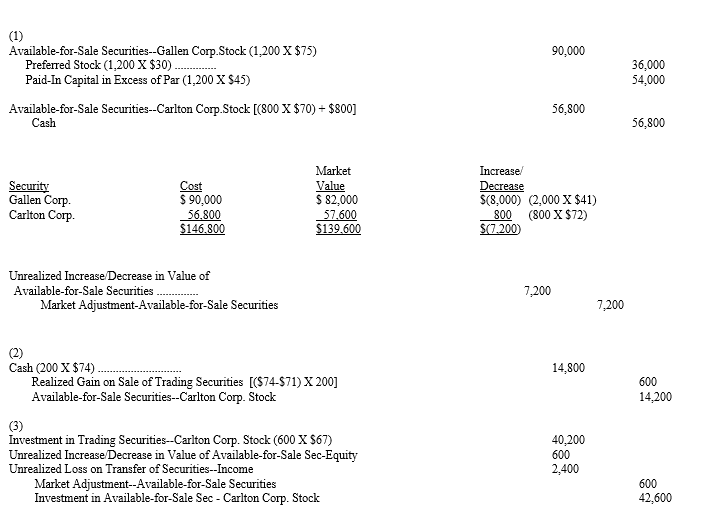
(CMA adapted, Dec 92 #9) In a business combination that is accounted for as a purchase and does not create negative goodwill, the assets of the acquired company are to be recorded on the books of the acquiring company at
(Multiple Choice)
4.9/5 (83)
(83) The Flavor Company owns 25 percent of the shares of Mac, and accounts for its investment using the equity method.During the year Mac earned income of $1,500 million and declared dividends.Flavor's share of the dividends were $150.0 million.
Required:
a. What amount of income did Flavor report from its investment in Mac?
b. What amount of cash flow from operations did Flavor report for the year from its investment in Mac?
(Short Answer)
4.7/5 (86)
(86) Which of the following investments in securities would require the preparation of consolidated financial statements by the investor corporation?
(Multiple Choice)
4.9/5 (84)
(84) U.S.GAAP and IFRS view investments of between 20% and 50% of the voting stock of another company as minority, active investments unless evidence indicates that the investor cannot exert significant influence.
(True/False)
4.8/5 (78)
(78) If an entity qualifies as a variable interest entity (VIE), U.S.GAAP requires the primary beneficiary of the VIE to consolidate the VIE.
(True/False)
4.8/5 (87)
(87) U.S.GAAP and IFRS require firms to account for business combinations using the _____ method.
(Multiple Choice)
4.9/5 (85)
(85) Pareto Corporation owns 40% of Spring Corporation.During Year 3, Spring has net income of $60,000.What entry should Pareto record related to its investment in Spring during Year 3?
(Multiple Choice)
4.9/5 (84)
(84) Purchaser Corporation acquires 30% of the outstanding voting common shares of the Investee Corporation for $600,000.Purchaser Corporation acquires the investment in Investee Corporation by buying previously issued shares of Investee Corporation from other investors. When Purchaser Corporation acquired 30% of Investee Corporation's common shares for $600,000, Investee Corporation's total shareholders' equity was $1.5 million.Purchaser Corporation's cost exceeds the carrying value of the net assets acquired by $150,000 [ $600,000 - (0.30 x $1,500,000)]. What is/are the accounting procedure(s) for this premium?
(Multiple Choice)
4.7/5 (73)
(73) What role does management intent play in the accounting treatment of marketable equity securities?
(Essay)
4.9/5 (80)
(80) The rationale for the equity method is that it better measures an investor's income from investing activities when, because of its ownership interest, it can exert significant influence over the operations and dividend policy of the investee.
(True/False)
4.7/5 (62)
(62) Describe the accounting and reporting of investments in common stock.
(Essay)
4.9/5 (85)
(85) For various reasons, a single economic entity may exist in the form of a parent and several legally separate subsidiaries, often referred to as an affiliated group.
(True/False)
4.7/5 (73)
(73) Dividends and interest from Minority, Passive Investments become income when the
(Multiple Choice)
4.7/5 (82)
(82) 
Filters
- Essay(0)
- Multiple Choice(0)
- Short Answer(0)
- True False(0)
- Matching(0)