



 Chat with AI
Exam 12: Intermolecular Forces: Liquids, Solids, and Phase Changes

Exam 1: Keys to the Study of Chemistry79 Questions
Exam 2: The Components of Matter105 Questions
Exam 3: Stoichiometry of Formulas and Equations87 Questions
Exam 4: The Major Classes of Chemical Reactions124 Questions
Exam 5: Gases and the Kinetic-Molecular Theory115 Questions
Exam 6: Thermochemistry: Energy Flow and Chemical Change85 Questions
Exam 7: Quantum Theory and Atomic Structure83 Questions
Exam 8: Electron Configuration and Chemical Periodicity85 Questions
Exam 9: Models of Chemical Bonding74 Questions
Exam 10: The Shapes of Molecules109 Questions
Exam 11: Theories of Covalent Bonding58 Questions
Exam 12: Intermolecular Forces: Liquids, Solids, and Phase Changes111 Questions
Exam 13: The Properties of Mixtures: Solutions and Colloids105 Questions
Exam 14: Periodic Patterns in the Main Group Elements: Bonding, Structure, and Reactivity118 Questions
Exam 15: Organic Compounds and the Atomic Properties of Carbon118 Questions
Exam 16: Kinetics: Rates and Mechanisms of Chemical Reactions88 Questions
Exam 17: Equilibrium: the Extent of Chemical Reactions104 Questions
Exam 18: Acid-Base Equilibria103 Questions
Exam 19: Ionic Equilibria in Aqueous Systems119 Questions
Exam 20: Thermodynamics: Entropy, Free Energy, and the Direction of Chemical Reactions94 Questions
Exam 21: Electrochemistry: Chemical Change and Electrical Work102 Questions
Exam 22: The Elements in Nature and Industry57 Questions
Exam 23: The Transition Elements and Their Coordination Compounds92 Questions
Exam 24: Nuclear Reactions and Their Applications94 Questions
Select questions type


In a transistor, the current through one semiconductor junction controls the current through a neighboring junction.
(True/False)
4.9/5  (75)
(75) A temperature increase causes __________________ in the conductivity of a conductor.
(Multiple Choice)
4.9/5 (73)
(73) When the adhesive forces between a liquid and the walls of a capillary tube are greater than the cohesive forces within the liquid
(Multiple Choice)
4.9/5 (87)
(87) A 5.00 g sample of water vapor, initially at 155°C is cooled at atmospheric pressure, producing ice at -55°C. Calculate the amount of heat energy lost by the water sample in this process, in kJ. Use the following data: specific heat capacity of ice is 2.09 J/gK; specific heat capacity of liquid water is 4.18 J/gK; specific heat capacity of water vapor is 1.84 J/gK; heat of fusion of ice is 336 J/g; heat of vaporization of water is 2260 J/g.
(Multiple Choice)
4.8/5 (84)
(84) Which of the following liquids is likely to have the highest surface tension?
(Multiple Choice)
5.0/5 (77)
(77) When identical particles pack in a simple cubic lattice, there is/are ____ particle(s) per unit cell.
(Multiple Choice)
4.9/5 (63)
(63) The meniscus of mercury in a glass capillary tube is convex because of
(Multiple Choice)
4.9/5 (81)
(81) Smectic liquid crystals are more highly ordered than either nematic or cholesteric liquid crystals.
(True/False)
4.9/5 (89)
(89) What word best describes the type of liquid crystal represented below? 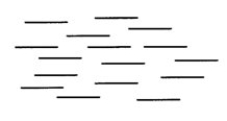
(Multiple Choice)
4.9/5 (83)
(83) Examine the following phase diagram and identify the feature represented by point B. 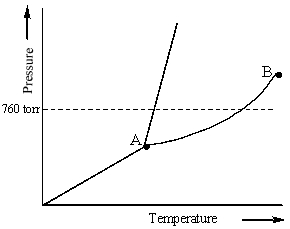
(Multiple Choice)
4.8/5 (87)
(87) 
Filters
- Essay(0)
- Multiple Choice(0)
- Short Answer(0)
- True False(0)
- Matching(0)