



 Chat with AI
Exam 12: Intermolecular Forces: Liquids, Solids, and Phase Changes

Exam 1: Keys to the Study of Chemistry79 Questions
Exam 2: The Components of Matter105 Questions
Exam 3: Stoichiometry of Formulas and Equations87 Questions
Exam 4: The Major Classes of Chemical Reactions124 Questions
Exam 5: Gases and the Kinetic-Molecular Theory115 Questions
Exam 6: Thermochemistry: Energy Flow and Chemical Change85 Questions
Exam 7: Quantum Theory and Atomic Structure83 Questions
Exam 8: Electron Configuration and Chemical Periodicity85 Questions
Exam 9: Models of Chemical Bonding74 Questions
Exam 10: The Shapes of Molecules109 Questions
Exam 11: Theories of Covalent Bonding58 Questions
Exam 12: Intermolecular Forces: Liquids, Solids, and Phase Changes111 Questions
Exam 13: The Properties of Mixtures: Solutions and Colloids105 Questions
Exam 14: Periodic Patterns in the Main Group Elements: Bonding, Structure, and Reactivity118 Questions
Exam 15: Organic Compounds and the Atomic Properties of Carbon118 Questions
Exam 16: Kinetics: Rates and Mechanisms of Chemical Reactions88 Questions
Exam 17: Equilibrium: the Extent of Chemical Reactions104 Questions
Exam 18: Acid-Base Equilibria103 Questions
Exam 19: Ionic Equilibria in Aqueous Systems119 Questions
Exam 20: Thermodynamics: Entropy, Free Energy, and the Direction of Chemical Reactions94 Questions
Exam 21: Electrochemistry: Chemical Change and Electrical Work102 Questions
Exam 22: The Elements in Nature and Industry57 Questions
Exam 23: The Transition Elements and Their Coordination Compounds92 Questions
Exam 24: Nuclear Reactions and Their Applications94 Questions
Select questions type


For the solid forms of the following elements, which one is most likely to be of the molecular type?
(Multiple Choice)
4.8/5  (65)
(65) When liquid bromine is cooled to form a solid, which of the following types of solid would it form?
(Multiple Choice)
4.9/5 (72)
(72) The phase diagram of a substance can be used to obtain the vapor pressure of that substance at a given temperature.
(True/False)
4.9/5 (80)
(80) Liquid crystal displays are most commonly constructed of smectic type liquid crystals.
(True/False)
4.9/5 (82)
(82) Select the pair of substances in which the one with the higher vapor pressure at a given temperature is listed first.
(Multiple Choice)
4.9/5 (86)
(86) a. Explain what is meant by the term "unit cell".
b. Copper metal has a face-centered cubic unit cell. The edge length of the unit cell is 361 pm, and the atomic weight of copper is 63.55 amu. Calculate the density of the copper in g/cm3.
(1 amu = 1.661 × 10⁻²⁴ g.)
c. From the data in (b), calculate the radius of a copper atom in pm.
(Essay)
5.0/5 (92)
(92) Which of the following has a boiling point which does not fit the general trend?
(Multiple Choice)
5.0/5 (77)
(77) Examine the phase diagram for the substance Bogusium (Bo) and select the correct statement. 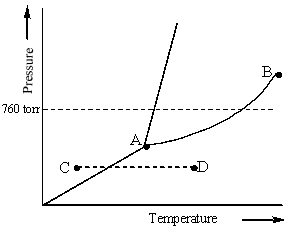
(Multiple Choice)
4.8/5 (81)
(81) Octane is a component of fuel used in internal combustion engines. The dominant intermolecular forces in octane are
(Multiple Choice)
4.7/5 (85)
(85) Strontium metal crystallizes in a cubic unit cell which has an edge length of 612 pm. If the mass of an atom of Sr is 87.62 amu, and the density of Sr metal is 2.54 g/cm3, calculate the number of atoms per unit cell. (1 amu = 1.661 × 10⁻²⁴ g.)
(Short Answer)
4.9/5 (75)
(75) Assuming that atoms are spherical, calculate the fraction of space which is occupied by atoms (i.e., the packing efficiency) in a metal with a face-centered cubic unit cell.
(Short Answer)
4.8/5 (71)
(71) Examine the following phase diagram and determine what phase exists at point F. 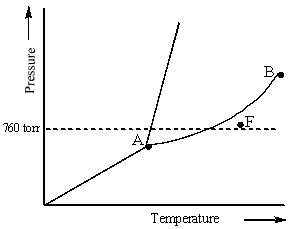
(Multiple Choice)
4.8/5 (73)
(73) Which of the following should have the highest surface tension at a given temperature?
(Multiple Choice)
4.7/5 (79)
(79) In the packing of identical atoms with cubic unit cells, the packing efficiency increases as the coordination number increases.
(True/False)
4.8/5 (77)
(77) Germanium is a semiconductor. With the aid of diagrams showing bands of molecular orbital, explain why it is a poor conductor and how doping it with phosphorus increases its conductivity.
(Essay)
4.8/5 (81)
(81) The highest temperature at which superconductivity has been achieved is approximately
(Multiple Choice)
4.9/5 (86)
(86) 
Filters
- Essay(0)
- Multiple Choice(0)
- Short Answer(0)
- True False(0)
- Matching(0)