



 Chat with AI
Exam 6: Process Costing

Exam 1: Introduction to Cost Management115 Questions
Exam 2: Basic Cost Management Concepts161 Questions
Exam 3: Cost Behavior132 Questions
Exam 4: Activity-Based Costing154 Questions
Exam 5: Product and Service Costing: Job-Order System102 Questions
Exam 6: Process Costing137 Questions
Exam 7: Allocating Costs of Support Departments and Joint Products143 Questions
Exam 8: Budgeting for Planning and Control167 Questions
Exam 9: Standard Costing: a Functional-Based Control Approach86 Questions
Exam 10: Decentralization: Responsibility Accounting, Performance Evaluation, and Transfer Pricing110 Questions
Exam 11: Strategic Cost Management121 Questions
Exam 12: Activity-Based Management116 Questions
Exam 13: The Balanced Scorecard: Strategic-Based Control92 Questions
Exam 14: Quality and Environmental Cost Management157 Questions
Exam 15: Lean Accounting and Productivity Measurement137 Questions
Exam 16: Cost-Volume-Profit Analysis108 Questions
Exam 17: Activity Resource Usage Model and Tactical Decision Making98 Questions
Exam 18: Pricing and Profitability Analysis102 Questions
Exam 19: Capital Investment97 Questions
Exam 20: Inventory Management: Economic Order Quantity, Jit, and the Theory of Constraints98 Questions
Select questions type


Figure 6-11 Champ Inc.manufactures a product that passes through two processes: mixing and molding.All manufacturing costs are added uniformly in the Mixing Department.Information for the Mixing Department for October follows:
 During October, 26,750 units were completed and transferred to the Molding Department.The following costs were incurred by the Mixing Department during October:
 -Refer to Figure 6-11.There were 3,750 units that were 80 percent complete remaining in Mixing at October 31.Total cost per equivalent unit of production using the FIFO method is
During October, 26,750 units were completed and transferred to the Molding Department.The following costs were incurred by the Mixing Department during October:
-Refer to Figure 6-11.There were 3,750 units that were 80 percent complete remaining in Mixing at October 31.Total cost per equivalent unit of production using the FIFO method is (Multiple Choice)
4.8/5  (87)
(87) Figure 6-12 Reed Company manufactures steno pads.There are two processes: printing and binding.
The following information is given for the printing department for November.
 The company uses FIFO inventory assumption.
-
Refer to Figure 6-12.What are the FIFO cost per unit for materials?
The company uses FIFO inventory assumption.
-
Refer to Figure 6-12.What are the FIFO cost per unit for materials? (Multiple Choice)
4.8/5 (80)
(80) "Total costs to account for" does NOT include which of the following costs?
(Multiple Choice)
4.9/5 (84)
(84) Figure 6-6 Pelosi Company manufactures chairs.The following information was given for the company:
Units, beginning work in process 0
Units started 20,000
Units completed ?
Units, ending work in process 5,000
Cost of direct materials $440,000
Cost of conversion $ 64,000
Materials in the ending inventory were 100 percent complete and conversion in the ending inventory was 20 percent complete.
-
Refer to Figure 6-6.What cost is assigned to ending work in process?
(Multiple Choice)
4.8/5 (79)
(79) Figure 6-12 Reed Company manufactures steno pads.There are two processes: printing and binding.
The following information is given for the printing department for November.
The company uses FIFO inventory assumption.
-
Refer to Figure 6-12.What are the FIFO equivalent units for materials?
The company uses FIFO inventory assumption.
-
Refer to Figure 6-12.What are the FIFO equivalent units for materials? (Multiple Choice)
5.0/5 (89)
(89) The two methods used to determine equivalent units of production are
(Multiple Choice)
4.7/5 (84)
(84) _______________ is (are) the whole units that could have been produced in a period given the amount of manufacturing inputs used.
(Multiple Choice)
4.8/5 (79)
(79) Figure 6-9 Gill Corporation adds raw materials to production at the beginning of the process in the Assembly Department.Materials data for this department for March 2011 are as follows:
 Beginning inventory was 70 percent complete.Ending inventory was 40 percent complete.
-
Refer to Figure 6-9.How many equivalent units for conversion costs would there be for Gill Corporation in March using the FIFO method?
Beginning inventory was 70 percent complete.Ending inventory was 40 percent complete.
-
Refer to Figure 6-9.How many equivalent units for conversion costs would there be for Gill Corporation in March using the FIFO method? (Multiple Choice)
4.9/5 (91)
(91) Figure 6-11 Champ Inc.manufactures a product that passes through two processes: mixing and molding.All manufacturing costs are added uniformly in the Mixing Department.Information for the Mixing Department for October follows:
 During October, 26,750 units were completed and transferred to the Molding Department.The following costs were incurred by the Mixing Department during October:
 -Refer to Figure 6-11.There were 2,500 units that were 80 percent complete remaining in Mixing at October 31.The amount of total costs to account for is
During October, 26,750 units were completed and transferred to the Molding Department.The following costs were incurred by the Mixing Department during October:
-Refer to Figure 6-11.There were 2,500 units that were 80 percent complete remaining in Mixing at October 31.The amount of total costs to account for is (Multiple Choice)
4.9/5 (87)
(87) Figure 6-6 Pelosi Company manufactures chairs.The following information was given for the company:
Units, beginning work in process 0
Units started 20,000
Units completed ?
Units, ending work in process 5,000
Cost of direct materials $440,000
Cost of conversion $ 64,000
Materials in the ending inventory were 100 percent complete and conversion in the ending inventory was 20 percent complete.
-
Refer to Figure 6-6.What are the costs per unit for materials and conversion respectively?
(Multiple Choice)
4.8/5 (68)
(68) Figure 6-15 The Dodd Company uses a weighted average process costing system.The following information was reported for the Assembly Process for July.Materials are added at the beginning of the process and are 100%.
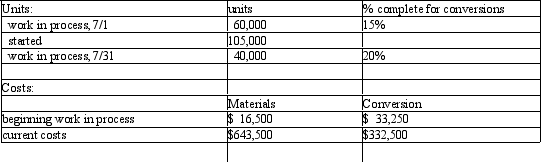 -Refer to Figure 6-15.What is the cost per unit for conversion?
 (Multiple Choice)
4.9/5 (89)
(89) Figure 6-8 The following information is available:
 Materials are added at the beginning of the process.
-
Refer to Figure 6-8.Beginning and ending units were 60 percent converted.How many equivalent units for materials would there be using the FIFO method?
Materials are added at the beginning of the process.
-
Refer to Figure 6-8.Beginning and ending units were 60 percent converted.How many equivalent units for materials would there be using the FIFO method? (Multiple Choice)
4.9/5 (86)
(86) Figure 6-2 Speakeasy Co.manufactures podiums.Production consists of three processes: cutting, assembly, and finishing.The following costs are given for May:
 There were no work in process inventories and 1,000 podiums were produced.
Refer to Figure 6-2.The journal entry to assign costs to the Assembly process would be
There were no work in process inventories and 1,000 podiums were produced.
Refer to Figure 6-2.The journal entry to assign costs to the Assembly process would be (Multiple Choice)
4.7/5 (77)
(77) Figure 6-21 Ring Company produces two types of product: Small and Large.Two work orders for two batches of the products are shown below, along with some additional cost information:
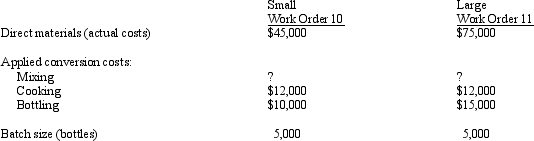 In the Mixing Department, conversion costs are applied on the basis of direct labor hours.Budgeted conversion costs for the department for the year were $50,000 for labor and $125,000 for overhead.Budgeted direct labor hours were 2,500.It takes three minutes to mix the ingredients needed for each bottle.
Small (Work Order 10) and Large (Work Order 11) flow through the Mixing Department first, then through the Cooking and Bottling departments.
-
Refer to Figure 6-21.What is Ring Company's journal entry to record materials used in the Mixing Department for Work Order 10?
In the Mixing Department, conversion costs are applied on the basis of direct labor hours.Budgeted conversion costs for the department for the year were $50,000 for labor and $125,000 for overhead.Budgeted direct labor hours were 2,500.It takes three minutes to mix the ingredients needed for each bottle.
Small (Work Order 10) and Large (Work Order 11) flow through the Mixing Department first, then through the Cooking and Bottling departments.
-
Refer to Figure 6-21.What is Ring Company's journal entry to record materials used in the Mixing Department for Work Order 10? (Multiple Choice)
4.8/5 (94)
(94) Transferred-in costs are accounted for in the same manner as
(Multiple Choice)
4.9/5 (80)
(80) The costs included in the cost per equivalent unit using the weighted average method are
(Multiple Choice)
4.9/5 (84)
(84) When products and their costs are moved from one process to the next process, these costs are referred to as
(Multiple Choice)
4.9/5 (75)
(75) 
Filters
- Essay(0)
- Multiple Choice(0)
- Short Answer(0)
- True False(0)
- Matching(0)