



 Chat with AI
Exam 1: The Fundamentals of Managerial Economics

Exam 1: The Fundamentals of Managerial Economics143 Questions
Exam 2: Market Forces: Demand and Supply150 Questions
Exam 3: Quantitative Demand Analysis170 Questions
Exam 4: The Theory of Individual Behavior179 Questions
Exam 5: The Production Process and Costs173 Questions
Exam 6: The Organization of the Firm157 Questions
Exam 7: The Nature of Industry123 Questions
Exam 8: Managing in Competitive, Monopolistic, and Monopolistically Competitive Markets130 Questions
Exam 9: Basic Oligopoly Models134 Questions
Exam 10: Game Theory: Inside Oligopoly140 Questions
Exam 11: Pricing Strategies for Firms With Market Power140 Questions
Exam 12: The Economics of Information128 Questions
Exam 13: Advanced Topics in Business Strategy89 Questions
Exam 14: A Managers Guide to Government in the Marketplace112 Questions
Select questions type


Suppose total benefits and total costs are given by B(Y) = 150Y - 10Y2 and C(Y) = 5Y2. Then marginal costs are:
(Multiple Choice)
4.8/5  (73)
(73) Generally when calculating profits as total revenue minus total costs, accounting profits are larger than economic profits because economists take into account:
(Multiple Choice)
5.0/5 (78)
(78) To maximize profits, a firm should continue to increase production of a good until:
(Multiple Choice)
4.9/5 (87)
(87) 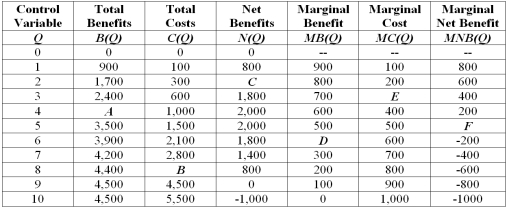
To maximize net benefits in the table, it is most appropriate to use: 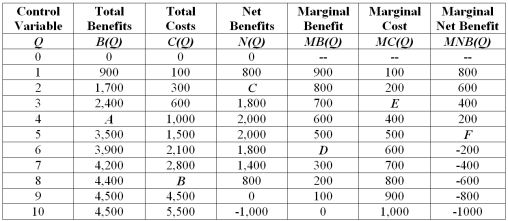
(Multiple Choice)
5.0/5 (60)
(60) Given the cost function C(Y) = 6Y2, what is the marginal cost?
(Multiple Choice)
4.8/5 (82)
(82) If the interest rate is 10 percent and cash flows are $1,000 at the end of year one and $2,000 at the end of year two, then the present value of these cash flows is:
(Multiple Choice)
4.9/5 (88)
(88) 
Suppose the growth rate of the firm's profit is 7 percent, the interest rate is 9 percent, and the current profits of the firm are $60 million. What is the value of the firm?
(Multiple Choice)
5.0/5 (77)
(77) Which is the correct statement about the relationship between government and the market?
(Multiple Choice)
4.8/5 (93)
(93) Suppose total benefits and total costs are given by B(Y) = 600Y - 12Y2 and C(Y) = 20Y2. What level of Y will yield the maximum net benefits?
(Multiple Choice)
4.9/5 (82)
(82) If the annual interest rate is 0 percent, the present value of receiving $1.10 in the next year is:
(Multiple Choice)
4.8/5 (80)
(80) Maximizing total benefits is equivalent to maximizing net benefits if and only if there are:
(Multiple Choice)
4.8/5 (73)
(73) Suppose the growth rate of the firm's profit is 7 percent, the interest rate is 10 percent, and the current profits of the firm are $120 million. What is the value of the firm?
(Multiple Choice)
4.9/5 (68)
(68) Which of the following is an implicit cost of going to college?
(Multiple Choice)
4.8/5 (78)
(78) Your firm's research department has estimated your total revenues to be R(Q) = 3,000 - 8Q2 and your total costs to be C(Q) = 100 + 2Q2. (Note that MB = 3,000 - 16Q and MC = 4Q.)
a. What level of Q maximizes net benefits?
b. What is marginal benefit at this level of Q?
c. What is marginal cost at this level of Q?
d. What is the maximum level of net benefits?
e. What is another word for net benefits in this example?
(Essay)
4.8/5 (81)
(81) Find the annual interest rate that would create a perpetual cash flow stream of $15,000 when the present value of the asset is $100,000.
(Multiple Choice)
4.9/5 (68)
(68) Suppose total benefits and total costs are given by B(Y) = 600Y - 12Y2 and C(Y) = 20Y2. What is the maximum level of net benefits?
(Multiple Choice)
4.8/5 (73)
(73) 
Filters
- Essay(0)
- Multiple Choice(0)
- Short Answer(0)
- True False(0)
- Matching(0)