



 Chat with AI
Exam 6: The Organization of the Firm

Exam 1: The Fundamentals of Managerial Economics143 Questions
Exam 2: Market Forces: Demand and Supply150 Questions
Exam 3: Quantitative Demand Analysis170 Questions
Exam 4: The Theory of Individual Behavior179 Questions
Exam 5: The Production Process and Costs173 Questions
Exam 6: The Organization of the Firm157 Questions
Exam 7: The Nature of Industry123 Questions
Exam 8: Managing in Competitive, Monopolistic, and Monopolistically Competitive Markets130 Questions
Exam 9: Basic Oligopoly Models134 Questions
Exam 10: Game Theory: Inside Oligopoly140 Questions
Exam 11: Pricing Strategies for Firms With Market Power140 Questions
Exam 12: The Economics of Information128 Questions
Exam 13: Advanced Topics in Business Strategy89 Questions
Exam 14: A Managers Guide to Government in the Marketplace112 Questions
Select questions type


Suppose a principal knew with certainty the level of profits that would result if an agent put forth maximum effort.
a. Would there be a principal-agent problem?
b. Devise two incentive contracts that would induce the manager to put forth maximum effort in this instance.
(Essay)
4.8/5  (75)
(75) If a firm manager has a base salary of $50,000 and also gets 2 percent of all profits, how much will his/her income be if revenues are $8,000,000 and profits are $2,000,000?
(Multiple Choice)
4.9/5 (63)
(63) The most commonly used negative incentive used by firms is:
(Multiple Choice)
4.8/5 (85)
(85) Which of the following methods might be an efficient way of obtaining inputs when specialized investments are not important?
(Multiple Choice)
4.8/5 (85)
(85) Which of the following involves the LEAST risk from the point of view of the employee?
(Multiple Choice)
4.9/5 (75)
(75) Which of the following is an outside incentive that forces managers to put forth maximal effort?
(Multiple Choice)
4.9/5 (81)
(81) Refer to the figure below. Suppose that the marginal benefit of writing a contract is $100 and the marginal cost of that contract is $100. Based on this information, the optimal contract length should be: 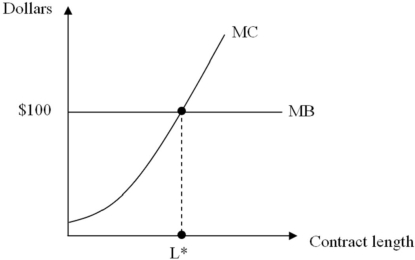
(Multiple Choice)
4.8/5 (76)
(76) Suppose compensation is given by W = 512,000 + 217π + 10.08S, where W = total compensation of the CEO, π = company profits (in millions) = $200, and S = sales (in millions) = $400. What percentage of the CEO's total earnings are tied to profits of the firm?
(Multiple Choice)
4.8/5 (91)
(91) Which of the following forms of payment is NOT an incentive plan?
(Multiple Choice)
4.8/5 (82)
(82) Which of the following payment plans does NOT give an incentive to a manager to stop shirking?
(Multiple Choice)
4.9/5 (80)
(80) Given that the income of franchise restaurant managers is directly tied to profits and the income of the manager of the company-owned restaurant is paid a flat fee, we might expect profits to be:
(Multiple Choice)
4.9/5 (74)
(74) 
Filters
- Essay(0)
- Multiple Choice(0)
- Short Answer(0)
- True False(0)
- Matching(0)