



 Chat with AI
Exam 10: Game Theory: Inside Oligopoly

Exam 1: The Fundamentals of Managerial Economics143 Questions
Exam 2: Market Forces: Demand and Supply150 Questions
Exam 3: Quantitative Demand Analysis170 Questions
Exam 4: The Theory of Individual Behavior179 Questions
Exam 5: The Production Process and Costs173 Questions
Exam 6: The Organization of the Firm157 Questions
Exam 7: The Nature of Industry123 Questions
Exam 8: Managing in Competitive, Monopolistic, and Monopolistically Competitive Markets130 Questions
Exam 9: Basic Oligopoly Models134 Questions
Exam 10: Game Theory: Inside Oligopoly140 Questions
Exam 11: Pricing Strategies for Firms With Market Power140 Questions
Exam 12: The Economics of Information128 Questions
Exam 13: Advanced Topics in Business Strategy89 Questions
Exam 14: A Managers Guide to Government in the Marketplace112 Questions
Select questions type


Refer to the normal-form game of advertising shown below. 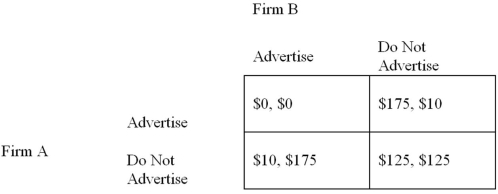 Suppose there is a 50 percent chance that the advertising game depicted in Figure 10-17 will end next period. The collusive agreement {(not advertise, not advertise)} is:
 (Multiple Choice)
4.8/5  (70)
(70) Consider the following entry game: Here, firm B is an existing firm in the market, and firm A is a potential entrant. Firm A must decide whether to enter the market (play "enter") or stay out of the market (play "not enter"). If firm A decides to enter the market, firm B must decide whether to engage in a price war (play "hard"), or not (play "soft"). By playing "hard," firm B ensures that firm A makes a loss of $1 million, but firm B only makes $1 million in profits. On the other hand, if firm B plays "soft,", the new entrant takes half of the market, and each firm earns profits of $5 million. If firm A stays out, it earns zero while firm B earns $10 million. Which of the following are Nash equilibrium strategies?
(Multiple Choice)
4.8/5 (74)
(74) Consider the following entry game: Here, firm B is an existing firm in the market, and firm A is a potential entrant. Firm A must decide whether to enter the market (play "enter") or stay out of the market (play "not enter"). If firm A decides to enter the market, firm B must decide whether to engage in a price war (play "hard"), or not (play "soft"). By playing "hard," firm B ensures that firm A makes a loss of $2 million, but firm B only makes $2 million in profits. On the other hand, if firm B plays "soft," the new entrant takes half of the market, and each firm earns profits of $4 million. If firm A stays out, it earns zero while firm B earns $8 million. Which of the following are Nash equilibrium strategies?
(Multiple Choice)
4.9/5 (78)
(78) The figure below presents information for a one-shot game.  What are the Nash equilibrium strategies for firm A and B respectively?
 (Multiple Choice)
4.9/5 (80)
(80) Refer to the normal-form game of price competition shown below. 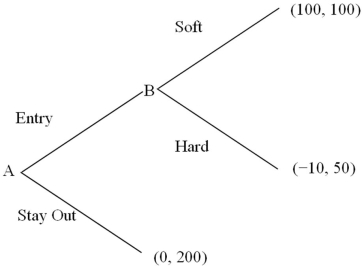 Firm B is the incumbent facing potential entry from its rival, firm A. Firm A's strategies consist of {entry, stay out}. Firm B's strategies are then {hard if entry; hard if stay out; soft if entry; soft if stay out}. Find the subgame Nash equilibrium to this game, if one exists.
 (Multiple Choice)
5.0/5 (84)
(84) The following provides information for a one-shot game.  What are the Nash equilibrium strategies for this game?
 (Multiple Choice)
4.9/5 (89)
(89) If you advertise and your rival advertises, you each will earn $4 million in profits. If neither of you advertises, you will each earn $10 million in profits. However, if one of you advertises and the other does not, the firm that advertises will earn $1 million and the non-advertising firm will earn $5 million. If you and your rival plan to hand your business down to your children (and this "bequest" goes on forever), then a Nash equilibrium is for each firm to:
(Multiple Choice)
4.8/5 (85)
(85) There are two existing firms in the market for computer chips. Firm A knows how to reduce the production costs for the chip and is considering whether to adopt the innovation or not. Innovation incurs a fixed setup cost of C, while increasing the revenue. However, once the new technology is adopted, another firm, B, can adopt it with a smaller setup cost of C/2. If A innovates and B does not, A earns $20 in revenue while B earns $0. If A innovates and B does likewise, both firms earn $15 in revenue. If neither firm innovates, both earn $5. If C = 15, which is the perfect equilibrium of the game?
(Multiple Choice)
4.9/5 (65)
(65) Refer to the following game.  What are the Nash equilibrium strategies for firm A and firm B, respectively, in a one-shot game?
 (Multiple Choice)
4.9/5 (85)
(85) Which of the following is NOT an important determinant of collusion in pricing games?
(Multiple Choice)
4.7/5 (84)
(84) Consider the following innovation game: Firm A must decide whether or not to introduce a new product. Firm B must decide whether or not to clone firm A's product. If firm A introduces and B clones, then firm A earns $1 and B earns $10. If A introduces and B does not clone, then A earns $10 and B earns $2. If firm A does not introduce, both firms earn profits of 0. Which of the following is true?
(Multiple Choice)
4.9/5 (77)
(77) Which of the following is a correct statement about a Nash equilibrium in a two-player game?
(Multiple Choice)
4.9/5 (76)
(76) Consider the following information for a simultaneous move game: If you advertise and your rival advertises, you each will earn $5 million in profits. If neither of you advertises, you will each earn $10 million in profits. However, if one of you advertises and the other does not, the firm that advertises will earn $15 million and the non-advertising firm will earn $1 million. If you and your rival plan to be in business for only one year, the Nash equilibrium is:
(Multiple Choice)
4.9/5 (86)
(86) You operate in a duopoly in which you and a rival must simultaneously decide what price to advertise in the weekly newspaper. If you each charge a low price, you each earn zero profits. If you each charge a high price, you each earn profits of $3. If you charge different prices, the one charging the higher price loses $5 and the one charging the lower price makes $5.
a. Find the Nash equilibrium for a one-shot version of this game.
b. Now suppose the game is infinitely repeated. If the interest rate is 10 percent, can you do better than you could in a one-shot play of the game? Explain.
c. Explain how "history" affects the ability of firms in this game to achieve an outcome superior to that of the one-shot version of the game.
(Essay)
4.8/5 (85)
(85) In the game shown below, firms 1 and 2 must independently decide whether to charge high or low prices.  Suppose the game is infinitely repeated. Then the "best" the firms could do in a Nash equilibrium is to earn _________ per period.
 (Multiple Choice)
4.9/5 (87)
(87) Suppose Philips and Toshiba are the first companies to introduce digital versatile disk (DVD) machines to the market. Studies by the firms suggest that consumers who purchase consumer electronics are very brand-loyal. To capture future loyalties, each firm will attempt to maximize its initial market share, for one time only, by setting prices. An economist has estimated the initial market share of each firm under different pricing scenarios. Her results are captured in the following payoff matrix: 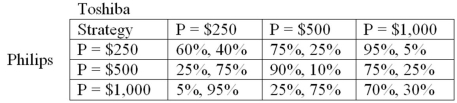 a. Given this scenario, if you were in charge of pricing at Philips, what price would you charge? Explain.
b. What market share would you anticipate as a result of your pricing strategy? Explain.
a. Given this scenario, if you were in charge of pricing at Philips, what price would you charge? Explain.
b. What market share would you anticipate as a result of your pricing strategy? Explain. (Essay)
4.9/5 (72)
(72) There are two existing firms in the market for computer chips. Firm A knows how to reduce the production costs for the chip and is considering whether to adopt the innovation or not. Innovation incurs a fixed setup cost of C, while increasing the revenue. However, once the new technology is adopted, another firm, B, can adopt it with a smaller setup cost of C/2. If A innovates and B does not, A earns $20 in revenue while B earns $0. If A innovates and B does likewise, both firms earn $15 in revenue. If neither firm innovates, both earn $5. Under what condition will firm B have an incentive to adopt if firm A adopts the innovation?
(Multiple Choice)
4.8/5 (83)
(83) 
Filters
- Essay(0)
- Multiple Choice(0)
- Short Answer(0)
- True False(0)
- Matching(0)