



 Chat with AI
Exam 25: Pricing Decisions, including Target Costing and Transfer Pricing

Exam 1: Uses of Accounting Information and the Financial Statements178 Questions
Exam 2: Measurement Concepts: Recording Business Transactions139 Questions
Exam 3: Measuring Business Income: Adjusting the Accounts168 Questions
Exam 4: Foundations of Financial Reporting and the Classified Balance Sheet130 Questions
Exam 5: Accounting for Merchandising Operations177 Questions
Exam 6: Inventories162 Questions
Exam 7: Cash and Internal Control141 Questions
Exam 8: Receivables111 Questions
Exam 9: Long-Term Assets227 Questions
Exam 10: Current Liabilities and Fair Value Accounting179 Questions
Exam 11: Long-Term Liabilities200 Questions
Exam 12: Stockholders Equity196 Questions
Exam 13: The Statement of Cash Flows147 Questions
Exam 14: Financial Statement Analysis164 Questions
Exam 15: Managerial Accounting and Cost Concepts199 Questions
Exam 16: Costing Systems: Job Order Costing121 Questions
Exam 17: Costing Systems: Process Costing139 Questions
Exam 18: Value-Based Systems: Activity-Based Costing and Lean Accounting146 Questions
Exam 19: Cost-Volume-Profit Analysis167 Questions
Exam 20: The Budgeting Process113 Questions
Exam 21: Flexible Budgets and Performance Analysis116 Questions
Exam 22: Standard Costing and Variance Analysis118 Questions
Exam 23: Short-Run Decision Analysis128 Questions
Exam 24: Capital Investment Analysis106 Questions
Exam 25: Pricing Decisions, including Target Costing and Transfer Pricing139 Questions
Exam 26: Quality Management and Measurement101 Questions
Exam 27: Accounting for Unincorporated Businesses106 Questions
Exam 28: Accounting for Investments112 Questions
Select questions type


Target costing identifies a competitive price and then subtracts the desired profit to determine a target cost.
(True/False)
5.0/5  (68)
(68) Economic theory indicates that as a product is marketed,price reductions will have to be made to sell additional units.
(True/False)
4.9/5 (72)
(72) Organizations will not invest in making a product or providing a service unless it will provide a minimum return.
(True/False)
4.7/5 (80)
(80) A common problem associated with transfer pricing occurs when
(Multiple Choice)
4.7/5 (83)
(83) A major advantage of the target costing approach to pricing is that target costing
(Multiple Choice)
5.0/5 (76)
(76) Market research shows potential customers will buy a particular product at a selling price of $2,590.If the desired profit is 40 percent of target cost,the company should make the product if the cost does not exceed
(Multiple Choice)
4.9/5 (94)
(94) Gross margin is the difference between sales and the total production costs of those sales.
(True/False)
4.8/5 (79)
(79) A manager may deviate from the four pricing rules if a specific short-term objective is being targeted.
(True/False)
5.0/5 (83)
(83) A negotiated transfer price will be between the negotiation floor (selling division's variable cost)and the negotiation ceiling (the market price).
(True/False)
4.7/5 (88)
(88) Tyler,Inc.is in the process of developing a transfer price for a part produced by Department A and used by other departments in manufacturing various products.Unit costs for the part are as follows:
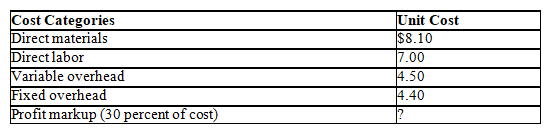 Department B can purchase the part from an outside supplier at $29.50 per unit.
a.Develop the cost-plus transfer price for the part.
b.What should be the transfer price? Support your answer.
Department B can purchase the part from an outside supplier at $29.50 per unit.
a.Develop the cost-plus transfer price for the part.
b.What should be the transfer price? Support your answer. (Essay)
4.9/5 (78)
(78) A negotiated transfer price is often used for internal pricing.
(True/False)
4.9/5 (82)
(82) Whitney Company treats each division as a profit center and expects a 20 percent profit on its total production costs.Division A produces a part that it sells externally for $19.00.It also supplies this part to other internal divisions.Its production cost for the part is $13.70.
-What should be the transfer price for the part using the market-price approach?
(Multiple Choice)
4.8/5 (74)
(74) Negotiation between managers is not appropriate in determining a transfer price.
(True/False)
4.8/5 (75)
(75) A good starting point for any pricing method is to develop a price based on the cost of producing the good or service.
(True/False)
4.9/5 (81)
(81) 
Filters
- Essay(0)
- Multiple Choice(0)
- Short Answer(0)
- True False(0)
- Matching(0)