



 Chat with AI
Exam 25: Pricing Decisions, including Target Costing and Transfer Pricing

Exam 1: Uses of Accounting Information and the Financial Statements178 Questions
Exam 2: Measurement Concepts: Recording Business Transactions139 Questions
Exam 3: Measuring Business Income: Adjusting the Accounts168 Questions
Exam 4: Foundations of Financial Reporting and the Classified Balance Sheet130 Questions
Exam 5: Accounting for Merchandising Operations177 Questions
Exam 6: Inventories162 Questions
Exam 7: Cash and Internal Control141 Questions
Exam 8: Receivables111 Questions
Exam 9: Long-Term Assets227 Questions
Exam 10: Current Liabilities and Fair Value Accounting179 Questions
Exam 11: Long-Term Liabilities200 Questions
Exam 12: Stockholders Equity196 Questions
Exam 13: The Statement of Cash Flows147 Questions
Exam 14: Financial Statement Analysis164 Questions
Exam 15: Managerial Accounting and Cost Concepts199 Questions
Exam 16: Costing Systems: Job Order Costing121 Questions
Exam 17: Costing Systems: Process Costing139 Questions
Exam 18: Value-Based Systems: Activity-Based Costing and Lean Accounting146 Questions
Exam 19: Cost-Volume-Profit Analysis167 Questions
Exam 20: The Budgeting Process113 Questions
Exam 21: Flexible Budgets and Performance Analysis116 Questions
Exam 22: Standard Costing and Variance Analysis118 Questions
Exam 23: Short-Run Decision Analysis128 Questions
Exam 24: Capital Investment Analysis106 Questions
Exam 25: Pricing Decisions, including Target Costing and Transfer Pricing139 Questions
Exam 26: Quality Management and Measurement101 Questions
Exam 27: Accounting for Unincorporated Businesses106 Questions
Exam 28: Accounting for Investments112 Questions
Select questions type


The long-term objectives of a company need not include statements concerning pricing policy.
(True/False)
4.8/5  (76)
(76) Within the relevant range,fixed and variable costs are fairly predictable.
(True/False)
4.8/5 (75)
(75) Companies should be concerned about the effect of their prices on their public image.
(True/False)
4.8/5 (70)
(70) A transfer price should not contain any profit since the profit for a product should be determined when the product is completed.
(True/False)
4.8/5 (86)
(86) The state of Ohio has passed a law requiring that every automobile be inspected at least once a year for pollution control.Anson Enterprises is considering entering into this type of business.After extensive studies,Mark Anson has developed the following set of projected annual data on which to make his decision: 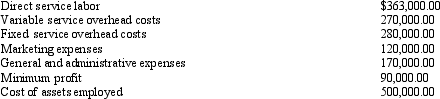 Anson believes that his company will inspect 100,000 automobiles per year.The company earns an average of 18.75 percent return on its assets.
-The projected cost for inspecting each automobile would be
Anson believes that his company will inspect 100,000 automobiles per year.The company earns an average of 18.75 percent return on its assets.
-The projected cost for inspecting each automobile would be (Multiple Choice)
4.8/5 (84)
(84) Overhead costs allocated to divisions from corporate levels should be incorporated in the computation of the transfer price.
(True/False)
4.8/5 (93)
(93) A cost-based price is a good starting point,but once a cost-based price has been determined what other factors should be considered before finalizing a selling price?
(Essay)
4.9/5 (89)
(89) Marginal cost is the change in total cost caused by a one-unit change in output.
(True/False)
4.9/5 (80)
(80) Marginal revenue is the change in total revenue caused by a one-unit change in output.
(True/False)
4.8/5 (85)
(85) It may seem that if a company could produce an infinite number of units of product,it would realize the maximum profit.Using microeconomic theory,explain why this is not the case.
(Essay)
4.8/5 (71)
(71) A company can stay in business as long as the selling price of its products is equal to all the costs incurred in bringing the product or service to market.
(True/False)
4.9/5 (83)
(83) Explain how target costing differs from traditional cost-based pricing methods.
(Essay)
4.8/5 (76)
(76) A company that produces standard items for a competitive market should not have the same pricing strategies as a company that makes unique items custom-designed for its customers.
(True/False)
4.8/5 (83)
(83) Selling products on an auction market falls under which stage of the management process?
(Multiple Choice)
4.9/5 (90)
(90) Transfer prices affect the revenues and costs of the divisions involved but do not affect the revenues and costs of the company as a whole.
(True/False)
4.9/5 (74)
(74) Auction-based pricing is a pricing method used primarily on the Internet where price is determined by willing buyers and sellers.
(True/False)
4.8/5 (91)
(91) 
Filters
- Essay(0)
- Multiple Choice(0)
- Short Answer(0)
- True False(0)
- Matching(0)