



 Chat with AI
Exam 4: Foundations of Financial Reporting and the Classified Balance Sheet

Exam 1: Uses of Accounting Information and the Financial Statements178 Questions
Exam 2: Measurement Concepts: Recording Business Transactions139 Questions
Exam 3: Measuring Business Income: Adjusting the Accounts168 Questions
Exam 4: Foundations of Financial Reporting and the Classified Balance Sheet130 Questions
Exam 5: Accounting for Merchandising Operations177 Questions
Exam 6: Inventories162 Questions
Exam 7: Cash and Internal Control141 Questions
Exam 8: Receivables111 Questions
Exam 9: Long-Term Assets227 Questions
Exam 10: Current Liabilities and Fair Value Accounting179 Questions
Exam 11: Long-Term Liabilities200 Questions
Exam 12: Stockholders Equity196 Questions
Exam 13: The Statement of Cash Flows147 Questions
Exam 14: Financial Statement Analysis164 Questions
Exam 15: Managerial Accounting and Cost Concepts199 Questions
Exam 16: Costing Systems: Job Order Costing121 Questions
Exam 17: Costing Systems: Process Costing139 Questions
Exam 18: Value-Based Systems: Activity-Based Costing and Lean Accounting146 Questions
Exam 19: Cost-Volume-Profit Analysis167 Questions
Exam 20: The Budgeting Process113 Questions
Exam 21: Flexible Budgets and Performance Analysis116 Questions
Exam 22: Standard Costing and Variance Analysis118 Questions
Exam 23: Short-Run Decision Analysis128 Questions
Exam 24: Capital Investment Analysis106 Questions
Exam 25: Pricing Decisions, including Target Costing and Transfer Pricing139 Questions
Exam 26: Quality Management and Measurement101 Questions
Exam 27: Accounting for Unincorporated Businesses106 Questions
Exam 28: Accounting for Investments112 Questions
Select questions type


Describe how the current ratio is calculated.If a company has a very low current ratio,what might this mean? If a company has a very high current ratio,what might this mean?
(Essay)
4.8/5  (72)
(72) Which of the following is not expressed in terms of a percentage?
(Multiple Choice)
4.7/5 (79)
(79) Use this information to answer the following question. 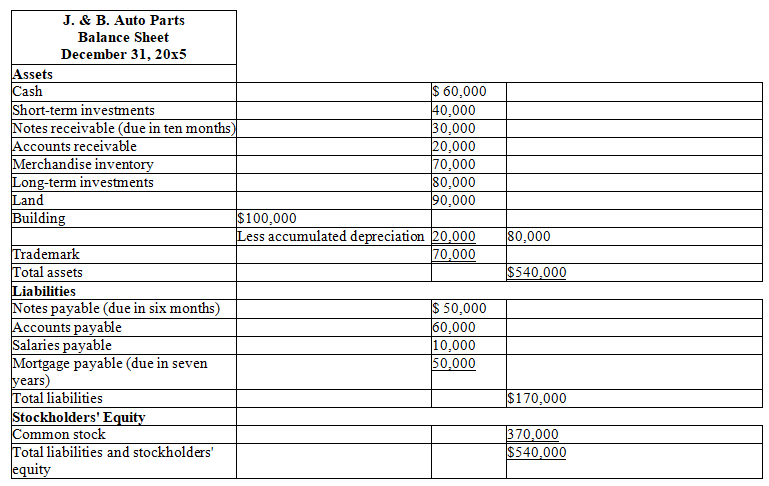 The debt to equity ratio is
 (Multiple Choice)
5.0/5 (79)
(79) Which of the following should be classified as a current asset?
(Multiple Choice)
4.8/5 (78)
(78) The qualitative characteristic of faithful representation includes
(Multiple Choice)
4.9/5 (102)
(102) A different set of financial statements usually is prepared for each user.
(True/False)
4.7/5 (82)
(82) Even when no errors have been made,accounting is never 100 percent accurate because of the extensive use of estimates.
(True/False)
4.9/5 (69)
(69) Liabilities have which of the following two major categories?
(Multiple Choice)
4.8/5 (86)
(86) A company's management can improve overall profitability by decreasing the profit margin,the asset turnover,or both.
(True/False)
4.9/5 (68)
(68) The profit margin and asset turnover ratios are important measures,but they have a limitation.Describe these limitations and discuss the ratio that can be used to overcome these deficiencies.
(Essay)
4.8/5 (76)
(76) To be useful for decision making,financial reporting must enable the user to assess cash flow prospects and assess management's stewardship.
(True/False)
4.8/5 (68)
(68) The user can depend on the accuracy of financial information when which of the following qualitative characteristics has been followed?
(Multiple Choice)
4.8/5 (79)
(79) The conservatism convention should not be used when the accountant is certain of a particular measure.
(True/False)
4.9/5 (75)
(75) Return on assets is a better measure of profitability than profit margin because it takes into account the assets invested in the business.
(True/False)
4.7/5 (80)
(80) Cape Company purchased a patent for use in the corporation's primary business activities.Where on the balance sheet is the patent reported?
(Multiple Choice)
4.8/5 (78)
(78) All of the following must certify that a public company's financial statements are accurate,complete,and not misleading,except for the
(Multiple Choice)
4.8/5 (85)
(85) Which of the following accounts is most likely to appear on the balance sheet as a current liability?
(Multiple Choice)
4.9/5 (91)
(91) Contributed capital is shown on a corporate balance sheet as two amounts: the par value of the issued stock and retained earnings.
(True/False)
4.8/5 (78)
(78) The investments category on the balance sheet normally includes investments that are intended to be held for a long period of time.
(True/False)
4.9/5 (72)
(72) 
Filters
- Essay(0)
- Multiple Choice(0)
- Short Answer(0)
- True False(0)
- Matching(0)