



 Chat with AI
Exam 4: Foundations of Financial Reporting and the Classified Balance Sheet

Exam 1: Uses of Accounting Information and the Financial Statements178 Questions
Exam 2: Measurement Concepts: Recording Business Transactions139 Questions
Exam 3: Measuring Business Income: Adjusting the Accounts168 Questions
Exam 4: Foundations of Financial Reporting and the Classified Balance Sheet130 Questions
Exam 5: Accounting for Merchandising Operations177 Questions
Exam 6: Inventories162 Questions
Exam 7: Cash and Internal Control141 Questions
Exam 8: Receivables111 Questions
Exam 9: Long-Term Assets227 Questions
Exam 10: Current Liabilities and Fair Value Accounting179 Questions
Exam 11: Long-Term Liabilities200 Questions
Exam 12: Stockholders Equity196 Questions
Exam 13: The Statement of Cash Flows147 Questions
Exam 14: Financial Statement Analysis164 Questions
Exam 15: Managerial Accounting and Cost Concepts199 Questions
Exam 16: Costing Systems: Job Order Costing121 Questions
Exam 17: Costing Systems: Process Costing139 Questions
Exam 18: Value-Based Systems: Activity-Based Costing and Lean Accounting146 Questions
Exam 19: Cost-Volume-Profit Analysis167 Questions
Exam 20: The Budgeting Process113 Questions
Exam 21: Flexible Budgets and Performance Analysis116 Questions
Exam 22: Standard Costing and Variance Analysis118 Questions
Exam 23: Short-Run Decision Analysis128 Questions
Exam 24: Capital Investment Analysis106 Questions
Exam 25: Pricing Decisions, including Target Costing and Transfer Pricing139 Questions
Exam 26: Quality Management and Measurement101 Questions
Exam 27: Accounting for Unincorporated Businesses106 Questions
Exam 28: Accounting for Investments112 Questions
Select questions type


Using the following amounts taken from the balance sheet and income statement of a business,compute the measures listed below.After each answer,write "L" if it is a measure of liquidity or "P" if it is a measure of profitability.Round to two decimal places.
 a.Return on assets
b.Working capital
c.Return on equity
d.Current ratio
a.Return on assets
b.Working capital
c.Return on equity
d.Current ratio (Essay)
4.9/5  (91)
(91) To understand accounting information,users must be familiar with the accounting conventions,or rules of thumb,used in preparing financial statements.
(True/False)
4.9/5 (65)
(65) Use this balance sheet and income statement for the first year of operations for Cane Construction to answer the following question.Use ending balances whenever average balances are required for computing ratios. 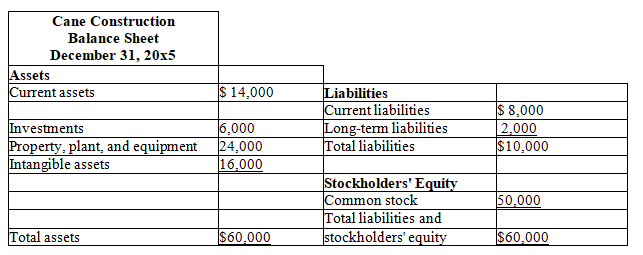
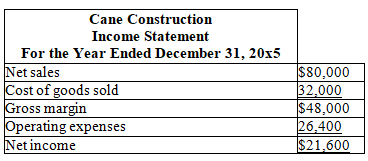 -The profit margin for Cane Construction is
 (Multiple Choice)
4.9/5 (89)
(89) Natural resources,such as coal mines and oil wells,are classified as intangible assets.
(True/False)
4.9/5 (72)
(72) On a corporate balance sheet,earned capital is also known as
(Multiple Choice)
4.8/5 (81)
(81) Use this balance sheet and income statement to answer the following question.Use ending balances whenever average balances are required for computing ratios. 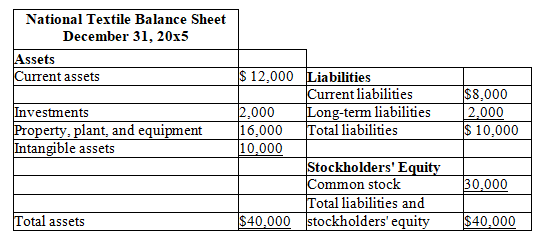
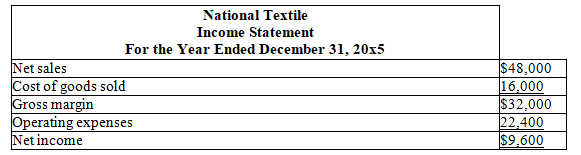 -The current ratio for National Textile is
 (Multiple Choice)
4.9/5 (75)
(75) Use this balance sheet and income statement to answer the following question.Use ending balances whenever average balances are required for computing ratios.
-The debt to equity ratio for National Textile is
-The debt to equity ratio for National Textile is (Multiple Choice)
4.8/5 (81)
(81) The lower-of-cost-or-market method of accounting for inventories follows the convention of
(Multiple Choice)
4.8/5 (86)
(86) Consistency in accounting means that a company uses the same generally accepted accounting principles from one accounting period to the next accounting period.
(True/False)
4.8/5 (76)
(76) Use this balance sheet and income statement for the first year of operations for Cane Construction to answer the following question.Use ending balances whenever average balances are required for computing ratios.
-The current ratio for Cane Construction is
-The current ratio for Cane Construction is (Multiple Choice)
4.9/5 (87)
(87) The convention of consistency refers to consistent use of accounting principles
(Multiple Choice)
4.8/5 (77)
(77) Financial statements have faithful representation when the information has all of the following except
(Multiple Choice)
4.9/5 (74)
(74) A company should classify land held for a planned manufacturing facility as
(Multiple Choice)
4.8/5 (68)
(68) Investors and creditors use financial statements to evaluate a company's ability to pay dividends and interest.
(True/False)
4.9/5 (80)
(80) 
Filters
- Essay(0)
- Multiple Choice(0)
- Short Answer(0)
- True False(0)
- Matching(0)