



 Chat with AI
Exam 11: Technology, production, and Costs

Exam 1: Economics: Foundations and Models233 Questions
Exam 2: Trade-Offs, comparative Advantage, and the Market System259 Questions
Exam 3: Where Prices Come From: the Interaction of Demand and Supply242 Questions
Exam 4: Economic Efficiency, government Price Setting, and Taxes208 Questions
Exam 5: Externalities, environmental Policy, and Public Goods267 Questions
Exam 6: Elasticity: The Responsiveness of Demand and Supply295 Questions
Exam 7: The Economics of Health Care169 Questions
Exam 8: Firms, the Stock Market, and Corporate Governance278 Questions
Exam 9: Comparative Advantage and the Gains From International Trade189 Questions
Exam 10: Consumer Choice and Behavioral Economics302 Questions
Exam 11: Technology, production, and Costs330 Questions
Exam 12: Firms in Perfectly Competitive Markets298 Questions
Exam 13: Monopolistic Competition: the Competitive Model in a More Realistic Setting278 Questions
Exam 14: Oligopoly: Firms in Less Competitive Markets262 Questions
Exam 15: Monopoly and Antitrust Policy271 Questions
Exam 16: Pricing Strategy263 Questions
Exam 17: The Markets for Labor and Other Factors of Production286 Questions
Exam 18: Public Choice,taxes,and the Distribution of Income258 Questions
Select questions type


What is the difference between total cost and variable cost in the long run?
(Essay)
4.7/5  (88)
(88) Figure 11-10 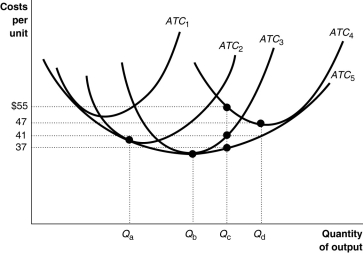 -Refer to Figure 11-10.Identify the minimum efficient scale of production.
 (Multiple Choice)
4.9/5 (81)
(81) If the 15th unit of output has a marginal cost of $29.50 and the average cost of producing 14 units of output is $30.23,what will happen to the average cost of production if the 15th unit is produced?
(Multiple Choice)
4.7/5 (79)
(79) Figure 11-15  -Refer to Figure 11-15.Suppose Hilda hires labor at $8 per hour and capital costs $10 per unit.What is the minimum cost of producing 200 gooseberry pies?
 (Multiple Choice)
4.8/5 (83)
(83) Over the past twenty years,the number of small family farms has fallen significantly and in their place there are fewer,but larger,farms owned by corporations.Which of the following best explains this trend?
(Multiple Choice)
4.8/5 (65)
(65) If production displays economies of scale,the long-run average cost curve is
(Multiple Choice)
4.8/5 (76)
(76) Sam Lewis owns a firm in New York City's garment district.If Sam keeps adding workers to use the same number of sewing machines,eventually the workplace will become so crowded that workers will get in each other's way.At this point
(Multiple Choice)
4.8/5 (86)
(86) Figure 11-2  -Refer to Figure 11-2.Diminishing returns to labor set in
 (Multiple Choice)
4.9/5 (82)
(82) Figure 11-5 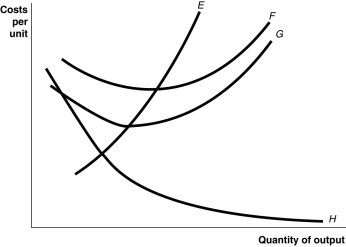 -Refer to Figure 11-5.Curve G approaches curve F because
 (Multiple Choice)
4.8/5 (66)
(66) If the long-run average total cost curve is downward-sloping,then the firm is experiencing decreasing returns to scale.
(True/False)
5.0/5 (83)
(83) Figure 11-15
-Refer to Figure 11-15.Suppose Hilda produces 100 gooseberry pies.What is the marginal rate of technical substitution of labor for capital when labor is increased from 10 to 20 hours?
-Refer to Figure 11-15.Suppose Hilda produces 100 gooseberry pies.What is the marginal rate of technical substitution of labor for capital when labor is increased from 10 to 20 hours? (Multiple Choice)
5.0/5 (67)
(67) If 11 workers can produce a total of 54 units of a product and a 12th worker has a marginal product of 6 units,then the average product of 12 workers is
(Multiple Choice)
4.8/5 (85)
(85) If average product is decreasing,then marginal product must be negative.
(True/False)
4.8/5 (99)
(99) What is the marginal product of labor and what is the average product of labor.
(Essay)
4.9/5 (75)
(75) Figure 11-7 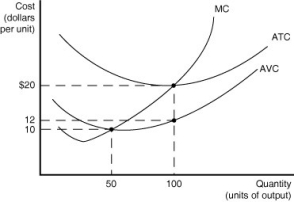 Figure 11-7 shows the cost structure for a firm.
-Refer to Figure 11-7.If output is 100 units what is the fixed cost of production?
Figure 11-7 shows the cost structure for a firm.
-Refer to Figure 11-7.If output is 100 units what is the fixed cost of production? (Multiple Choice)
4.8/5 (80)
(80) Explain whether each of the following is a fixed cost or a variable cost for Damian Dandridge's tattoo parlor.
a.The payment he makes to buy tattoo ink.
b.The wages he pays his employees.
c.The $500-per-month payment he makes to advertise his shop on highway billboards.
d.The lease payment he makes to the landlord who owns the building where his shop is located.
e.The payment he makes on his liability insurance policy.
(Essay)
4.9/5 (74)
(74) Vipsana's Gyros House sells gyros.The cost of ingredients (pita,meat,spices,etc.)to make a gyro is $2.00.Vipsana pays her employees $60 per day.She also incurs a fixed cost of $120 per day.Calculate Vipsana's average fixed cost per day when she produces 50 gyros using two workers?
(Multiple Choice)
4.9/5 (80)
(80) 
Filters
- Essay(0)
- Multiple Choice(0)
- Short Answer(0)
- True False(0)
- Matching(0)